De Lesseps
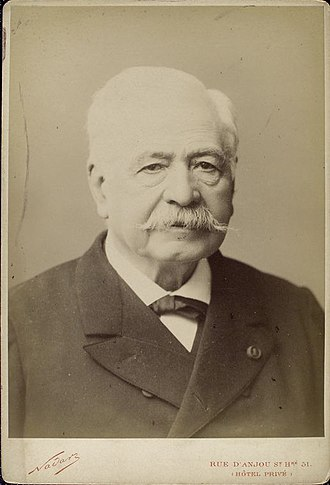
Name: Ferdinand, Vicomte de Lesseps
Achievements: Built the Suez Canal
Born: November 19, 1805; Versailles, France
Died: December 7, 1894; La Chenaie, near Guilly, France (Aged 89)
Field & Discipline: Government; Diplomacy
Language: French
Education: College Henri IV, Paris
Life & Times:
De Lesseps’s father worked in the French Foreign Office and was a friend of [father a pal of] Napoleon*. When the French had to withdraw from Egypt after Nelson defeated them at sea, it was his father who had recommended Mehemet Ali Bey - a Turk who was pro-French and anti-British - to lead the Egyptian government.
De Lesseps spent his early years in Italy where his father was posted and was educated in Paris after the family returned to France in 1814. At school, he read the political philosopher, [influenced by] Saint-Simon*, and admired his vision of a world in which freedom of trade united the nations and put an end to war. To facilitate trade, Saint-Simon envisaged a sea-going route that would join the Red Sea and the Mediterranean, and another joining the Pacific and Atlantic oceans.
After leaving school, De Lesseps followed family tradition and joined the French Foreign Office. In 1825, he took a post as assistant his uncle at Lisbon. Three years later he joined his father at the French consulate in Tunis and in 1832 he was assigned to Egypt. While quarantined on board ship off Alexandria he read a book by one of Napoleon’s engineers about plans for a canal to join the Red Sea and the Mediterranean and so give France control of a new trade route to India.
Mehemet Ali was now the ruling Pasha of Egypt and De Lesseps sounded him out about building a canal. Mehemet Ali co-opted De Lesseps to help with the education of his son, Said, and De Lesseps became a good friend of both father and son.
In 1833, [met] Enfantin* and a group of religious followers of Saint-Simon landed at Alexandria with the aim of making a survey for a canal. They were not welcome by the French or by the Turkish rulers of Egypt. De Lesseps was detailed to look after them and did what he could to help when their funds ran out.
In 1837, De Lesseps was recalled from Egypt and was posted to Rotterdam, Malaga and Barcelona before being appointed Minister in Madrid, in 1848. In 1849 he was asked to negotiate between [negotiated with] Mazzini* who had declared a republic in Rome and the Pope who had escaped to Austrian protection at Gaeta. When the French decided to reinstate the Pope by force and drop negotiations De Lesseps was recalled and censured for disobedience to orders.
His diplomatic career was ruined and he resigned. He retired to the country and occupied himself by acting as land agent to his mother-in-law, during which time he redrew his plans for a canal in Egypt and sent them off to Abbas Pasha, then ruler of Egypt.
In 1854 Said Pasha, the boy he had taught, became Egyptian ruler and invited De Lesseps to Egypt. De Lesseps arrived in November 1854 and was received by Said as a friend. Within a few days, De Lesseps was authorized by an Act of Concession to start preparatory work on the cutting of a canal through the isthmus of the Suez.
In 1855 an international commission of engineers was set up to debate the proposed canal scheme and the following year it reported in favor of a modified version of de Lessep’s scheme. The French subscribed more than half the capital needed and the Universal Company of the Maritime Suez Canal Company was formed in 1858 against the continued opposition of Britain and Turkey.
On 25 April 1859, De Lesseps started excavation work on the [built] Suez Canal* at Port Said. Over the next ten years, he worked tirelessly in Egypt and in Europe to overcome financial, diplomatic, engineering and labor problems. [cousin’s husband was] Napoleon III’s* wife, the Empress [his cousin was] Eugenie*, was de Lessep’s cousin and she was instrumental in interesting the Emperor in the project and ensuring his support.
In April 1869 the Red Sea was joined to the Mediterranean. On 17 November 1869, leading a convoy of fifty-one ships, Eugenie inaugurated the canal at a grand ceremony attended by six thousand people including the Emperor of Austria and the Crown Prince of Prussia. [met] Monckton Milnes* from Britain represented the Royal Geographical Society and the first customer for the canal the next day was a British freighter home-bound from India. ([work related to] Verdi* had been commissioned to write the music for the opening, but his “Aida” was finished too late).
De Lesseps married again before returning to France, where he was treated as a hero. In 1870 he was made a freeman of the City of London and honored by [honored by] Queen Victoria*. After the British secretly bought Said’s shares in 1875 and became the largest shareholder’s in the Canal, De Lesseps co-operated with Britain.
In 1879 he reluctantly became President of a new company set up to build a Panama Canal and at the end of that year visited Panama. The construction of the canal was begun in January 1880, following which De Lesseps toured the United States and raised a large number of subscriptions. An opening date was set for 1891 but in 1887 the company went into financial crisis and in 1889 into liquidation.
De Lesseps telegraphed Panama to halt work on the canal after which he had a stroke and spent the rest of his life in a semi-coma. In 1892 the government backed a judicial enquiry into the Panama Canal Company and De Lesseps and his son, Charles, were made scapegoats and prosecuted.
Both were sentenced to five years’ imprisonment although De Lesseps, who was too ill to be moved, remained in his home. The prison sentences were repealed on a technicality but Charles De Lesseps was forced to flee the country because he could not pay civil indemnity. De Lesseps died a year later.
Extra Connections:
He wrote in support of [a supporter of] Dunant’s* call for a Geneva prisoner-of-was Convention.
The Panama project involved [involved with] Bigelow*
Was admired by Zionist [admired by] Hertzl*
He sold the Panama rights to [sold Panama rights to] Theodore Roosevelt*
Assessment: De Lesseps was not the first to conceive of joining the Red Sea to the Mediterranean but was the first to carry through the project.
Oneliner: Ferdinand De Lesseps, who built the Suez Canal
Bibliography:
- Beatty, Charles, Ferdinand De Lesseps, Eyre & Spottiswode, London, 1956.
- Schonfield, Hugh J, Ferdinand De Lesseps, Herbert Joseph Ltd., London, 1937.
Ferdinand de Lesseps - Wikipedia
Father: Mathieu De Lesseps
Mother: Catherine de Grivignee
Siblings: 1 brother: Theodore; 1 sister: Adele
Spouse: 1) Agathe Delamalle; 2) Loyise-Helene Autard de Bragard
Children: by Delamalle: 2 surviving sons: Charles, Victor. by de Bragard: 12