Saint-Simon
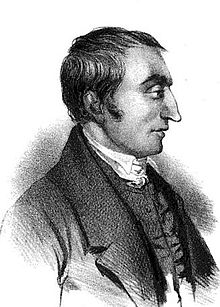
Full Name: Claude *Henri* de Rouvroy, comte de *Saint*-*Simon*
Alternate Name/Alias:Henri de Saint-Simon
Achievements: Political and social philosophy
Born: October 17, 1760; Paris, France
Died: May 19, 1825; Paris, France (Aged 65)
Field & Discipline: Government; Religion; Diplomat; Social Theorist
Education: Private tutors
Major Work:
“New Christianity” (1825)
Life & Times:
When Saint Simon was seventeen he joined the army as a second lieutenant, offering to serve without pay against the British in the American War of Independence. He joined the American expedition as a captain and fought against [fought against] Cornwallis* at Yorktown in 1781. He was captured by the British in the West Indies and briefly imprisoned on Jamaica. Before returning to France he attempted to interest the Viceroy of Mexico in a scheme for a canal across the isthmus of Panama - a project which [work related to] de Lesseps* later took on.
Over the next few years Saint-Simon undertook a secret diplomatic mission to Holland in 1785, and in 1788 became involved in a Spanish scheme for building a canal from the mountains of Guadarrama to Seville. During the French Revolution of 1789 he lived a double life. In the provinces he was a defender of Republican virtues and lived quietly. In Paris, he mixed with speculators, spies and foreign bankers. Through these contacts he bought land confiscated by the Revolutionary government. He was imprisoned in 1794 during the Reign of Terror but survived to become immensely wealthy because the currency fluctuations during the Revolution favoured his land dealings.
When order was restored in France, Saint-Simon spent most of this largesse on a rich lifestyle in Paris and in his support of young scientists. In 1797 he began to study the physical sciences as part of a plan to classify all known facts. He went to public lectures at the newly created Ecole Polytechnique and studied the pioneering work of young scientists like [studied work of] Bichat* whose division of men into three physiological categories Saint-Simon adopted.
The mathematician [gave money to] Poisson* accepted financial help from Saint-Simon but the physician [his help refused by] Dupuytren* was offended to be offered money. Saint-Simon paid a number of young scientists to give a series of public lectures.
In 1801 he married a young aristocrat who presided over a salon where, according to Saint-Simon, the artists and scientists he had invited ate and drank more than they talked. The marriage ended amicably in divorce in 1802 and Saint-Simon closed his Paris house and went abroad.
He found both England and Germany disappointing and ended up in Geneva. In 1803 he published his “Letters of an Inhabitant of Geneva to His Contemporaries,” dedicated to [dedicated book to] Napoleon*. In this work, Saint-Simon argued that scientists were the new priestly order in society and stated that it was the moral duty of the property-owning class who possessed political rights to subsidize the advance of knowledge.
He returned to Paris in 1804 and five years had spent all his money. For the remainder of his life he survived on the generosity of friends. He devoted his time to working out a new social order relevant for a world where science and industrialization was taking the place of the old feudal and military order. His hopes for recognition from Napoleon came to nothing. After Napoleon’s fall in 1814 he published: “On the Reorganization of European Society” in which he re-stated his belief that science and technology could solve most of society’s problems. Civil administration should be done by businessmen and industrial leaders, while scientists and engineers would provide the direction for society. The aim should be to produce useful things and improve the general standard of living. Saint-Simon’s larger aim was that the European states should band together in an association to suppress war.
In 1816 Saint-Simon raised subscriptions and founded a periodical called “Industry” with articles on industrial and financial matters. Auguste [secretary was] Comte* agreed to act as Saint-Simon’s secretary and collaborator, and in 1817 he was the principal writer of the third volume which stated that philosophers and scientists should take the place of the clergy. Many subscribers withdrew their patronage in outrage at this subversive notion and after the fourth volume was published in 1818 “Industry” came to an end. Saint-Simon was now almost destitute and during a period of severe depression in 1823 shot himself in the head in a suicide attempt but only succeeded in putting out one of his eyes.
His concern for the poor eventually turned into a religious form of socialism and he spent his last years writing his best known work: “New Christianity” (1825). Saint-Simon declared that the medieval ideas and aims of religion had to change in accordance with the new industrial world and that the aim of Christians in a modern industrial society should be to help the poor and make sure that new inventions and material progress were put to this end. Saint-Simon was attended on his deathbed by [at deathbed was] Gall* and [at deathbed was] Broussais*.
After his death a movement formed to keep alive his ideas and by the end of 1828 the Saint-Simonians were holding meetings in Paris and in several provincial towns. Prosper [successor was] Enfantin* was one of the most prominent Saint-Simonians and he later led a group of followers to Egypt where they attempted to anticipate the work of de Lesseps and build a canal.
In 1830 a Saint-Simonian church was established and after the revolution of July 1830 they issued a proclamation demanding ownership of goods in common, the abolition of the right of inheritance and the enfranchisement of women. Among those who attended the salon held by the church were the composers [follower was] Liszt* and [follower was] Berlioz*. The movement later faded out, mainly due to differences among the leaders, but the influence of Saint-Simon’s ideas was acknowledged by the English writers [follower was] Carlyle* who translated “New Christianity” into English, and by politicial theorists [follower was] John Stuart Mill* and [follower was] Engels*. Others who were influenced by Saint-Simon include the Italian revolutionary [follower was] Garibaldi*, the English cleric [follower was] Kingsley* and the French novelist [follower was] Hugo*.
Extra Connections: One of his followers was [follower was] Pierre Curie*, grandfather of Marie Curie’s husband
He proposed marriage to [proposed to] De Stael* and she turned him down.
Assessment: Saint-Simon’s social and religious philosophy anticipated the doctrines of later socialists and Marxists.
ONELINER: Henri de Saint-Simon, inventor of socialist New Christianity
Bibliography:
- Dondo, Mathurin,The French Faust, Henri de Saint-Simon, Philosophical Library, New York, 1955.
- Manuel, Frank E., The New World of Henri Saint-Simon, Harvard University Press, Cambridge, Mass., 1956.
Language: French
Father: Balthazar-Henri, comte de Saint-Simon
Mother: Blanche-Elizabeth de Saint-Simon
Siblings: 5 brothers; 3 sisters
Spouse: Alexandrine-Sophie Goury de Champgrand
Children: illegitimate daughter: Caroline-Charlotte Thillays