Charles I
Charles I, King of England, Scotland and Ireland
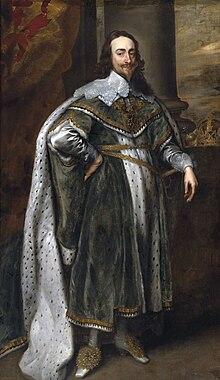
Achievements: King of England, Scotland and Ireland, 1625-49.
Born: November 19, 1600; Dunfermline Palace, Scotland.
Died: January 30, 1649; Whitehall, London, England (Aged 49)
Field & Discipline: Royalty; King
Language: English
Father: James I of England and VI of Scotland
Mother: Anne of Denmark
Siblings: Henry; Elizabeth
Spouse: Henrietta Maria
Children: Charles; Henry; James; Mary; Elizabeth; Henrietta
Education: Private tutors
Life & Times:
When he was four, Charles’ father, then King James VI of Scotland, also became James I of England and the family moved to the English court. Being too weak for the journey, Charles was left behind and, as a result, became a shy and silent boy. When he was twelve, his elder brother Henry died, leaving him the heir to the throne.
Charles was lonely and, detesting his father James I, spent his time studying hard. Due to his stammer he often avoided speaking, which made him appear aloof and so he had few friends, mainly enjoying the company of George Villiers, who was later to become the Duke of Buckingham.
In 1623, James I proposed that Charles marry the Infanta Donna Maria, sister of Philip IV of Spain. Charles' brother-in-law, Frederick, had been forced from his throne in Germany by the Hapsburgs, so an alliance with Spain would have put pressure on Germany. But Charles refused to adopt the Catholic religion.
In 1625, Charles succeeded to the throne, and married Henrietta Maria, daughter of the late Henry IV of France. Henrietta, aged only fifteen at the time of the wedding, was lively and determined but was a committed Catholic, and unpopular at Court.
Charles declared war on Catholic Spain, and a Protestant alliance of England, Denmark and Holland was formed to attack Spain. The plan was to relieve the Huguenots in France and put Frederick back on the throne in Germany. All of these expeditions failed due to lack of money for manpower, equipment and transport.
To raise money, Charles began selling titles such as 'baronet', created specially as a commodity to be sold. He also introduced fines for non-attendance at Church and arresting people who refused to lend him money. Some of these were defended by the lawyer, [opposed by] Selden*.
Parliament curbed Charles’ behavior by the Petition of Right of 1628. In the same year, an ex-officer of the army assassinated Charles’ friend Buckingham.
In January 1629, Parliament attacked Charles' appointment of [appointed] William Laud* as Bishop of London because he was High Church. The Puritan members in Parliament distrusted Catholic influence at court and violent scenes erupted when the King dissolved Parliament. Charles called in his troops and the leaders of the disturbance, including Selden, were imprisoned. Charles ruled without Parliament until 1640, and all laws were passed by Royal Proclamation.
The artist [commissioned] Rubens* visited England as an envoy from the king of Spain and Charles commissioned him to paint the ceiling of the banqueting hall in Whitehall, designed by [commissioned] Inigo Jones*. One of Rubens's apprentices, [commissioned] van Dyck*, became the artist most commonly associated with Charles I.
Charles, in need of money, enlisted the help of [aided by] Gustavus Aldophus*, the Swedish King and introduced Ship Money, a tax to help rebuild the navy. In 1635, Selden, released from prison, was commissioned to find a legal justification for the earlier statement by James I, that England could claim dominion of the seas. Charles wanted to quash the 1609 claim by Dutch statesman, [opposed] Grotius*, that the sea was free to all. In 1636, Selden produced his "Mare Clausum seu de Domanio Maris Libris duo", which argued that the sea was under the dominion of Great Britain.
As monarch, Charles was Supreme Governor of the Church of England but the Puritans wanted the church to be independent of the Crown. Laud introduced reforms and in 1637 imposed the Book of Common Prayer, which was rejected by the Scottish Presbyterians.
On the advice of Thomas Wentworth, Earl of Strafford, Charles sent an army against the Scots in 1639, but, outmanoeuvred, he was forced to sign a truce.
In November 1641, the Grand Remonstrance, a list of grievances against the King's rule and a proposal to establish Presbyterianism in place of the Church of England, went through Parliament with a majority of just eleven votes.
The following year, Charles left London and the Queen sailed to Holland with the Crown Jewels, to raise money for arms. Royalist and Parliamentarians began preparing for Civil War.
The Members of Parliament remaining in London sent Charles “Nineteen Propositions”, including the right of Parliament to reform the Church, control the army and appoint all ministers of state. The king replied courteously, without surrendering his powers.
In August 1642, the English Civil War began. The Royalist plan was to control London and Charles' nephew, [nephew was] Prince Rupert*, took command of the army, fighting against [beheaded by] Cromwell* .
At the battle of Marston Moor in July 1644, Prince Rupert was badly defeated by Cromwell's forces, and the north of the country was lost. Charles sent the Queen to France and in 1645, his son, later [son was] Charles II*, also escaped to join his mother. Charles took refuge with the Royalist Scots (after Oxford, where he had set up Court, became surrounded in 1646) but in January 1647, they made peace with Parliament and handed Charles over.
The King's trial for treason began on 20th January, before a tribunal of commissioners, but Charles refused to plead, refusing to accept the legality of the court.
Charles, found guilty of being a traitor, tyrant, murderer and public enemy, received
the sentence of death by beheading on 27th January and was executed on 30th January 1649.
Extra Connections: He ignored the appeal for religious tolerance from [ignored] John Durie*
Had an audience with [met] Graham, marquis of Montrose*
A close adviser/jailer was [jailer was] Harrington*
His doctor was [doctor was] Harvey*
He withdrew support for[withdrew support for] Jonson*
He supported [supported] Ussher’s* high-church tendencies
He was opposed by [opposed by] Milton*
A supporter was [supported by] Monck*
One of his Crown servants was [served by] Archibald Napier*
His execution was formally opposed by [execution opposed by] Wallis*
His grandson was [grandson was] William of Orange*
Partly inspired by his visit to the Spanish court in 1623,[310] Charles became a passionate and knowledgeable art collector, amassing one of the finest art collections ever assembled.[311] In Spain, he sat for a sketch by Velázquez, and acquired works by Titian and Correggio, among others.[312] In England, his commissions included the ceiling of the Banqueting House, Whitehall, by Rubens and paintings by other artists from the Low Countries such as van Honthorst, Mytens, and van Dyck.[313] His close associates, including the Duke of Buckingham and the Earl of Arundel, shared his interest and have been dubbed the Whitehall Group.[314] In 1627 and 1628, Charles purchased the entire collection of the Duke of Mantua, which included work by Titian, Correggio, Raphael, Caravaggio, del Sarto and Mantegna.[315] His collection grew further to encompass Bernini, Bruegel, Leonardo, Holbein, Hollar, Tintoretto and Veronese, and self-portraits by both Dürer and Rembrandt.[316] By Charles's death, there were an estimated 1,760 paintings,[317] most of which were sold and dispersed by Parliament.[318]
Assessment: Charles I was high-minded and devout but he was unrealistic and uncompromising and his downfall weakened the position of the monarchy.
Oneliner: Charles I of England, beheaded by Oliver Cromwell
Bibliography:
- Carlton, Charles, Charles I, The Personal Monarch, Routledge, London and New York, 1995.