Charles II
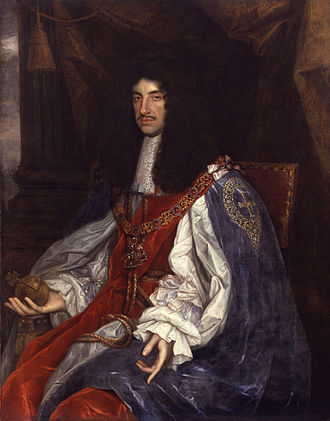
Name: Charles II of England
Nickname/Alias: The Merry Monarch
Achievements: Restored the English monarchy after the Commonwealth
Born: May 29, 1630; St James’ Palace, London, England.
Died: February 6, 1685; London, England (Aged 55)
Field & Discipline: Royalty; King
Language: English
Father: Charles, King of Great Britain and Ireland
Mother: Henrietta Maria, daughter of Henry IV of France
Siblings: James; Henry; Mary; Elizabeth; Henriette Anne
Spouse: Catherine of Braganza
Children: At least 14 illegitimate children, of which the Duke of Monmouth is the
only one who played a part in state affairs.
Education: Private tutors
Life & Times:
His father was [father was] Charles I*. As a young man, Charles had been brought up destined to become the monarch, but this came to a sudden end when the English Civil War broke out in 1642. Charles and his brother, under the supervision of [mentor was] Harvey*, were present at Edgehill, the first engagement of the war. For the next four years, Charles remained with the Royalist forces, then went to the safety of France, where he was taught for a time by mathematician [taught by] Hobbes*.
[offered sanctuary by] Cardinal Mazarin*, France’s First Minister, had offered Charles sanctuary but would not commit French forces to the struggle. After the execution of Charles’ father on 30th January 1649 (by a republican government whose authority he had never recognised) Ireland and Scotland defied Parliament and declared Charles king.
The Scots, led by the Marquis of Argyll, offered him the Scottish throne, but only if he supported Presbyterianism as the established church and repressed all other forms of religion. An alternative offer came from [supporter was] Graham, marquis of Montrose*, who pledged to raise an army to defeat the Scottish Presbyterians and the English as well, which would lead to Charles gaining the thrones of both Scotland and England.
In the end, Charles went along with Argyll and, by July 1651, was at the head of an army of twenty thousand Royalists which invaded England on 31st July. The Royalists were beaten at the battle of Worcester on 3rd September and for forty days Charles was hunted by [fought by] Cromwell’s* Republican army, finally escaping to France, where he lived in relative poverty for the next nine years.
Sometimes he would travel incognito and met, among others, [met] Christina* of Sweden in Frankfurt, in 1655.
When Oliver Cromwell died in 1658, England was in a state of discontent and Charles took advantage of the unrest, when he signed the Declaration of Breda in April 1660. In it, he agreed to grant a general amnesty, to uphold the liberties of the people, including that of religious toleration, and to be guided in all things by Parliament. On May 25th, he landed in England and reached London on his 30th birthday.
The conditions of the Breda agreement were never fully met, however. Charles wasn’t able to stop the execution of a number of the people who had signed his father’s death warrant and with the Clarendon Codes (limiting the actions of Free-church believers) he went back on his promise of religious freedom.
On the whole, Charles behaved reasonably well. Due mainly to his influence, the Restoration was brought about in a tolerant way and Charles rewarded those people who had supported him, making, for example, Horatio Townshend a viscount, and standing as godfather to his son the second [god-father of] Viscount Townshend*. In 1661 he married the Portuguese noblewoman, Catherine of Braganza.
Parliament gave Charles the right to maintain a standing army, but the grant that he received was not nearly enough to pay for it. The Crown’s responsibility for war sank him even further into debt, when the Anglo-Dutch war broke out in 1665, after the British had taken New York from the Dutch the year before.
In general, Charles was a reforming King. In 1667, he initiated reforms at the Treasury and in government administration and attempted to reform the Royal Navy as well. In the same year, Charles began an affair with the actress Nell [affair with] Gwynne*. He had a great love of for entertainment and was instrumental in the restoration of the English theatre and was a great admirer of the work of [a fan of] Dryden*. He gave the [chartered] Royal Society* its charter and was a supporter of overseas investment and expansion.
In the Treaty of Dover of 1670, Charles promised secretly that he would announce his conversion to Roman Catholicism, if France pledged aid should the conversion cause unrest in England. The Treaty and the need to keep the secret put Charles in some debt to [indebted to] Louis XIV* of France, which irritated the English Protestants.
Charles was true to his word and became a Catholic on his deathbed, after his reign had ended tranquilly.
Extra Connections:
In exile he was visited by [visited in exile by] Barrow*
Like his father, ignored petition of [ignored] John Durie*
A supporter was [ supporter was] Evelyn*
He recommended [supporter of] Graunt* to membership of the Royal Society.
He was a patron of [a patron of] Halley*
He employed [employed] Le Notre*
He betrayed the clan [betrayed] MacGregor*
He was opposed by [opposed by] Milton*
He advanced the career of [supported] D. North*
He imprisoned [imprisoned] Oldenburg*
[favorite was] William Penn* was a court favorite, as was [favorite was] Petty*
His restoration was negotiated by [restoration fixed by] Pepys*
[composer was] Purcell* composed for him
Supported the explorer [patron of] Radisson*
Was a patron of [financially supported] Tillotson*
Appointed [appointed] Flamsteed* Astronomer Royal
He much admired the work of [a fan of] Donne*.
Charles granted the East India Company the rights to autonomous government of its territorial acquisitions, to mint money, to command fortresses and troops, to form alliances, to make war and peace, and to exercise both civil and criminal jurisdiction over its possessions in the Indies.[53] Earlier in 1668 he leased the islands of Bombay to the company for a nominal sum of £10 paid in gold
Assessment: He made some attempt to reform a navy that badly needed it and was consistent in his attempts to introduce genuine religious tolerance.
Oneliner: Charles II of England, “the merry monarch”
Bibliography:
- Pearson, Hesketh, Charles II, His Life and Likeness, William Heinemann Ltd., London, 1960.