Mirabeau
Honoré Gabriel Riqueti, comte de Mirabeau - Wikipedia
Honoré Gabriel Riqueti, Count of Mirabeau (French pronunciation: [miʁabo]; 9 March 1749 – 2 April 1791) was a French writer, orator, statesman and a prominent figure of the early stages of the French Revolution.
A member of the nobility, Mirabeau had been involved in numerous scandals that had left his reputation in ruins. Well-known for his oratory skills, Mirabeau quickly rose to the top of the French political hierarchy following his election to the Estates-General in 1789, and was recognized as a leader of the newly organized National Assembly. Among the revolutionaries, Mirabeau was an advocate of the moderate position of constitutional monarchy built on the model of Great Britain. He was also a leading member of the Jacobin Club.
Mirabeau died of pericarditis in 1791 and was regarded as a national hero and a father of the Revolution. He received a grand burial and was the first to be interred at the Panthéon. During the 1792 Trial of Louis XVI, the discovery that Mirabeau had secretly been in the pay of the king brought him into posthumous disgrace, and two years later his remains were removed from the Panthéon. Historians are split on whether Mirabeau was a great leader who almost saved the nation from the Terror, a venal demagogue lacking political or moral values, or a traitor in the pay of the enemy.[1]
Family history
[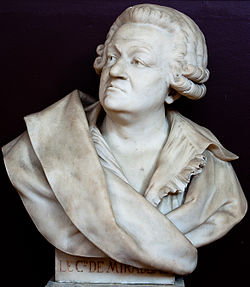 ](https://en.wikipedia.org/wiki/File:Buste_de_Honor%C3%A9_Gabriel_Riqueti_de_Mirabeau_--_Salle_du_serment_du_jeu_de_paume_--_Versailles.jpg)Bust of Honoré Gabriel Riqueti de Mirabeau at Palace of Versailles
The family of Riqueti, with possible distant origins in Italy, became wealthy through merchant trading in Marseilles. In 1570, Jean Riqueti bought the château and seigniory of Mirabeau, which had belonged to the great Provençal family of Barras. In 1685, Honoré Riqueti obtained the title "marquis de Mirabeau".[2]
His son, Jean Antoine, grandfather of Honoré Gabriel Riqueti, served with distinction through all the later campaigns of the reign of Louis XIV. At the Battle of Cassano (1705), he suffered a neck wound so severe that he had to wear a silver stock ever after. Because he tended to be blunt and tactless, he never rose above the rank of colonel. On retiring from the service, he married Françoise de Castellane, with whom he had three sons: Victor (marquis de Mirabeau), Jean Antoine (bailli de Mirabeau) and Louis Alexandre (comte de Mirabeau). Honoré Gabriel Riqueti, comte de Mirabeau, was the son of Victor.[3]