Deffand
Name: Marie du Deffand
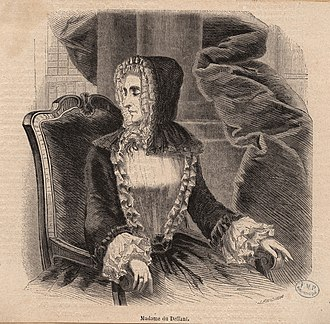
Nickname/Alias: born: Marie de Vichy-Champrond, Marquise du Deffand
Achievements: She ran a famous salon for the leading thinker and wits of the day.
Born: December 25, 1697; Chateau de Champrond, Burgundy, France.
Died: October 22, 1780; Paris, France.
Field & Discipline: Literature
Language: French
Father: Gaspard de Vichy
Mother: Anne Brolart
Siblings: Gaspard, Nicholas; one sister
Spouse: Jean-Baptiste-Jacques-Charles de La Lande, Marquis du Deffand
Children: None
Education: Convent of La Madeleine de Traisnel, Paris
Life & Times:
On June 11, 1718, Marie de Vichy was married to Jean-Baptiste-Jacques- Charles de La Lande, Marquis du Deffand, a union which almost immediately proved distasteful to both parties.
That autumn she was brought to Paris by her new husband and introduced to the dissipated society of the Regency court of Louis XV's minority, where her wit, beauty, grace and delight in immoral behavior made her an immediate favorite. She became the mistress of the Regent, Philippe II, Duke d'Orleans for a fortnight and this won her an annual pension of 6,000 livres which she held onto grimly until the end of her
life.
She also began an entirely indiscreet liaison with the well-known rake, the Count du Fargis. At this, her husband, acknowledging that he had no control over his wife's behavior, deserted her and returned to La Lande. Following the death of the Regent in 1723 Marie attempted a reconciliation and travelled to La Lande.
However, "bored to tears" by her husband and his relatives, she remained only five months. She was released by an inheritance she received on the death of her grandmother, the Duchess of Choiseul, and returned to Paris.
Around 1725, Mme du Deffand accompanied Lord Bolingbroke on a visit to the estate of Louise-Benedicte de Bourbon-Conde, Duchess de Maine at Sceaux, who ran a brilliant salon where a distinguished circle of friends (including [met] Fontenelle*, the Marquise de Lambert, and [a pal of] Voltaire*) remained for weeks at a time, and here during the late 1720’s Mme du Deffand became a regular guest, becoming friendly with Voltaire (whom she had already met earlier in Paris) and many others.
In particular, she became a great favourite of the Duchess, who wished her to reside at Sceaux permanently, and it was at Sceaux that she established her reputation as a wit and conversationalist.
Around 1730, Mme du Deffand met Jean-Francois Henault, a rich and worldly man who soon afterwards she took as her "official" lover. By the time the salon of the Duchess de Maine finally dispersed with her death (c. 1740), Mme du Deffand had established a wide circle of friends and acquaintances in the highest social and literary circles in France.
She returned to Paris, took an apartment in the rue de Beaune, and then from 1745 a suite of rooms at the Convent of St. Joseph, which stood, with its own church and gardens, in the Faubourg St. Germain.
The convent rented spacious apartments to a few society ladies who were living alone, the rooms separated from the convent proper. Tenants had all the freedom of a private house while enjoying propriety and protection of residing within a convent wall. In these ideal surroundings, Mme du Deffand was able both to receive daily visits from Henault and welcome the most morally upright of her relations, while also establishing a salon which attracted the very best company in Paris.
This distinguished circle included many members of the aristocracy, and also many of the liberal intellectual elite such as [salon guest was] Turgot*, [salon guest was] Maupertuis*, [salon guest was] Montesquieu* and d’ [salon guest was] Alembert*.
Maire’s financial position was greatly improved on the death of her husband in June 1750, when she inherited rents worth 32,000 livres per year.
Nevertheless, despite her position in society, her love of reading and the theater, the correspondence she carried on with such varied friends as Voltaire in Switzerland and the French Ambassador in Constantinople, Marie was still beset by boredom. By middle-age (1740’s) depression and accompanying insomnia became constant menace. This condition was greatly worsened during the early 1750’s, when she realized that she was gradually losing her eyesight.
In the spring of 1752 she decided to leave Paris and find solace with the family of her elder brother, the Comte de Vichy, at his chateau at Champrond. Later she said she did this because she felt she had nothing within herself to challenge the despair of growing old and blind alone.
Du Deffand left Paris for Champrond, where she met Julie de [ran salon with] Lespinasse*, the illegitimate half-sister of Diane, the wife of Gaspard de Vichy. The following autumn, having resigned herself to total blindness, she decided to return to Paris, determined to remain at the centre of her social circle, and decided to take a young companion, who would be more like a daughter than a servant.
The proposed companion was Lespinasse, with whom she had been corresponding since mid-1752. and in spring 1754 Marie invited the girl to moved to Paris to live with her at the convent of St. Joseph.
The 22-yr-old Lespinasse was an immediate success at Mme du Deffand's salon, and quickly took over the role of hostess, as well as companion and friend. Their relationship appears to have been close and happy for the first few years , but inevitably, as Lespinasse grew in confidence and proved herself an able hostess and conversationalist in her own right, Mme du Deffand became increasingly despotic, irritable and demanding.
As a result, around 1760 Lespinasse began secretly receiving guests in her own room during the late afternoons (while Mme du Deffand, still an inveterate insomniac, tended to sleep), before the salon proper began at 7 pm.
Inevitably, in 1764 this arrangement was finally discovered by Mme du Deffand and there was an appalling scene, after which Lespinasse left the house forever.
Mme du Deffand’s last, bitter years were redeemed by her friendship with the English writer and collector [fell for] Horace Walpole*, known for his estheticism and eccentricity, and whom she first met in late 1764.
Despite being 67 and blind, she became smitten with Walpole who, twenty years her junior, a finicky bachelor, and always aware of the possibility of ridicule from this friends, was able to return only a slightly condescending affection. Nevertheless, this attachment greatly helped du Deffand through the last two decades of her life. Their extensive correspondence was later collected and published.
Extra Connections: She knew UK politician [knew] CJ Fox*
She was related to the Duke de [related to] Choiseul*
Assessment: With neither great wealth nor power, Mme du Deffand won and kept her position in society through sheer force of personality - by her wit, shrewd and trenchant
criticism, fine taste, and exceptional conversation.
Oneliner: Mme du Deffand, great French saloniste
Bibliography:
- Encyclopedia Britannica.
- Royde-Smith, Naomi, The Double Heart: A Study of Julie de Lespinasse, London: Hamish Hamilton, 1931.
Research notes:
MARIE DE VICHY-CHAMPROND, MARQUISE DU DEFFAND
Marie de Vichy was born on 25 December 1697, at the family chateau de
Champrond, in Burgundy, France, the daughter of Gaspard de Vichy,
captain-lieutenant of the Gendarmes de Berry, and Anne Brölart, daughter of
the first president of the Parliament of Burgundy. Marie had two brothers,
Gaspard and Nicolas (known as the abb» de Champrond, tr»sorier de la Sainte
Chapelle), and a sister who married Jean-Fran¡ois SuarÀs, marquis d'Aulan.
She was brought up within the confines of very worldly convent of La
Madeleine de Traisnel in Paris, where the education was scanty, and where
she later claimed she received little religious or moral guidance. As she
grew to adulthood she proved herself highly intelligent and argumentative,
and was known for her mocking wit, indomitable spirit and great appetite for
life. At the age of 20, on 11 June 1718, she was married to
Jean-Baptiste-Jacques-Charles de La Lande, Marquis du Deffand, a union which
almost immediately proved distasteful to both parties. Although a reasonably
good match in material terms - the Marquis du Deffand was a landowner, a
bombardier and master of camp in the Albigensian-Infantry, the governor of
Neuf-Brisach, and king's lieutenant for Orl»ans. Owner of the chateau of La
Lande, close to ätampes, he was a relative of the Vichys via the Brölarts,
the son of Jean-Baptiste du Deffand, general-lieutenant of the king's
armies, and Charlotte-Ang»lique Amelot.
In autumn 1718, Marie du Deffand was brought to Paris by her new husband and
introduced to the dissipated society of the Regency court of Louis XV's
minority, where her wit, beauty, grace and delight in immoral behaviour made
her an immediate favourite. She became the mistress of the Regent, Philippe
II, Duke d'Orl»ans (regent 1715-23) for a fortnight (apparently dismissed
for the faults of excessive "vanity and curiosity"), which won her a pension
of 6,000 livres per year, which she held onto grimly until the end of her
life. She also began an entirely indiscreet liaison with the well-known
rou», le comte du Fargis, and at this her husband, acknowledging that he had
no control over his wife's behaviour, left her and returned to La Lande.
Left to her own devices, Mme de Deffand sank into a life of such
licentiousness that her friends, in particular Mlle AŒss», intervened in
order to rescue her from herself. The result of this was, following the
death of the Regent in 1723, Marie du Deffand attempted a reconciliation
with her husband, and travelled to La Lande; however, soon "bored to tears"
by her husband and his relatives, she remained there only five months, being
released by an inheritance she received on the death of her grandmother, the
Duchess of Choiseul, and returned to Paris.
Around 1725, Mme du Deffand accompanied Lord Bolingbroke on a visit to the
estate of Louise-B»n»dicte de Bourbon-Cond», Duchesse de Maine at Sceaux;
the Duchesse, herself a Bourbon and married to an illegitimate son of Louis
XIV, Louis-Auguste de Bourbon, duc de Maine, who had been involved in a plot
against the Regent and imprisoned for a year (1718-19) before being exiled
to their chateau at Sceaux. Undaunted, during the 1720s the Duchesse
established a brilliant salon at her chateau, where a distinguished circle
of friends - including Fontenelle, the Marquise de Lambert, and Voltaire -
remained for weeks at a time, and here during the late 1720s Mme du Deffand
became a regular guest, becoming friendly with Voltaire (whom she had
already met earlier in Paris), Mme de Tencin, d'Argental, Ferriol, and many
others. In particular, she became a great favourite of the Duchesse de
Maine, who wished her to reside at Sceaux permanently, and it was at Sceaux
that she established her reputation as a wit and conversationalist. Around
1730, Mme du Deffand met Jean-Fran¡ois H»nault, known as President H»nault
(because he had once been president of the one of the courts of law of the
Paris Parlement), son of a farmer general, a rich and worldly man who soon
afterwards she took as her "official" lover. This was as much an alliance of
convenience as passion; the relationship gave the effectively husband-less
Mme du Deffand a certain social standing, while Henault retained an earlier
mistress (Mme de Castelmoron) throughout their relationship. Despite several
temporary estrangements, Mme du Deffand remained on intimate terms with
H»nault until his death in 1770.
By the time the salon of the Duchesse de Maine finally dispersed with her
death (c. 1740?), Mme du Deffand had established a wide circle of friends
and acquaintances in the highest social and literary circles in France. She
returned to Paris, and took first an apartment in the rue de Beaune, and
from 1745 a suite of rooms at the Convent of St. Joseph, which stood, with
its own church and gardens, in the Faubourg St. Germain (on the site of what
is now the Ministry of War). The convent rented spacious apartments to a few
society ladies who were living alone, the rooms separated from the convent
proper - tenants had all the freedom of a private house while enjoying
propriety and protection of residing within a convent wall. Strict purity of
conduct was fortunately not expected of the tenants: first occupant of Mme
du Deffand's rooms had been Mme de Maintenon, mistress (although eventual
wife) of Louis XIV, and Charles Edward Stuart, Young Pretender, had spent
some time hiding there in another lady's apartment. In these ideal
surroundings, Mme du Deffand was able both to receive daily visits from
H»nault and welcome the most morally upright of her relations, while also
establishing a salon which attracted the very best company in Paris. This
distinguished circle included many members of the aristocracy, and also many
of the liberal intellectual elite - e.g. Turgot, Maupertuis, the abb»
Morellet, Montesquieu, Chamfort, and d' Alembert. Thus, with neither great
wealth nor power, Mme du Deffand won and kept her position in society
through sheer force of personality - by her wit, shrewd and trenchant
criticism, fine taste, and exceptional conversation. Her financial position
was greatly improved, however, on the death of her husband in June 1750,
when she inherited rents worth 32,000 livres per year. (Her salon also
became well-known for her famous "barrel" - an armchair in the form of
niche - which had been renovated from the days of Mme de Maintenon).
Nevertheless, despite her position in society, her love of reading and the
theatre, the wide correspondence she carried on with such varied friends as
Voltaire in Switzerland and the French Ambassador in Constantinople, Mme du
Deffand was still beset by ennui - and by middle-age (ie 1740s) this
depression became constant menace, esp with accompanying insomnia. This
condition was greatly worsened during the early 1750s, when she realized
that she was gradually losing her eyesight, and in 1752, now in her early
50s, she decided to leave Paris - having consulted many doctors, including
the famous Tronchin - and find some kind of solace with the family of her
elder brother, the Comte de Vichy, at his chateau at Champrond. (Later said
she did this because she felt she had nothing within herself to challenge
despair of growing old and blind alone - had no children etc.; plus,
although highly intelligent, had never had the habit of mental discipline
necessary to intellectual pursuits - often blamed her poor education for the
boredom of her later years).
Thus, Mme du Deffand left Paris for Champrond in the spring of 1752, and it
was here that she met Julie de Lespinasse, the illegitimate half-sister of
Diane, the wife of Gaspard de Vichy (and also quite possibly her own niece -
as there remains a strong possibility that Julie was actually the daughter
of Gaspard, who had many years earlier had had an affair with his wife's
mother). Although v. taken with JDL, Mme du Deffand's spirits were not
raised as she had hoped by the longueurs of family life in an ancient
country chateau, and in the autumn she moved to Macon for the winter, and
did not return to Champrond. The following autumn (1753), having resigned
herself to total blindness, she decided to return to Paris - determined to
remain at the centre of her social circle, but realizing that she now needed
extra support, both physical and moral, to cope with her new situation. At
Macon she had engaged a secretary, Wiart, to read and write her considerable
correspondance, and during this winter she decided to take a young
companion, who would be more like a daughter than a servant - someone who
she would cherish and protect, and in return would be endlessly grateful and
loyal. Proposed companion was JDL, with whom she had been corresponding
since mid-1752: seemed perfect match - both women craving stimulating
company and affection - and, finally having overcome difficulties with JDL's
relations and extracted protracted promises not to marry nor seek to change
her position (ie sue for legitimacy), the latter moved to Paris to live with
Mme du Deffand at the convent of St. Joseph in spring 1754.
22-yr-old JDL was an immediate success at Mme du Deffand's salon, and
quickly took over the role of hostess, as well as companion and friend.
Their relationship appears to have been close and happy for the first few
years together, but inevitably, as JDL grew in confidence and proved herself
an able hostess and conversationalist in her own right, Mme du Deffand - her
natural suspiciousness and jealousy exacerbated by her now total blindness -
became increasingly despotic, irritable and demanding, even to the point
where many of her friends frequently found her impossible company, and began
preferring that of JDL. As a result, around 1760 JDL began secretly
receiving guests in her own room during the late afternoons (while Mme du
Deffand, still an inveterate insomniac, tended to sleep), before the salon
proper began at 7 pm. Inevitably, this arrangment was finally discovered by
Mme du Deffand in 1764, and an appalling scene ensued - MDD accusing JDL of
the greatest betrayal etc. - after which JDL left the house forever. To Mme
du Deffand's great grief and chagrin several of her closest friends remained
allied to JDL - including her favourite, d'Alembert - and once she had
unwisely demanded that they choose between them, many chose her rival. There
remained until JDL's death in 1776 an inexpiable hatred between the two
women.
Already a misanthrope, Mme du Deffand now became an increasingly bitter and
caustic, although she still retained a group of entirely devoted servants
and friends - including the Duchess de Choiseul, to whom she wrote many
letters - the latter attending her now much reduced and devotedly
anti-encyclopediste salon. However, her last years were redeemed to a great
extent by her friendship with writer and collector Horace Walpole, youngest
son of Sir Robert, 1st Earl of Orford, who was known for his aestheticism
and eccentricity, whom she first met in late 1764. Despite being 67 and
blind, she became smitten in her old age with Walpole - who of course she
had never seen and who, 20 yrs her junior and a finicky bachelor always
aware of the possibility of ridicule from this friends at this situation,
was only able to return a slightly condescending affection. Nevertheless,
and despite only seeing him occasionally, it appears that this attachment
greatly helped MDD through the difficult years of blindness - in fact, all
through her seventies and into her eighties, although her love was
effectively unrequited. Their extensive correspondance - Walpole was also a
devoted letter writer - was later collected and published. She died in Paris
on 22 October 1780, aged 83, outliving Julie de Lespinasse - to her great
satisfaction - by four years.
The 'Unedited Correspondance' of Mme De Deffand was published for the first
time in 1809 in two volumes (by Walpole's friend and legatee Mary Berry),
and was then edited and republished in 1859. Her 'Complete Correspondence'
was published in 3 volumes in 1865, and her 'Letters to Walpole' were
published in 4 volumes in 1812. Her correspondance shows her to be a woman
of great intelligence and spirit - although perhaps speaking too readily
about remedies and foods that of philosophy and feelings - and were the
source of her enduring reputation as a woman of letters. EB: "Her prose
developed qualities of style and eloquence of which her earlier writings had
given little promise, and her chronicle of events at court and at home form
a fascinating and valuable document."
N.B. After JDL left, Mme du Deffand consoled herself by getting a dog -
called Tonton, became as well-known as his mistress for being bad-tempered
and vicious. When she died in 1780, she left not only her vast collection of
letters (including many from Voltaire) but also Tonton, who finished his
days pampered and fat at Strawberry Hill.