De Broglie
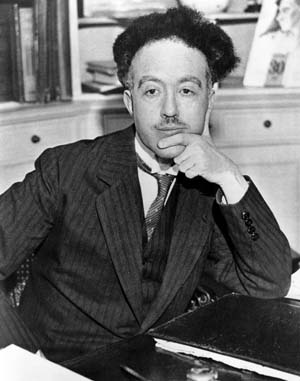
NAME: De Broglie, Louis-Victor-Pierre-Raymond, 7th duke of De Broglie
ACHIEVEMENTS: Discovered the wave motion of electrons
NICKNAME/ALIAS: None
DATE AND PLACE OF BIRTH: August 15, 1892, Dieppe, France
DATE/PLACE OF DEATH/AGE AT DEATH: March 19, 1987, Paris, France. Aged 94
DISCIPLINE: Physicist
FIELD: Physics
LANGUAGE: French
PARENTS: Louis Alphonse Victor, Prince de De Broglie; Pauline de la Forest d'Armaille
SIBLINGS: Maurice; Albertine; Charlotte
SPOUSE: None
CHILDREN: None
EDUCATION: School at Janson de-Sailly; University of Paris (Sorbonne)
MAJOR WORK: "Researches sur la theorie des quanta", "Matter and Light: The New Physics", "The Revolution in Physics", "Physics and Micro-Physics", "New Perspectives in Physics"
LIFE AND TIMES:
De Broglie learned about atomic physics and the work of Planck* and Einstein* while working in his brother's laboratory in Paris. At university, he studied history as well as physics. At first intent on becoming a diplomat, he changed his mind and did his thesis on physics.
During the First World War (1914-18), De Broglie served with the radio telegraphy section in the Eiffel tower and stayed there another four years after the War, becoming an expert in practical electromagnetism. In his doctoral dissertation of 1924, he proposed a revolutionary theory about electron waves, elaborating on research already done on electromagnetic light in the 19th century.
During the 19th century, there had been different theories of light. One held that light was a wave. The other said it was a flight of fast-moving particles. At the turn of the 20th century, Einstein suggested that at short wavelengths light behaved as though it were made up of particles, an idea which was validated in 1923. Scientists then began to accept the dual nature of light: as both a particle and a wave.
Before De Broglie published his theory, experimental work had suggested that in every atom, electrons moved around a nucleus. It had also been established that there were restrictions on the movement of electrons, but there was no explanation why. De Broglie provided that explanation.
De Broglie proposed that the way electrons moved was in a wave: any wave that was confined within a nuclear charge would be restricted in shape and motion because when it came up against the boundaries set by the nucleus it would become distorted and be canceled out.
The publication of De Broglie's thesis aroused little interest until it fell into the hands of Einstein. After reading it, Einstein enthusiastically endorsed De Broglie's idea and developed it further. Through Einstein's work, Austrian physicist Schrodinger* became familiar with De Broglie's ideas and based his wave mechanics theory on De Broglie's concept of electron waves.
De Broglie accepted a job as Professor of Theoretical Physics at the Sorbonne and lectured at the Henri Poincare Institute for the rest of his working life. In 1929, he was awarded the Nobel prize for Physics. In 1945, he was an adviser to the French Atomic Energy Commissariat. His interest in the philosophical questions arising out of new scientific advances led him to write several books and articles. In 1952, he was awarded the Kalinga Prize by the United Nations Economic and Social Council for his scientific writings aimed at the general public.
ASSESSMENT: His theory of electron waves, though his only original contribution to scientific knowledge, was of huge significance for the work on quantum physics produced by others during the 20 century
EXTRA CONNECTIONS: He influenced the work of Dirac*
His brother hired Langevin*
ONELINER: Louis de Broglie, pioneer in quantum physics
BIBLIOGRAPHY:
EB
Archives Biographiques Francais.