Foscolo U
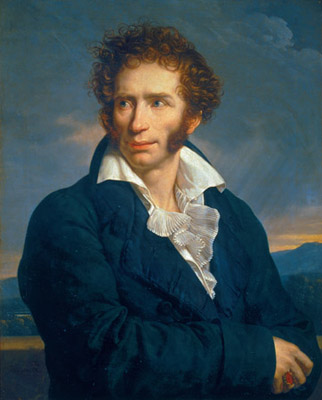
NAME: Foscolo, Ugo
OTHER-NAME: born Niccolo Foscolo
BIRTH: 6 February 1778, Zakynthos, Greece
DEATH: 10 September 1827, Turnham Green, London, UK
DISCIPLINE: Literature
FIELD: Poetry, drama, literary criticism
ASSESSMENT: The first modern Italian poet of exile
LANGUAGE: Italian, English
EDUCATION: Grammar school, Split, Croatia; University of Padua, Italy
ACHIEVEMENT: He wrote the first Italian Romantic novel
MAJOR-WORK: ‘Of Sepulchers’ (1807)
PARENTS: Father Andrea Foscolo (Venetian doctor); Mother Diamantina Spathis (Greek)
SPOUSE: Never married
SIBLINGS: Three brothers
CHILDREN: Illegitimate daughter: Floriana
DETAILS:
In 1788, while he was still at school, Ugo Foscolo’s aristocratic father died and in 1792 the family moved from Zakynthos back to Venice. At the University of Padua, one of Foscolo’s university teachers was Melchiorre Cesarotti, who influenced the young man’s poetic thought by introducing him to a translation of the immensely-popular fake-‘ancient’ Scottish epic, ‘Ossian,’ by MacPherson* In 1797 Foscolo (who knew ancient and modern Greek) wrote a tragedy, ‘Tieste.’ The work made him famous, and he began to involve himself in politics.
After the French invasion of northern Italy, in expectation that <wrote ode to>Napoleon* would create a free Venetian republic, in 1797, by now in the independent city of Bologna (where he enlisted in Napoleon’s army) Foscolo wrote an ode to the Emperor as ‘the great liberator.’ Later that year his sense of shock and betrayal when Napoleon handed Venice over to the Austrians triggered his novel: ‘The Last Letters of Jacopo Ortis’ (1798) about the suffering and suicide of a young Italian patriot.
Foscolo moved to Milan, and many love affairs. He was wounded and taken prisoner in the 1800 siege of Genoa. Released, he returned to Milan and joined the staff of the Italian General Pino, produced a version of the Iliad, and began his translation of ‘Sentimental Journey’ by the English writer Sterne*.
In 1804, during Napoleon’s preparation for an invasion of England Foscolo was stationed with the French army in northern France, where he met the young English noblewoman, Lady Mary Hamilton, and had a daughter by her, named Mary (whom he called her Floriana).
By 1806 he was back in Milan and in 1807 was in Venice, where, in opposition to Napoleon’s rule that no (nationalist) inscriptions were to be permitted on tombs, he wrote ‘Dei sepolchri’ (‘On Sepulchers’ inspired by the work of the English poet Thomas Gray, was a nationalist work in which the mighty dead are summoned from the grave to fight for their country).
In 1809 Foscolo was appointed Professor of Italian Eloquence at Pavia University. After his inaugural lecture (a thinly-veiled nationalistic expression of what the duty of Italian literature should be) all such Italian chairs were immediately abolished by Napoleon.
In 1811, in Milan, his ‘Ajax’ was staged and caused a fuss with its scarcely-veiled attack on Napoleon. Foscolo headed for Florence, more love affairs, his next play, ‘Ricciarda’ and lyrical neo-classical sonnets.
In 1814, after Napoleon’s defeat, Northern Italy was occupied by the Austrians and Foscolo, refusing to take their oath of allegiance, went into exile, first in Switzerland and then (1816) in London, where he lived for eleven years with his daughter.
During his London stay he was feted as an exotic foreign celebrity, garnering praise but no money. For a brief period he was in debtor’s prison and lived under a false name to avoid his creditors. Moving in cultural circles he became friendly with <knew> Sir Walter Scott*. He was befriended by publisher <helped by> John Murray*. He helped settle an Italian fellow-exile, <helped> Panizzi* and advised <advised>Lady Caroline Lamb* on the structure of her second novel, ‘Graham Hamilton.’
In his final years he wrote critical reviews of Dante, Petrarch and Tasso for the Edinburgh Review and the Quarterly Review. In 1822 he wrote one of his best poems, ‘The Three Graces.’
He died in poverty and obscurity and was buried in the nearby London suburb of Chiswick. In 1871 his remains were removed to Florence, where he was buried in the church of Santa Croce.
ONELINER: Ugo Foscolo, first Italian Romantic novelist
EXTRA-CONNECTIONS:
In Pavia Foscolo lived in Palazzo Cornazzani, in the same building, curiously, then Contardo Ferrini, Ada Negri and Albert Einstein also lived.
His contributions to the Edinburgh Review and Quarterly Review, his dissertations in Italian on the text of Dante Alighieri and Giovanni Boccaccio, and still more his English essays on Petrarch..., heightened his previous fame as a Man of Letters. However, he was frequently accused of financial ineptitude, and ended up spending time in debtors' prison, which affected his social standing after his release.
Forty-four years after his death, on 7 June 1871, his remains were exhumed at the request of the King of Italy and taken to Florence, where with all the pride, pomp and circumstance of a great national mourning, found their final resting-place beside the monuments of Niccolò Machiavelli and Vittorio Alfieri, of Michelangelo and Galileo, in the church of Santa Croce,[8][16] the pantheon of Italian glory he had celebrated in Dei Sepolcri.
BIBLIOGRAPHY:
Oxford Companion to English Literature
Wikipedia
Encyclopedia Britannica
www.italialibri.net