Macpherson, James

Achievements: Produced the fake Ossianic epic poems, which became a catalyst for several romantic, nationalist movements in Europe.
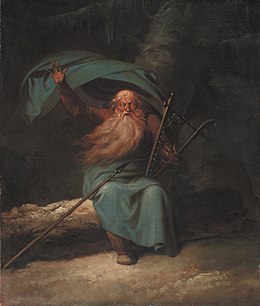
Born: October 27, 1736; Ruthven, Scotland
Died: February 17, 1796; Belleville, Scotland (Aged 59)
Field & Discipline: Literature; Writer
Language: English
Father: Andrew Macpherson
Mother: Ellen Macpherson
Siblings: None
Spouse: None
Children: Juliet
Education: King’s College, Cambridge (no degree)
Major Work:
“Fingal: An Ancient Epic Poem” (1761)
“Temora” (1763)
Life & Times:
Growing up in the Highlands, James Macpherson had witnessed the struggle between the English army and the pretender to the English throne, [affected by] Prince Charles Stuart*. Charles’ defeat dealt a blow to the Scots’ hope of independence. After returning from college and taking a job as a schoolteacher in his native Ruthven, Macpherson began translating the Gaelic songs and stories his neighbors recited.
Macpherson soon left for Edinburgh, where he was swept up by the capital’s intellectual elite. [knew] Adam Smith*, Hugh Blair, and [knew] Hume* all read his translations and encouraged him to publish. Soon he produced “Fingal: An Ancient Epic Poem” in six books (1761). Macpherson said the cycle of poems about the ancient hero Fingal were written by Fingal’s son, Ossian. In fact, they were fabrications loosely based on fragments of Celtic tales that originated in Ireland, not Scotland. Macpherson used the same dubious method for his second Ossianic epic: “Temora” (1763). Macpherson dedicated both books to his patron, the Earl of [patron was] Bute*, who was then Prime Minister.
Suspicion was aroused in Britain and elsewhere when Macpherson would not produce the originals. [work questioned by] Schiller* was one of the first to doubt their authenticity. However, he was an exception to the rule on the Continent, where the authenticity of the poems was less of an issue than recognition of their true literary merit.
This is evidenced in Germany, where [inspired] Herder* was inspired to found the Sturm und Drang movement, and in France, where the works were translated by [translated by] Diderot* and [translated by] Merimee*. [a fan was] Napoleon* declared Ossian his favorite poet and carried the books with him on his campaigns. He had [inspired work by] Ingres paint “The Dream of Ossian” (1813) for his bedroom ceiling. Musicians such as [inspired] Gade* and [inspired] Felix Mendelssohn* were inspired to compose romantic overtures based on the works.
In Macpherson’s later years he was employed by the government as a political writer. One of his assignments was drafting a reply to America in 1776, when the Declaration of Independence was signed. Between 1771-9 he wrote histories of Great Britain and Ireland that emphasized the Celtic past.
In 1775 [denounced by] Dr Johnson* published his own denunciation: “A Journey to the Western Islands.” His response was typical of disbelievers:- while accurate in his accusations of forgery, he also denounced Gaelic as a crude language, and characterized the Highlanders as an ignorant race. Macpherson sent a threatening letter to Johnson before Johnson published the book. Johnson sent back an equally severe letter and thereafter he always carried an oak staff, reportedly to defend himself against Macpherson should they bump into one another. Macpherson’s daughter married [daughter married] Brewster*, inventor of the kaleidoscope.
Extra Connections:
[influenced] Scott* read Macpherson as a teenager.
[edited by] Burns* edited “Scots Musical Museum,” in which some of Macpherson’s work appeared.
[influenced] Fenimore Cooper* drew parallels in “The Last of the Mohicans” between Celts and Native Americans.
Ugo [influenced] Foscolo* was influenced by Ossian while at University
Assessment: Macpherson’s fabrication helped trigger the Romantic Movement
Oneliner: James Macpherson, creator of the fake Ossian poems
Bibliography:
- deGategno, Paul J., James Macpherson, Twayne Publishers, 1989.
- Ward and Trent, et al., The Cambridge History of English and American Literature, G.P Putnam’s Sons, 1907-21.
https://en.wikipedia.org/wiki/Ossian