Duchamp, Marcel 2
see main node
Henri-Robert-Marcel Duchamp (UK: /ˈdjuːʃɒ̃/, US: /djuːˈʃɒ̃, djuːˈʃɑːmp/,[1] French: [maʁsɛl dyʃɑ̃]; 28 July 1887 – 2 October 1968) was a French painter, sculptor, chess player, and writer whose work is associated with Cubism, Dada, and conceptual art.[2][3][4] He is commonly regarded, along with Pablo Picasso and Henri Matisse, as one of the three artists who helped to define the revolutionary developments in the plastic arts in the opening decades of the 20th century, responsible for significant developments in painting and sculpture.
He has had an immense impact on 20th- and 21st-century art, and a seminal influence on the development of conceptual art. By the time of World War I, he had rejected the work of many of his fellow artists (such as Henri Matisse) as "retinal", intended only to please the eye. Instead, he wanted to use art to serve the mind.[9]
- Early life and education
- Early work
- Leaving "retinal art" behind
- Readymades
- Antecedent
- *The Large Glass*
- Kinetic works
- Musical ideas
- Rrose Sélavy
- Transition from art to chess
- Later artistic involvement
- *Étant donnés*
- Personal life
- Death and burial
- Legacy
Early life and education
Three Duchamp brothers, left to right: Marcel Duchamp, Jacques Villon, and Raymond Duchamp-Villon in the garden of Jacques Villon's studio in Puteaux, France, 1914, (Smithsonian Institution collections)
Duchamp was born at Blainville-Crevon in Normandy, France, to Eugène Duchamp and Lucie Duchamp (formerly Lucie Nicolle) and grew up in a family that enjoyed cultural activities. The art of painter and engraver Émile Frédéric Nicolle, his maternal grandfather, filled the house, and the family liked to play chess, read books, paint, and make music together.
Of Eugene and Lucie Duchamp's seven children, one died as an infant and four became successful artists. Marcel Duchamp was the brother of:
- Jacques Villon (1875–1963), painter, printmaker
- Raymond Duchamp-Villon (1876–1918), sculptor
- Suzanne Duchamp-Crotti (1889–1963), painter.
As a child, with his two elder brothers already away from home at school in Rouen, Duchamp was closer to his sister Suzanne, who was a willing accomplice in games and activities conjured by his fertile imagination. At eight years old, Duchamp followed in his brothers' footsteps when he left home and began schooling at the Lycée Pierre-Corneille, in Rouen. Two other students in his class also became well-known artists and lasting friends: Robert Antoine Pinchon and Pierre Dumont.[10] For the next eight years, he was locked into an educational regime which focused on intellectual development. Though he was not an outstanding student, his best subject was mathematics and he won two mathematics prizes at the school. He also won a prize for drawing in 1903, and at his commencement in 1904 he won a coveted first prize, validating his recent decision to become an artist.
He learned academic drawing from a teacher who unsuccessfully attempted to "protect" his students from Impressionism, Post-Impressionism, and other avant-garde influences. However, Duchamp's true artistic mentor at the time was his brother Jacques Villon, whose fluid and incisive style he sought to imitate. At 14, his first serious art attempts were drawings and watercolors depicting his sister Suzanne in various poses and activities. That summer he also painted landscapes in an Impressionist style using oils.
Early work
Duchamp's early art works align with Post-Impressionist styles. He experimented with classical techniques and subjects. When he was later asked about what had influenced him at the time, Duchamp cited the work of Symbolist painter Odilon Redon, whose approach to art was not outwardly anti-academic, but quietly individual.
Marcel Duchamp, Nude (Study), Sad Young Man on a Train (Nu [esquisse], jeune homme triste dans un train), 1911–12, oil on cardboard mounted on Masonite, 100 x 73 cm (39 3/8 × 28 3/4 in), Peggy Guggenheim Collection, Venice. This painting was identified as a self-portrait by the artist. Duchamp's primary concern in this painting is the depiction of two movements; that of the train in which there is a young man smoking, and that of the lurching figure itself.[11]
He studied art at the Académie Julian[12][13] from 1904 to 1905, but preferred playing billiards to attending classes. During this time Duchamp drew and sold cartoons which reflected his ribald humor. Many of the drawings use verbal puns (sometimes spanning multiple languages), visual puns, or both. Such play with words and symbols engaged his imagination for the rest of his life.
In 1905, he began his compulsory military service with the 39th Infantry Regiment,[14] working for a printer in Rouen. There he learned typography and printing processes—skills he would use in his later work.
Owing to his eldest brother Jacques' membership in the prestigious Académie royale de peinture et de sculpture Duchamp's work was exhibited in the 1908 Salon d'Automne, and the following year in the Salon des Indépendants. Fauves and Paul Cézanne's proto-Cubism influenced his paintings, although the critic Guillaume Apollinaire—who was eventually to become a friend—criticized what he called "Duchamp's very ugly nudes" ("les nus très vilains de Duchamp").[15][16][17] Duchamp also became lifelong friends with exuberant artist Francis Picabia after meeting him at the 1911 Salon d'Automne, and Picabia proceeded to introduce him to a lifestyle of fast cars and "high" living.
In 1911, at Jacques' home in Puteaux, the brothers hosted a regular discussion group with Cubist artists including Picabia, Robert Delaunay, Fernand Léger, Roger de La Fresnaye, Albert Gleizes, Jean Metzinger, Juan Gris, and Alexander Archipenko. Poets and writers also participated. The group came to be known as the Puteaux Group, or the Section d'Or. Uninterested in the Cubists' seriousness, or in their focus on visual matters, Duchamp did not join in discussions of Cubist theory and gained a reputation of being shy. However, that same year he painted in a Cubist style and added an impression of motion by using repetitive imagery.
During this period Duchamp's fascination with transition, change, movement, and distance became manifest, and as many artists of the time, he was intrigued with the concept of depicting the fourth dimension in art.[18] His painting Sad Young Man on a Train embodies this concern:
First, there's the idea of the movement of the train, and then that of the sad young man who is in a corridor and who is moving about; thus there are two parallel movements corresponding to each other. Then, there is the distortion of the young man—I had called this elementary parallelism. It was a formal decomposition; that is, linear elements following each other like parallels and distorting the object. The object is completely stretched out, as if elastic. The lines follow each other in parallels, while changing subtly to form the movement, or the form of the young man in question. I also used this procedure in the Nude Descending a Staircase.[19]
In his 1911 Portrait of Chess Players (Portrait de joueurs d'échecs) there is the Cubist overlapping frames and multiple perspectives of his two brothers playing chess, but to that Duchamp added elements conveying the unseen mental activity of the players.
Works from this time also included his first "machine" painting, Coffee Mill (Moulin à café) (1911), which he gave to his brother Raymond Duchamp-Villon. The later more figurative machine painting of 1914, Chocolate Grinder (Broyeuse de chocolat), prefigures the mechanism incorporated into the Large Glass on which he began work in New York the following year.[20]
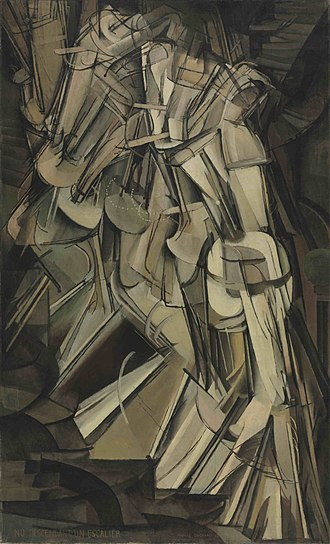
Marcel Duchamp. Nude Descending a Staircase, No. 2 (1912). Oil on canvas. 57 7/8" x 35 1/8". Philadelphia Museum of Art.
Nude Descending a Staircase, No. 2
Main article: Nude Descending a Staircase, No. 2
Duchamp's first work to provoke significant controversy was Nude Descending a Staircase, No. 2 (Nu descendant un escalier n° 2) (1912). The painting depicts the mechanistic motion of a nude, with superimposed facets, similar to motion pictures. It shows elements of both the fragmentation and synthesis of the Cubists, and the movement and dynamism of the Futurists.
He first submitted the piece to appear at the Cubist Salon des Indépendants, but Albert Gleizes (according to Duchamp in an interview with Pierre Cabanne, p. 31)[21] asked Duchamp's brothers to have him voluntarily withdraw the painting, or to paint over the title that he had painted on the work and rename it something else. Duchamp's brothers did approach him with Gleizes' request, but Duchamp quietly refused. However, there was no jury at the Salon des Indépendants and Gleizes was in no position to reject the painting.[21] The controversy, according to art historian Peter Brooke, was not whether the work should be hung or not, but whether it should be hung with the Cubist group.[21]
Of the incident Duchamp later recalled, "I said nothing to my brothers. But I went immediately to the show and took my painting home in a taxi. It was really a turning point in my life, I can assure you. I saw that I would not be very much interested in groups after that."[22] Yet Duchamp did appear in the illustrations to ..., he participated in the La Maison Cubiste (Cubist House), organized by the designer André Mare for the Salon d'Automne of 1912 (a few months after the Indépendants); he signed the Section d'Or invitation and participated in the Section d'Or exhibition during the fall of 1912. The impression is, Brooke writes, "it was precisely because he wished to remain part of the group that he withdrew the painting; and that, far from being ill treated by the group, he was given a rather privileged position, probably through the patronage of Picabia".[21]
The painting was exhibited for the first time at Galeries Dalmau, Exposició d'Art Cubista, Barcelona, 1912, the first exhibition of Cubism in Spain.[23] Duchamp later submitted the painting to the 1913 "Armory Show" in New York City. In addition to displaying works of American artists, this show was the first major exhibition of modern trends coming out of Paris, encompassing experimental styles of the European avant-garde, including Fauvism, Cubism, and Futurism. American show-goers, accustomed to realistic art, were scandalized, and the Nude was at the center of much of the controversy.
After attending the Armory Show and seeing Marcel Duchamp's nude, President Theodore Roosevelt wrote: "Take the picture which for some reason is called 'A Naked Man Going Down Stairs'. There is in my bathroom a really good Navajo rug which, on any proper interpretation of the Cubist theory, is a far more satisfactory and decorative picture. Now, if, for some inscrutable reason, it suited somebody to call this rug a picture of, say, 'A Well-Dressed Man Going Up a Ladder', the name would fit the facts just about as well as in the case of the Cubist picture of the 'Naked Man Going Down Stairs'. From the standpoint of terminology each name would have whatever merit inheres in a rather cheap straining after effect; and from the standpoint of decorative value, of sincerity, and of artistic merit, the Navajo rug is infinitely ahead of the picture.
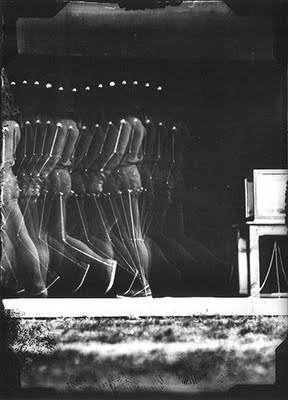
Nude Descending a Staircase, No. 2 combines elements of both the Cubist and Futurist movements. In the composition, Duchamp depicts motion by successive superimposed images, similar to stroboscopic motion photography. Duchamp also recognized the influence of the chronophotography of Étienne-Jules Marey and others, particularly Muybridge's Woman Walking Downstairs from his 1887 picture series, published as *The Human Figure in Motion.
Leaving "retinal art" behind...
Dada
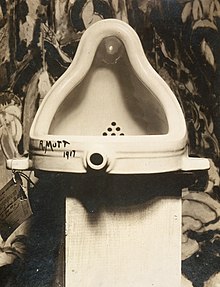
Photograph of Duchamp's Fountain (1917) by Alfred Stieglitz

The cover of the second (and final) issue of The Blind Man (May 1917) featured a graphic reference to Duchamp's painting The Chocolate Grinder. The issue is best known for its response to Fountain not being displayed at the purportedly open inaugural exhibition of the Society of Independent Artists.
Dada or Dadaism was an art movement of the European avant-garde in the early 20th century. It began in Zurich, Switzerland, in 1916, and spread to Berlin shortly thereafter.[33] To quote Dona Budd's The Language of Art Knowledge,
Dada was born out of negative reaction to the horrors of World War I. This international movement was begun by a group of artists and poets associated with the Cabaret Voltaire in Zurich. Dada rejected reason and logic, prizing nonsense, irrationality, and intuition. The origin of the name Dada is unclear; some believe that it is a nonsense word. Others maintain that it originates from the Romanian artists Tristan Tzara and Marcel Janco's frequent use of the words da, da, meaning yes, yes in the Romanian language. Another theory says that the name "Dada" came during a meeting of the group when a paper knife stuck into a French-German dictionary happened to point to "dada", a French word for "hobbyhorse".[34]
The movement primarily involved visual arts, literature, poetry, art manifestoes, art theory, theatre, and graphic design, and concentrated its anti-war politics through a rejection of the prevailing standards in art through anti-art cultural works. In addition to being anti-war, Dada was also anti-bourgeois and had political affinities with the radical left.
Dada activities included public gatherings, demonstrations, and publication of art/literary journals; passionate coverage of art, politics, and culture were topics often discussed in a variety of media. Key figures in the movement, apart from Duchamp, included: Hugo Ball, Emmy Hennings, Hans Arp, Raoul Hausmann, Hannah Höch, Johannes Baader, Tristan Tzara, Francis Picabia, Richard Huelsenbeck, Georg Grosz, John Heartfield, Beatrice Wood, Kurt Schwitters, and Hans Richter, among others. The movement influenced later styles, such as the avant-garde and downtown music movements, and groups including surrealism, Nouveau réalisme, pop art, and Fluxus.
Dada is the groundwork to abstract art and sound poetry, a starting point for performance art, a prelude to postmodernism, an influence on pop art, a celebration of antiart to be later embraced for anarcho-political uses in the 1960s and the movement that lay the foundation for Surrealism.[35]
New York Dada had a less serious tone than that of European Dadaism, and was not a particularly organized venture. Duchamp's friend Francis Picabia connected with the Dada group in Zürich, bringing to New York the Dadaist ideas of absurdity and "anti-art". Duchamp and Picabia first met in September 1911 at the Salon d'Automne in Paris, where they were both exhibiting. Duchamp showed a larger version of his Young Man and Girl in Spring 1911, a work that had an Edenic theme and a thinly veiled sexuality also found in Picabia's contemporaneous Adam and Eve 1911. According to Duchamp, "our friendship began right there".[36] A group met almost nightly at the Arensberg home, or caroused in Greenwich Village. Together with Man Ray, Duchamp contributed his ideas and humor to the New York activities, many of which ran concurrent with the development of his Readymades and The Large Glass.
The most prominent example of Duchamp's association with Dada was his submission of Fountain, a urinal, to the Society of Independent Artists exhibit in 1917. Artworks in the Independent Artists shows were not selected by jury, and all pieces submitted were displayed. However, the show committee insisted that Fountain was not art, and rejected it from the show. This caused an uproar among the Dadaists, and led Duchamp to resign from the board of the Independent Artists.[37]: 181–186
Along with Henri-Pierre Roché and Beatrice Wood, Duchamp published multiple Dada magazines in New York—including The Blind Man and Rongwrong—which included art, literature, humor and commentary.
When he returned to Paris after World War I, Duchamp did not participate in the Dada group.
Readymades
Main article: Readymades of Marcel Duchamp
"Readymades" were found objects which Duchamp chose and presented as art. In 1913, Duchamp installed a Bicycle Wheel in his studio. The Bicycle Wheel was an idea of Elsa von Freytag-Loringhoven. However, the idea of Readymades did not fully develop until 1915. The idea was to question the very notion of Art, and the adoration of art, which Duchamp found "unnecessary".[38]
My idea was to choose an object that wouldn't attract me, either by its beauty or by its ugliness. To find a point of indifference in my looking at it, you see.[38]
Bottle Rack (1914), a bottle-drying rack signed by Duchamp, is considered to be the first "pure" readymade. In Advance of the Broken Arm (1915), a snow shovel, also called Prelude to a Broken Arm, followed soon after. His Fountain, a urinal signed with the pseudonym "R. Mutt", shocked the art world in 1917.[31] Fountain was selected in 2004 as "the most influential artwork of the 20th century" by 500 renowned artists and historians.[8]
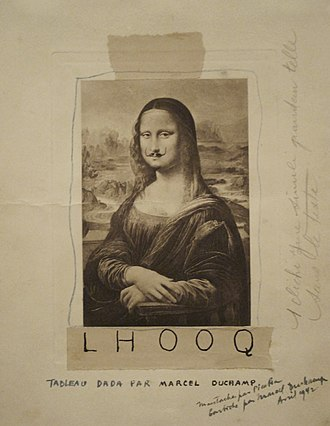
Marcel Duchamp, 1919, L.H.O.O.Q.[39]
In 1919, Duchamp made a parody of the Mona Lisa by adorning a cheap reproduction of the painting with a mustache and goatee. To this he added the inscription L.H.O.O.Q., a phonetic game which, when read out loud in French quickly sounds like "Elle a chaud au cul". This can be translated as "She has a hot ass", implying that the woman in the painting is in a state of sexual excitement and availability. It may also have been intended as a Freudian joke, referring to Leonardo da Vinci's alleged homosexuality. Duchamp gave a "loose" translation of L.H.O.O.Q. as "there is fire down below" in a late interview with Arturo Schwarz. According to Rhonda Roland Shearer, the apparent Mona Lisa reproduction is in fact a copy modeled partly on Duchamp's own face.[40] Research published by Shearer also speculates that Duchamp himself may have created some of the objects which he claimed to be "found objects"....
Kinetic works
Marcel Duchamp, 1918, A regarder d'un oeil, de près, pendant presque une heure, To Be Looked at (from the Other Side of the Glass) with One Eye, Close to, for Almost an Hour. Photograph by Man Ray, published in 391, July 1920 (N13), Museum of Modern Art, New York
Duchamp's interest in kinetic art works can be discerned as early as the notes for The Large Glass and the Bicycle Wheel readymade, and despite losing interest in "retinal art", he retained interest in visual phenomena. In 1920, with help from Man Ray, Duchamp built a motorized sculpture, Rotative plaques verre, optique de précision ("Rotary Glass Plates, Precision Optics"). The piece, which he did not consider to be art, involved a motor to spin pieces of rectangular glass on which were painted segments of a circle. When the apparatus spins, an optical illusion occurs, where the segments appear to be closed concentric circles. Man Ray set up equipment to photograph the initial experiment, but when they turned the machine for the second time, a drive belt broke and caught a piece of the glass, which after glancing off Man Ray's head, shattered into bits.[37]: 227–228
After moving back to Paris in 1923, at André Breton's urging, with financing by Jacques Doucet, Duchamp built another optical device based on the first one, Rotative Demisphère, optique de précision (Rotary Demisphere, Precision Optics). This time the optical element was a globe cut in half, with black concentric circles painted on it. When it spins, the circles appear to move backward and forward in space. Duchamp asked that Doucet not exhibit the apparatus as art.[37]: 254–255
Rotoreliefs were the next phase of Duchamp's spinning works. To make the optical "play toys", he painted designs on flat cardboard circles and spun them on a phonographic turntable. When spinning, the flat disks appeared three-dimensional. He had a printer produce 500 sets of six of the designs, and set up a booth at a 1935 Paris inventors' show to sell them. The venture was a financial disaster, but some optical scientists thought they might be of use in restoring three-dimensional stereoscopic sight to people who have lost vision in one eye.[37]: 301–303 In collaboration with Man Ray and Marc Allégret, Duchamp filmed early versions of the Rotoreliefs, and they named the film Anémic Cinéma (1926). Later, in Alexander Calder's studio in 1931, while looking at the sculptor's kinetic works, Duchamp suggested that these should be called mobiles. Calder agreed to use this novel term in his upcoming show. To this day, sculptures of this type are called "mobiles".[37]: 294
Musical ideas
Between 1912 and 1915, Duchamp worked with various musical ideas. At least three pieces have survived: two compositions and a note for a musical happening. The two compositions are based on chance operations. Erratum Musical, written for three voices, was published in 1934. La Mariée mise à nu par ses célibataires même. Erratum Musical is unfinished and was never published or exhibited during Duchamp's lifetime. According to the manuscript, the piece was intended for a mechanical instrument "in which the virtuoso intermediary is suppressed". The manuscript also contains a description for "An apparatus automatically recording fragmented musical periods," consisting of a funnel, several open-end cars and a set of numbered balls.[44] These pieces predate John Cage's Music of Changes (1951), which is often considered the first modern piece to be conceived largely through random procedures.[45]
In 1968, Duchamp and John Cage appeared together at a concert entitled "Reunion", playing a game of chess and composing Aleatoric music by triggering a series of photoelectric cells underneath the chessboard.[46]
....
Death and burial
Marcel Duchamp's gravestone Rouen, France with the epitaph, D'ailleurs, c'est toujours les autres qui meurent (Besides, it's always the others who die)
Duchamp died suddenly and peacefully in the early morning of 2 October 1968 at his home in Neuilly-sur-Seine, France. After an evening dining at home with his friends Man Ray and Robert Lebel, Duchamp retired at 1:05 am, collapsed in his studio, and died of heart failure.[70]
He is buried in the Rouen Cemetery, in Rouen, France, with the epitaph, "D'ailleurs, c'est toujours les autres qui meurent" ("Besides, it's always the others who die").
Legacy
Many critics consider Duchamp to be one of the most important artists of the 20th century,[71][72][73][74][75] and his output influenced the development of post–World War I Western art. He advised modern art collectors, such as Peggy Guggenheim and other prominent figures, thereby helping to shape the tastes of Western art during this period.[37] He challenged conventional thought about artistic processes and rejected the emerging art market, through subversive anti-art.[76] He famously dubbed a urinal art and named it Fountain. Duchamp produced relatively few artworks and remained mostly aloof of the avant-garde circles of his time. He went on to pretend to abandon art and devote the rest of his life to chess, while secretly continuing to make art.[77] In 1958 Duchamp said of creativity,
The creative act is not performed by the artist alone; the spectator brings the work in contact with the external world by deciphering and interpreting its inner qualifications and thus adds his contribution to the creative act.[78]
Duchamp in his later life explicitly expressed negativity toward art. In a BBC interview with Duchamp conducted by Joan Bakewell in 1968 he compared art with religion, saying that he wished to do away with art the same way many have done away with religion. Duchamp goes on to explain to the interviewer that "the word art etymologically means to do", that art means activity of any kind, and that it is our society that creates "purely artificial" distinctions of being an artist.[79][80]
A quotation erroneously attributed to Duchamp suggests a negative attitude toward later trends in 20th century art:
This Neo-Dada, which they call New Realism, Pop Art, Assemblage, etc., is an easy way out, and lives on what Dada did. When I discovered the ready-mades I sought to discourage aesthetics. In Neo-Dada they have taken my readymades and found aesthetic beauty in them, I threw the bottle-rack and the urinal into their faces as a challenge and now they admire them for their aesthetic beauty.
However, this was written in 1961 by fellow Dadaist Hans Richter, in the second person, i.e. "You threw the bottle-rack...". Although a marginal note in the letter suggests that Duchamp generally approved of the statement, Richter did not make the distinction clear until many years later.[81]
Duchamp's attitude was more favorable, however, as evidenced by another statement made in 1964:
Pop Art is a return to "conceptual" painting, virtually abandoned, except by the Surrealists, since [Gustave] Courbet, in favor of retinal painting... If you take a Campbell soup can and repeat it 50 times, you are not interested in the retinal image. What interests you is the concept that wants to put 50 Campbell soup cans on a canvas.[82]
The Prix Marcel Duchamp (Marcel Duchamp Prize), established in 2000, is an annual award given to a young artist by the Centre Georges Pompidou. In 2004, as a testimony to the legacy of Duchamp's work to the art world, a panel of prominent artists and art historians voted Fountain "the most influential artwork of the 20th century".[8][83]...
Knowledge Web Content (see main node)
NAME: Duchamp, Marcel
OTHER-NAME: Henri-Robert-Marcel Duchamp; R. Mutt; Rrose Selavy
BIRTH: 28 July 1887; Blainville, France
DEATH: 1 October 1968; Neuilly, France
CATEGORY: Fine Arts & Crafts
CATEGORY: Painting, sculpture
ASSESSMENT: Marcel Duchamp is called, variously, a dadaist or a surrealist. He is regarded as the fountainhead of such modern movements as Pop art and kinetic sculpture and has been a major influence on the artists who have followed him. His concern with the concepts of art, questioning what is art and what is not, and how art works in concert with the spectator, have remained topics for lively debate to the present day.
LANGUAGE: French; English
EDUCATION: Ecole Bossuet, Rouen, France (1898-1904); Academie Julian, Paris, France (1904-1905)
ACHIEVEMENTS: Editor, The Blind Man and Rongwrong (art magazines, dadaist in slant). He was one of the organizers of the Independents Exhibition, April 1917, New York, New York, USA
MAJOR-WORK: Nude Descending a Staircase, No. 2 (1912, oil on canvas); The Bride Stripped Bare by Her Bachelors, Even (1915 - 1923, mixed media, also known as The Large Glass); Readymades [1913 - 1917, a series of ‘found objects’ (which might be altered, or presented as found) given a title and signed by Duchamp and declared by him to be art]
PARENTS: Eugene (formerly Justin-Isidore) Duchamp (1848-1925); Marie-Caroline-Lucie Nicolle (1856 ? -1925, m. 1874)
SPOUSE: Lydie Sarazin-Levassor (m. 1927; div. 1928); Alexina "Teeny" Sattler (m. 16 January 1954, 1906-1995)
SIBLINGS: Jacques Villon (half-brother, 1875-1963); Raymond Duchamp-Villon (1876-1918); Suzanne Duchamp (m. Jean Crotti, 1889-1963); Yvonne Duchamp (m.Alphonse Duvernoy, 1895-); Magdeleine Duchamp (1898-)
CHILDREN: Yvonne Mayer (m. Jacques Savy, born 1911; mother Jeanne Serre)
DETAILS: Marcel Duchamp was born on July 18, 1887, into a middle-class family. He and three of his siblings decided to become artists rather than aim for more acceptable middle-class professions. His parents were supportive of all their children and provided them with allowances while their artistic careers were being established.
Duchamp married twice, the first time for approximately a year and the second time for some fourteen years (from 1954 to his death in 1968). Neither marriage produced any children, but from a youthful relationship he had a daughter, who also became an artist.
Duchamp was not only those of a painter and a sculptor. Among other things he edited art magazines, wrote poetry and works on art theory, composed music, created experimental films, and played championship chess.
Duchamp's art is sometimes described as dadaist, sometimes as cubist and sometimes as surrealist, but he pursued a unique course which is not easily slotted into any particular school.
"What he was interested in above all was freedom – complete personal and intellectual and artistic freedom – and the manner in which he achieved all three was, in the opinion of his close friends, his most impressive and enduring work of art. . . . Approach his work with a light heart, though, and the rewards are everywhere in sight. Duchamp's work sets the mind free to act on its own." (Tomkins)
His view of the creative act was that it was not performed solely by the artist but also involved the spectator.
Duchamp's artistic aims included efforts to free art from its traditional academic bias. One way he chose to question the definition of art was to create what he called Readymades. These were everyday objects such as a snow shovel or a bottle rack, sometimes left as found and sometimes combined with other objects. In either case, he signed these ‘found’ objects, gave them titles which had nothing to do with their everyday use, and, since they were titled works and signed by an artist, called them art.
One of Duchamp's best known paintings is Nude Descending a Staircase, No. 2 (painted in 1912). This work is cubist in nature and shows several overlapping views of a nude woman as she walks down a staircase. This produces a sense of movement as we can see the figure moving through space. It also is a way of showing us what we know is true (that the nude, for instance, was on every step in her descent) rather than the traditional a single slice of life (for instance, the nude at the foot of the stairs). Duchamp is more interested in the idea of movement than in a picture of some actual or real movement frozen in time.
One of his more baffling and controversial works is a large mixed-media creation titled The Bride Stripped Bare by Her Bachelors, Even (1915 to 1923). In 1923, he finished work on this project even though unfinished. Argument on the meaning of the various components and their relationships continues to this day.
Among the products of Duchamp's art are such innovative 20th century artistic concepts as kinetic art, ready-made art, and crucial contributions to dadaism, surrealism, and pop art. Such artists as Fernand Leger*, Andrew Calder* and Tristan Tzara* were influenced and inspired by his work. His influence also affected the poet Guillaume Apollinaire* who was both a friend and a supporter of surrealism and Dadaism.
Though Duchamp is generally regarded as a founder of, or contributor to so many schools of art, he declined to categorize himself in any way. He constantly pushed the boundaries of art and, by the time a name had been invented for what he was doing he had generally moved on to something else.
In 1923, he declared that he was no longer an artist, since he had said all he had to say. From then on he generally described himself as a chess player or, alternatively, as a cheese dealer, or a breather. In spite of this he continued to interest himself in the concepts of art and in the discussion of what art is and how it works.
In addition, he made experimental films and in 1934 published a selection of drawings and other items relating to his monumental work The Bride Stripped Bare by Her Bachelors, Even.
EXTRA CONNECTIONS: He was a friend of Peggy Guggenheim*
ONELINER: Marcel Duchamp, multi-talented modern French artist
BIBLIOGRAPHY: Tomkins, Clavin, Duchamp: A Biography. New York: Henry Holt and Company, 1996.
"Marcel Duchamp." Brain-Juice.Com, Inc., c2000-2002.http://www.brain-juice.com/cgi-bin/show_bio.cgi?p_id=12 Accessed March 21, 2004.
"Making Sense of Marcel Duchamp." Andrew Stafford, c2002-2004.
http://www.understandingduchamp.com/ Accessed March 21, 2004.
"Marcel Duchamp World Community." Art Science Research Laboratory, Inc. and Succession Marcel Duchamp, c2003. http://www.marcelduchamp.net/ Accessed March 21, 2004.