Calder A
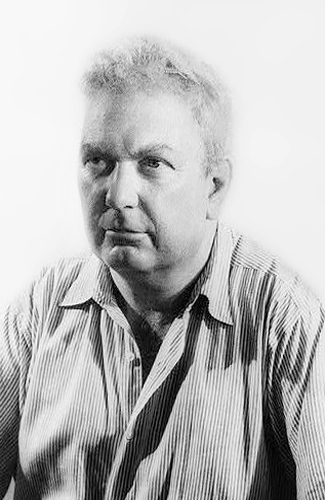
NICKNAME/ALIAS: Sandy
DATE OF BIRTH: 22 July 1898
PLACE OF BIRTH: Lawnton, PA
DATE OF DEATH: 11 November 1976
PLACE OF DEATH: New York, NY
DISCIPLINE: Sculpture
FIELD: Fine Arts & Crafts
ASSESSMENT: One of America’s preeminent twentieth-century sculptors, he is best remembered as the inventor of the mobile.
LANGUAGE/S: English; French; Spanish
EDUCATION: Stevens Institute of Technology, Hoboken, New Jersey (mechanical engineering, 1915-18); Art Students League, New York (drawing and painting, 1923-25); Academie de la Grande Chaumiére, Paris (1926-27)
ACHIEVEMENTS: Calder created works in different media, including sculpture, painting, printmaking, drawing, illustration, theatrical settings, and outdoor monuments. His work has been displayed in numerous one-man exhibitions internationally during his lifetime and posthumously.
MAJOR WORK: Calder’s most famous project, “The Calder Circus,” combined wire, cork, wood, cloth, and other materials in a movable, miniature reproduction of an actual circus. He is also remembered for his innovative mobiles and his monumental mobiles/ stabiles, many of which are on public display in major cities around the world. He published an autobiography and illustrated several books.
PARENTS: Alexander Stirling Calder (sculptor); Nanette Lederer (painter)
SIBLINGS: Peggy (b. 1896)
SPOUSE: Louisa Cushing James (m. 1931)
CHILDREN: Sandra (born 1935); Mary (born 1939)
LIFE AND TIMES:
Born into a family of artists (his grandfather and father were famous sculptors, and his mother, a successful painter) Calder’s home was a virtual studio, but he was not anxious to follow in the family footsteps. Even as a child, his main interest lay in tools, not brushes and clay.
It wasn’t until after graduation with college degrees in mechanical engineering that Calder’s interest in art was awakened. While working as a drafter in an engineer’s office, he began taking drawing classes at a night school in New York and found that he enjoyed it more than his other post-college ventures. He went on to study at the Art Students’ League and embarked on a career in commercial illustration.
An assignment for the National Police Gazette sent him to cover the Ringling Brothers and Barnum and Bailey Circus, where he found inspiration for two later projects: a small book called Animal Sketching and a miniature circus of his own.
Bored with routine illustrator jobs, Calder decided to visit Paris in 1926, which “seemed the place to go, on all accounts of practically everyone who had been there.” There, he enrolled in art classes, worked odd jobs to make ends meet, and created his miniature circus (which showed off his artistic talent and mechanical know-how and ultimately brought him fame). Consisting of figures made from wire and cork, which could be manipulated to perform various feats, the troupe grew to include acrobats, tumblers, trained dogs, a trapeze act, and a lion-tamer, among others.
Its first “performances” complete with the unrolling of a green carpet and a spotlight were given on the floor of his small rented room, with the audience crowded onto his bed. Cirque Calder was the talk of Paris between 1927 and 1930, its performances attracting prominent artists and circus connoisseurs. The Circus brought Calder great personal success in his first steps as an idiosyncratic sculptor and introduced him to important European artists.
Calder displayed his first solo show in 1928 at the Weyhe Gallery in New York. Shows in Paris and Berlin quickly followed, and Calder spent much time traveling between Europe and the United States. He became one of the few American artists to gain the respect of Europe’s modern art community and, in 1930, was offered membership in an artists’ group called Abstraction-Création.
Also in 1930, Calder visited the studio of Dutch painter Mondrian*. Deeply impressed by a wall of colored, paper rectangles that Mondrian continually repositioned for compositional experiments, Calder wrote in his autobiography: “This one visit gave me a shock that started things.” He enthusiastically tried his hand at abstract painting but gave up after three weeks. The experimentation, however, led to the introduction of new elements into his sculptures, including color.
Calder also established a lasting friendship with Spanish Surrealist painter, Miro*, despite a less than favorable first impression (Calder said that he “didn’t understand his stuff”). The two artists became admirers of each other’s work, and Miro arranged for Calder to exhibit his work with him and other artists in Paris. The element of fantasy conveyed by Miro’s works could also be seen in Calder’s own.
In 1931, he married Louisa James, who was the grand-niece of Henry James*, having first met her on one of his transatlantic voyages. They established a home and studio in Roxbury, Connecticut, but continued to divide their time between Europe and the United States.
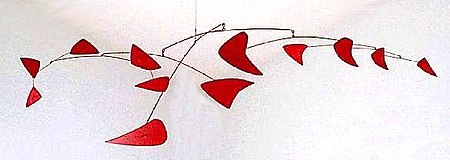
In 1931, Calder gave form to a new kind of art when he experimented with motor-driven sculptures composed of geometrical shapes, whose movement caused continually changing relationships between them. Duchamp* dubbed them “mobiles.” (Appropriately, Arp* coined the term, “stabiles” for pieces that did not move.) Calder’s later mobiles relied upon air currents for their movement because he felt that mechanically controlled movements ran the risk of being monotonous. The free, natural movement would give a greater sense of life. Many of his mobiles featured shapes of differing sizes, painted in primary colors, and balanced on pivoting points.
As Calder’s reputation began to increase, so did the size of his works. His first large-scale, outdoor stabile, called Devilfish, was constructed out of sheet metal. For the Paris World’s Fair in 1937, he created a mercury fountain, whose movement was produced by a stream of mercury striking a plate attached to a swiveling rod.
Some of his mobile panels were enlarged and incorporated into dance performances when choreographer Martha Graham* recognized their dramatic possibilities.
In his later years, Calder focused primarily on large-scale works, as he was continuously commissioned for public pieces from top architects. These pieces were too large for him to make on his own in his studio, so he relied upon assistance from factories skilled in iron and steel fabrication. His method was to create a small model and then supervise an enlargement. His monumental works were installed in cities around the world. The tallest was El Sol Rojo, which stood 67 feet high outside the Aztec Stadium for the Olympic Games in Mexico City (1968).
By the 1960s, Calder was renowned worldwide through his public pieces and dozens of one-man exhibitions in major museums, including the Museum of Modern and Guggenheim Museum in New York. A man of many interests and talents, Calder also made jewelry (he designed his own wedding ring), illustrated books, and published a well-received autobiography in 1966.
On October 14, 1976, the Whitney Museum of American Art in New York City mounted a retrospective show of Calder’s work, the largest to date. Less than a month later, Calder died of a heart attack.
His art is still displayed in permanent exhibitions in New York, Washington D.C. and Italy.
EXTRA CONNECTIONS: Japanese sculptor, Isamu Noguchi*, helped out at one of Calder’s circus performances in New York; he ran the victrola.
He knew and worked with Arp* and Leger*
For his lifelong friend Joan Miró, he set a shard of a broken porcelain vessel in a brass ring. Peggy Guggenheim received enormous silver mobile earrings and later commissioned a hammered silver headboard that shimmered with dangling fish.[47] In 1942, Guggenheim wore one Calder earring and one by Yves Tanguy to the opening of her New York gallery, The Art of This Century, to demonstrate her equal loyalty to Surrealist and abstract art, examples of which she displayed in separate galleries.[48] Others who were presented with Calder's pieces were the artist's close friend, Georgia O'Keeffe; Teeny Duchamp, wife of Marcel Duchamp; Jeanne Rucar, wife of the filmmaker Luis Buñuel; and Bella Rosenfeld, wife of Marc Chagall
ONELINER: Alexander Calder, inventor of the ‘mobile’ sculpture
BIBLIOGRAPHY: "Alexander Calder." Contemporary Artists, 4th ed. St. James Press, 1996. Reproduced in Biography Resource Center. Farmington Hills, Mich.: The Gale Group. 2004.
"Alexander Calder." Dictionary of American Biography, Supplement 10: 1976-1980. Charles Scribner's Sons, 1995. Reproduced in Biography Resource Center. Farmington Hills, Mich.: The
Gale Group. 2004.
Arnason, H. Harvard. “Alexander Calder.” Encyclopaedia Britannica. 2004. Encyclopaedia Britannica Online. 17 Feb. 2004
Calder, Alexander. Calder: an autobiography with pictures. New York: Pantheon Books, 1966.
Calder Foundation. 2003. Calder Foundation. 18 Feb 2004
Sweeney, James Johnson. Alexander Calder. New York: Museum of Modern Art, 1951.
Calder Foundation. www.calder.org (features a biography, life chronology, exhibition history, a collection of his essays, archival pictures, and a bibliography).
National Gallery of Art Calder Exhibition, http://www.nga.gov/exhibitions/calder/realsp/room2a-1.htm (features a virtual tour of the gallery and explanations of Calder’s career and works. Virtual tour requires Quicktime).