Verne, Jules
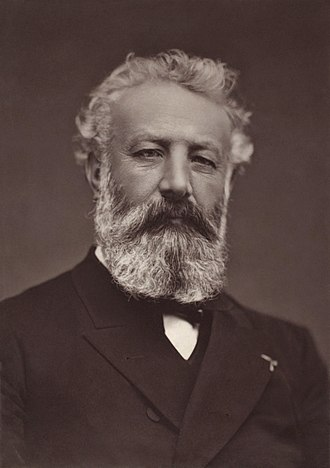
ACHIEVEMENT(S): The first writer to incorporate genuine principles of science into works of narrative fiction.
DATE/PLACE OF BIRTH: 8th February, 1828, at Nantes, France.
DATE/PLACE/AGE AT DEATH: 24th March, 1905, at Amiens, France. Aged 77.
DISCIPLINE: Writer
FIELD: Literature
LANGUAGE: French
EDUCATION: Clemenceau Lycée; Paris Faculty of Law.
MAJOR WORK: ‘Vingt mille lieues sous les mers,’ (Twenty thousand leagues under the sea)
LIFE AND TIMES:
In Paris Verne met Alexandre Dumas père*. The older Dumas welcomed young aspiring writers to his home where he cooked them dinner. Verne and Dumas' son wrote: ‘Broken Straws’, produced at Dumas père’s Théâtre Historique in November 1850. It was sufficiently successful to recoup for Verne all the money he had spent on it, and to win him his first literary spurs.
In 1851, after Verne had graduated in law, his father finally agreed to his pursuit of a literary career, and established his son in an apartment in Paris. Also at around this time, he read the work of Poe*, which had first appeared in translation in France in 1848 and was to be of profound influence on Verne.
By the summer of 1851, his first two prose pieces appeared in ‘Musée des Familles’, a publication for juveniles. These two stories were a curious mixture of reality and fiction, and proved how well Verne was suited to the narrative medium. He had natural flair for expressing a sense of adventure, and had the innovative talent of being able adapt science for popular understanding. Also in 1851, he wrote the short story ‘Un Voyage en ballon’ (A Voyage in a Balloon), and in 1854 the modern legend, ‘Maître Zacharius’ appeared. It is a story about the clockmaker who invented the principle of escapement, time and the devil.
Until 1862, Verne worked in stockbroking. In that year he approached Jules Hetzel, a successful publisher and writer of children’s stories, with a documentary-style traveller’s tale about ballooning. Hetzel suggested he turn into a proper novel, and in this form it was published in 1863. ‘Cinq semaines en ballon’ (Five Weeks in a Balloon) is about three colleagues who cross Africa in a balloon and have many adventures along the way was. This was the first novel in a long series of ‘Voyages extraordinaires’, which Hetzel would publish until the end of Verne’s career.
‘Voyage au centre de la terre’, (Journey to the center of the Earth) published in 1863, was Verne’s next work. His skills as a novelist are more highly developed here, portraying a rich array of characters, there is a tangible sense of thrill, as the reader is taken to the threshold of the unknown during the journey taken into the bowels of a volcano and so to the center of the earth.
Amongst his most memorable works at this time are: ‘De la terre à la lune,’ 1865, and the sequel, ‘Autour de la lune’, 1870, (From the Earth to the Moon Direct, and: a Trip Around the Moon); L’île mystérieuse’, (The Mysterious Island) and ‘Les enfants du Cpitaine Grant,’ 1867-68. Another very popular novel, ‘Vingt mille lieues sous les mers,’ (Twenty thousand leagues under the sea) which appeared in 1870, had been conceived around the year 1866, when Verne’s mind was filled with three key influences, the laying of the trans-Atlantic telegraph cable by the SS Great Eastern*, his own voyage on this ship in 1867 and his own boat, ‘San Michel’, which he had recently bought.
A non-science-fiction work, ‘Le tour du monde en quatre-vingt jours,’ or ‘Around the world in eighty days,’ 1873, has proved one of his most enduringly popular works. This is based on the actual travel arrangements existing at the time, and follows the progress of Phileas Fogg and his imperturbable valet. The novel was adapted for the stage two years after publication, and staged using elaborate sets and a live elephant.
In 1870s, Verne’s work lost some of its originality. Although science was still presented in an essentially positive light, there are hints of a darker side now too. In the mid 1880s, Verne created the character Robur, the inventor of an impressive flying machine, in ‘Robur le conquérant,’ 1886. Robur symbolizes technological progress, whilst he is allowed to make the world listen to his ideas, he is not attractive. In the sequel to this book, ‘Maître du monde,’ 1904, he is blasphemous and uncontrollable, eventually descending into madness.
Verne enjoyed financial success throughout his literary career, he lived in a large house in the country and went yachting occasionally. He became a nationally respected figure and was made an officer of the Legion of Honor in 1892. During the last years of his life Jules Verne travelled by boat around Italy. He also worked in the service of the service of the municipal council of Amiens. Even after his sight began to fail, he continued to write. He died of old age. Five thousand people attended his funeral.
The legacy of Verne’s writing can be seen in that of H.G. Wells*.
ASSESSMENT: He is regarded as one of the founders of the genre of science fiction.
EXTRA CONNECTIONS: He inspired Sikorsky*
BIBLIOGRAPHY:
Lottman, Herbert R., Jules Verne: an exploratory biography. St. Martin’s Press; New York, 1996.
PARENTS: Pierre Verne and Sophie Allotte de la Fuÿe
SIBLINGS: Paul, Anne, Mathilde, Marie.
SPOUSE: Honorine Morel, a widow née Deviane, married 1857.
CHILDREN: Michel, and two step-daughters.