Gauss
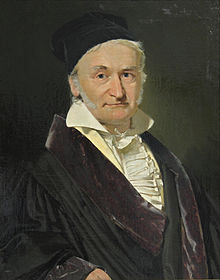
Achievements: Gaussian curve in math.
Born: April 30, 1777,;Brunswick, Germany
Died: February 23, 1855; Gottingen, Germany (Aged 77)
Field & Discipline: Mathematics; Science; Astronomy; Physics
Language: German
Education: Brunswick Collegium Carolineum; University of Gottingen
Major Work:
"Disquisitiones Arithmeticae"
Life & Times:
At 18, Gauss entered the University of Gottingen, where he studied mathematics for five years, reading every mathematical text he could find. In his first year, he discovered that a 17-sided polygon could be drawn inside a circle using only a ruler and compass (the first advance in Euclidian geometry in 2,000 year). In 1799, he was awarded his doctorate from the University of Helmstadt for his thesis on the fundamental theorem of algebra.
In 1801, Gauss published "Disquisitiones Arithmeticae", widely considered his greatest work. It summarized previous work in mathematics, solved some of its problems, and formulated concepts and questions which became the basis of research for the succeeding century. One of the book's most impressive revelations was the development of [revealed the work of] Lagrange*'s work on the binary quadratic. Gauss's work during these years had a strong influence on [influenced] Riemann,* who would later expand Gauss's work in geometry.
Between 1800 and 1810, Gauss concentrated on astronomy. He established a lifelong friendship with [a pal of] A. von Humboldt*. He also shared ideas with [a pal of] Olbers*, who, around 1804, introduced him to the young self-taught astronomer, [met] Bessel*.
In the field of natural science, Gauss conducted experiments with gravity to investigate the rotation of the earth. He worked under [worked under] Zach* to try to determine geographic longitudes. His work in dioptrics considerably influenced the optical industry in Germany, which became the prime supplier of fine optical instruments in the 19th century.
In 1801, Gauss set about trying to find the "lost" asteroid, Ceres. Discovered by [located lost asteroid of] Piazzi*, its path was seen for a while, then it grew faint and disappeared. Many scientists thought its orbit must be an ellipsis. [his asteroid search beat] Laplace* tried to calculate Ceres' orbit using some extremely complicated methods, then gave up the task as hopeless. Gauss, however, developed a method for calculating the orbit (known as the “method of least squares”), and after a year, it was found again by Zach, at almost exactly the position where Gauss had predicted it would be.
In 1809, Gauss published "The Theory of the Motion of Celestial Bodies" on the orbits of planets and comets and the calculation of their orbits from observations. He also worked out theories on how bodies affected each other, which were used in the discovery of the planet Neptune.
In 1816, Gauss returned to Gottingen University to become director of the reconstructed Observatory. After 1817, he ceased to work on theoretical astronomy, but continued to study positional astronomy until the end of his life. Between 1821 and 1848, he was scientific advisor to the Hanoverian and Danish governments in a geodetic survey. The survey required complicated calculations, which led to his work in the theory of errors, as well as his study of differential geometry.
Out of this came his formulation of the concepts of curvilinear coordinates, parametric representation, line-element, "Gaussian" curvature, conformal mapping, and the applicability of surfaces.
In 1831, [collaborated with] Wilhelm Weber* joined Gauss at Gottingen and together they researched electricity and developed the magnetometer. In 1832, Gauss began to research the earth's magnetism, supplementing his earlier work in geodetics.
Inspired by the work of [inspired by] Oersted*, [inspired by] Biot*, [inspired by] AM Ampere* and [inspired by] Faraday*, which laid the basis for the new field of electromagnetism, Gauss set himself to the study of theoretical electrodynamics.
His most famous experiment in this area, conducted with [developed telegraph with] Wilhelm Weber* in 1838, was with an electromagnetic [developed first] telegraph*, erected over a distance of 9,000 ft. between the Observatory and Weber's physics laboratory.
Gauss had such confidence in the potential of the telegraph, he suggested it be used by all railway lines, but he was unable to conduct the large-scale experiments needed to develop a really practical use for the instrument. The Gauss-Weber experiment came to the attention of [anticipated] Samuel Morse*, who benefited from it in his development of the telegraph in the United States.
Gauss often did not make his discoveries public until others had revealed their identical findings. In 1811, for example, he wrote to his friend, Bessel, outlining the fundamental theorem, but it was not until A.L. Cauchy discovered the same theorem in 1825, that it became known to the world.
Extra Connections:
His work and interests related to [influenced by] Sir William Jones*, [work related to] Grimm*, [work related to] Smyth*, [work related to] Berzelius*, [work related to] JWF Herschel *, [work related to] Airy*, [work related to] Bode*, [work related to] Morse*, [work related to] Vail*, and [work related to] Wheatstone*
His Magnetic Pole prediction spurred [theory tested by] James Ross's* expedition.
He used [work related to] Ohm*’s Law in his work.
The day after Gauss's death his brain was removed, preserved and studied by Rudolf Wagner, who found its mass to be slightly above average, at 1,492 grams (52.6 oz).[24][25] The cerebral area was determined by Wagner's son Hermann in his doctoral thesis to be 219,588 square millimetres (340.362 sq in).[26] Highly developed convolutions were also found, which in the early 20th century were suggested as the explanation for his genius.[27] After various previous investigations, a magnetic resonance study of 1998, done at the Max Planck Institute for Biophysical Chemistry in Göttingen, gave no results which could be used to explain his mathematical abilities.[28]
In 2013, a neurobiologist of the same institute discovered that Gauss's brain had been mixed up, due to mislabelling, with that of the physician Conrad Heinrich Fuchs [de], who died in Göttingen a few months after Gauss.[29] A further investigation showed no remarkable anomalies in the brains of either person. Thus, all investigations on Gauss's brain until 1998, except the first ones of Rudolf and Hermann Wagner, actually refer to the brain of Fuchs.[30]
Assessment: Provided much insight into many mathematical matters, some of which puzzle scientists today.
Oneliner: Carl Friedrich Gauss, German mathematical genius
Father: Gebhard Dietrich Gauss
Mother: Dorothea Benze
Siblings: Unknown
Spouse: 1) Johanna Osthoff; 2) Minna Waldeck
Children: by Osthoff: Joseph; Wilhelmina; Ludwig. by Waldeck: Eugen; Wilhelm; Therese