Grimm
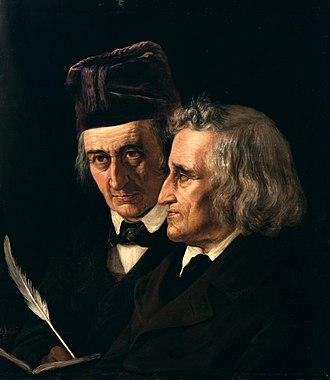
Name: Jakob Ludwig Carl Grimm & Wilhelm Carl Grimm
Nickname/Alias: The Brothers Grimm
Achievements: Grimms’ Fairy Tales
Born: Jakob: January 4, 1785; Hanau, Hesse-Kassel, Germany. Wilhelm: February 24, 1786; Hanau.
Died: Jakob: September 20, 1863; Berlin, Germany (Aged 78). Wilhelm: December 16, 1859; Berlin, Germany (Aged 73)
Field & Discipline: Folklore; Linguistics; Philology; Anthropology
Language: German
Father: Philipp Wilhelm Grimm
Mother: Dorothea Zimmer
Siblings: 8, of whom: Carl; Ferdinand; Charlotte Amalia; Ludwig Emil (4 died in infancy)
SPOUSES: Jakob: none. Wilhelm: Dorothea Wild
Children: Jakob: none. Wilhelm: Jacob (died in infancy); Herman Friedrich (literary and art historian); Rudolf (jurist); Auguste
Education: Private tutors; Lyceum Fridericianum, Kassel; Marburg University
Major Work:
"Kinder und Hausmarchen," known as "Grimms Fairy Tales"
Incomplete compilation of a definitive German dictionary
Grimm's law of linguistics, by Jakob
Life & Times:
The Grimm brothers, Jakob and Wilhelm, studied law at Marburg University, but soon took an interest in historical and philological studies under the tutelage of Friedrich Karl von Savigny, a brilliant lecturer in law. The brothers are among the best-known storytellers of folk tales, popularizing stories such as "Cinderella" ("Aschenputtel"), "The Frog Prince" ("Der Froschkönig"), "Hansel and Gretel" ("Hänsel und Gretel"), "Little Red Riding Hood" ("Rotkäppchen"), "Rapunzel", "Rumpelstiltskin" ("Rumpelstilzchen"), "Sleeping Beauty" ("Dornröschen"), and "Snow White" ("Schneewittchen"). Their first collection of folk tales, Children's and Household Tales (Kinder- und Hausmärchen), began publication in 1812.
Savigny introduced them to the research into German folk poetry and ballads carried out by the Romantic writers Ludwig Tieck, Johann Georg Hamann, and [studied work of] Herder* (who had been influenced by the oriental studies of [influenced by] Sir William Jones*). Savigny also introduced them to [wrote tales for] Brentano*, a collector of German folk songs, legends, and fairy tales, who, with his friend [wrote tales for] Achim von Arnim*, published a collection of folk songs, "Das Knaben Wunderhorn" in 1805.
Around 1806, the Grimm’s, both in their early 20’s, began writing down popular tales and collecting folk songs and poetry for Brentano and Arnim's second and third volumes of the "Wunderhorn." Over the next four years they compiled a large collection of fairy tales, and in 1812, published an edition of the two oldest German poems, "The Lay of Hildebrand" and the "Wessobrunn Prayer".
In the same year, they published the first volume of their fairy tales ("Nursery and Household Tales"): 200 simple stories transcribed so well that they took the German public by storm. Soon after, the fairy tales sold all over the world (they are now available in 70 languages), and the work of the Grimm’s, the earliest "scientific" collection of folk tales, became a model for the collecting of folk tales everywhere.
Kinder- und Hausmärchen was not an immediate bestseller, but its popularity grew with each edition.[49] The early editions attracted lukewarm critical reviews, generally on the basis that the stories were unappealing to children. The brothers responded with modifications and rewrites to increase the book's market appeal to that demographic.[17] By the 1870s the tales had increased greatly in popularity to the point that they were added to the teaching curriculum in Prussia.
After the defeat of Napoleon in 1813, Jakob went twice to Paris to recover books and paintings looted earlier by the French from Hesse and Prussia. He also took part in the Congress of Vienna (September, 1814 to June, 1815). In 1814, Wilhelm was made secretary at the Elector’s library in Kassel, where the brothers lived.
In 1815, the Grimms published a second volume of fairy tales, and in 1822 a third, and set to work preparing a fourth. Meanwhile, between 1816 and 1818, they published a collection of German historical and local legends, "Deutsche Sagen." Though less popular, the volume greatly influenced German authors and the study of folk narrative.
Working independently, Wilhelm collected, translated and edited many new editions of ancient texts, from the Germanic and other languages. His most acclaimed solo work was "Die Deutsche Heldensage” (The German Heroic Tale) (1820), a collection of themes and names from heroic legends mentioned in literature and art from the 6th to the 16th centuries, together with essays on the art of the saga.
Jakob's independent publications included his revolutionary philological study, the "Deutsche Grammatik "(1819-37), in which he was the first to take a strictly scientific approach to the grammar of all of the Germanic languages.
The work traced the historical development of German grammar, and treated language as something fluid and intricately bound with the life and destiny of the people who speak it. In a revised edition of the first volume, in 1822, Jakob for the first time clearly formulated the pattern and correspondence of consonant changes in the Germanic and other Indo-European languages (previously observed by Rasmus Rask). These observations are now known as "Grimm's Law."
Jakob also created a basic method of scientific etymology (research into the relationship between languages and development of meaning). His work had an enormous influence on the study of linguistics and remains valuable today.
In 1829, the brothers left Kassel, and the following year became librarians and professors at the University of Gottingen. But in 1837, the King of Hanover dismissed the Grimm’s for having been members of the "Gottingen Seven", professors who had protested the King's abrogation of the constitution. (The five other professors were W.E. Albrecht, F.C. Dahlmann, Heinrich Georg August von Ewald [son-in-law of [influenced] Gauss*], G. G. Gervinus, and [joined protest of] W.E. Weber*.) Of the seven, three, including Jakob, were ordered to leave the kingdom.
The brothers took refuge in Kassel, and after three years, accepted an appointment from the new Prussian king, Frederick William IV, as members of the Royal Academy of Sciences in Berlin. Here, they undertook the enormous task of compiling a German dictionary, the "Deutsches Worterbuch", that would include all the words in use from the 15th century. In 1848, Jakob published a two-volume work, "Geschichte der deutschen Sprache” (History of the Germanic Languages).
After the brothers died (Wilhelm in 1859, and Jakob in 1863) their work on the dictionary was continued by various groups of scholars and was completed in the 20th century.
The popularity of the Grimms' collected folk tales has endured well. The tales are available in more than 100 translations and have been adapted by renowned filmmakers, including Lotte Reiniger and Walt Disney, with films such as Snow White and the Seven Dwarfs. In the mid-20th century, the tales were used as propaganda by Nazi Germany; later in the 20th century, psychologists such as Bruno Bettelheim reaffirmed the value of the work in spite of the cruelty and violence in original versions of some of the tales, which were eventually sanitized by the Grimms themselves....In the 20th century the work maintained status as second only to the Bible as the most popular book in Germany. Its sales generated a mini-industry of criticism, which analyzed the tales' folkloric content in the context of literary history, socialism, and psychological elements often along Freudian and Jungian lines.[49]
Extra Connections: Wilhelm met [met] Goethe* in 1808.
Met [met] Herbart* in Gottingen.
Their work related to that of [work related to] Humperdinck*, [work related to] Tylor*, and [work related to] Cecil Sharp*.
Knew [knew] D’Holbach*.
Jakob was profoundly influenced by the Finnish folk-tales of [influenced by]Lonnrot*
Assessment: Although it is now known that some of their ‘traditional’ tales were in fact either made up, or editing by them, their collection effectively formed the basis for the science of folk narrative and folklore. They are also known as the founders of German philology.
Oneliner: The Brothers Grimm, great German fairy story writers
Bibliography:
- Encyclopedia Britannica.
- Colliers Encyclopedia.
- Michaelis-Jena, Ruth, The Brothers Grimm, London: Routledge & Kegan Paul, 1971.