Fechner GT
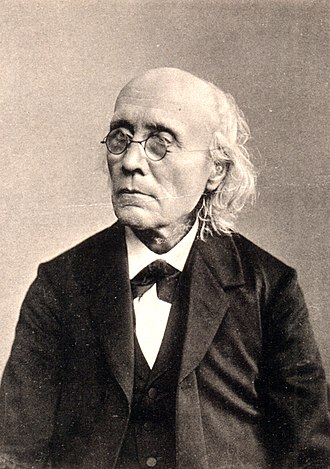
NAME: Fechner, Gustav Theodor
ACHIEVEMENTS: Psychophysics
NICKNAME/ALIAS: Dr Mises
DATE AND PLACE OF BIRTH:
19 April 1801, Gross-Sarchen, near Halle, Germany
DATE AND PLACE OF DEATH AND AGE AT DEATH:
18 November 1887, Leipzig, Germany. Aged 86
DISCIPLINE:
Physicist and psychologist
FIELD:
Psychophysics
LANGUAGE:
German
EDUCATION:
High School, Soran, nr Dresden
University of Leipzig
MAJOR WORK:
"Elements of Psychophysics" (1860)
LIFE AND TIMES
At university Fechner wrote some satirical pieces on doctors: "Proof that man is Made of Iodine" (1821) was a satire on the current fashion for using iodine for every ill and was published under the pseudonym 'Dr Mises', a name Fechner continued to use over the next quarter of a century.
When he qualified in 1822 he had fallen under the spell of the nature philosophers, in particular <a follower of> Schelling*, but in 1824 he translated <translated> Biot's* book on physics. He conducted his own research into electricity, concentrating particularly on <researched work of> Ohm's* Law, and wrote several articles on the subject.
In 1831 he published a paper on the quantitative measurements of the galvanic battery. In 1834 he became professor of physics at Leipzig. To help with household expenses, took edited a popular encyclopedia for which he also wrote many articles.
In 1838 the focus of his work moved to physiology and psychology, when he began to study subjective color experiences, producing a paper on subjective after-images (1840). Fechner used himself as a subject and spent long hours looking at lights, giving himself partial blindness.
He resigned his post in 1839 and spent the following three years sitting in a darkened room and occasionally venturing out with his eyes covered by bandages. In October 1843 he removed the bandages while in his garden and found that his vision had fully returned. He then began to “see” the souls of plants.
In 1844 he was granted an ill-health pension by the university and began to focus more on psychology. In particular, he developed his idea that the mind and body are two aspects of a single unit. These thoughts and the experiences with his returning eyesight resulted in: "Nanna, or the Soul Life of Plants" (1848) and he also wrote another philosophical work, "Zend-Avesta, or Concerning matters of Heaven and the World to Come" (1851).
The problem of giving a scientific framework to his concept of the human organism as a psychophysical entity was solved on 22 October 1850 (a date now commemorated by psychophysicists as ‘Fechner Day’). He woke that morning and before getting out of bed realised that since the connection between the body and the mind was the relation between mental sensation and bodily stimulus, this could be established by a statement of the quantitative relation between them, in which increases in mental sensation correspond to proportional changes in bodily stimulus.
Fechner was partly influenced by a paper "On the Conservation of Force" published by the German physiologist <influenced by> Helmholtz* in 1847 and stating that energy was constant, so energy acting on sense organs did not disappear but travelled via the nervous system and ended in a bodily effect.
Over the next decade Fechner worked on psychophysics and in 1860 published his major work: "Elements of Psychophysics", which he called a statement of the "exact science of the functional relations or relations of dependency between body and mind". His book provided the basis for the new discipline of psychophysics.
At Leipzig, the physiologist <collaborated with> EH Weber* was trying to measure and correlate stimulus intensity in muscles and the sensation of touch. Weber had found that that even a barely-noticeable difference between two stimuli could be experienced as a sensation and Fechner developed an equation to express the theory, now known as the Weber-Fechner law.
Fechner's equation caused controversy at the time with many scientists claiming he had not succeeded in measuring sensation at all. Helmholtz, <influenced> Mach* and <influenced> Wundt* were all stimulated by the controversy to write papers on psychophics. The American psychologist <his theory rejected by> William James* later rejected Fechner's claims while agreeing his contribution to the development of psychophysics.
In the final years of his life, Fechner wrote on philosophy, showing God as a psychophysic conscious law, and he also published an updated version of his psychophysics.
ASSESSMENT: His work provided a quantitative basis for sensory psychology and established psychophysics as a scientific discipline.
EXTRA CONNECTIONS: Influenced his friend <influenced> Vierordt*
His stellar magnitude studies related to <work related to> Steinheil*
He was a friend of <a pal of> Zollner*
His measurement concerns related to that of <work related to> Quetelet* and <work related to> Gauss*
He was a friend of <a pal of> WE Weber*
He influenced <influenced> Charles Henry*
BIBLIOGRAPHY:
Hall, G Stanly, Founders of Modern Psychology, D Appleton and Company, New York and London, 1912
Watson, Robert I, The Great Psychologists, J B Lippincott Company, Philadelphia, New York, 1968.
PARENTS:
Father: Samuel Traugott Fechner
Mother: Johanna Fischer
SIBLINGS: 4
SPOUSE: Clara Volkmann
CHILDREN: