Burns, Robert
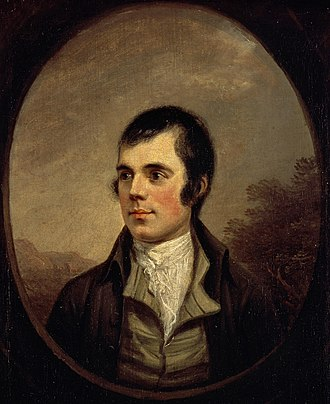
ACHIEVEMENT(S): National poet of Scotland.
NICKNAME/ALIAS: Robbie Burns, Rabbie Burns, Scotland's favourite son, the Ploughman Poet, Robden of Solway Firth, the Bard of Ayrshire and in Scotland as The Bard
DATE/PLACE OF BIRTH: January 25, 1759, Alloway, Scotland
DATE AND PLACE OF DEATH/AGE AT DEATH: July 21, 1796, Dumfries, Scotland. Aged 37
DISCIPLINE: Poet
FIELD: Literature
LANGUAGE: English (Scottish dialect)
EDUCATION: School at Alloway Mill; Alloway School; parish school Darymple.
MAJOR WORKS: A vast collection of poems and songs, including "Auld Lang
Syne, "The Cotter's Saturday Night", "Tam O'Shanter", "A Man's a Man for A'
That", "To a Mouse", "Afton Water", "Scots Wha’ Hae", "Address to a Haggis",
"Comin' Thru the Rye", "Green Grow the Rashes, O"
LIFE AND TIMES:
Watching his father virtually work himself to death made Robert both a rebel and a bitter satirist. It also made him a believer in the equality of men and led him to be an ardent supporter of the French Revolution in its early days. Burns's father, determined that his sons receive a good education, sent Burns to various schools, where he acquired a reading knowledge of French, some mathematics, a smattering of Latin, but mostly a love of reading. He read most of the important 18th-century English writers as well as Shakespeare, Milton, and Dryden. His knowledge of Scottish literature came from folk songs, ballads and folk tales. He began to write poetry at an early age.
When Burns's father died in 1784, he left the farm to Burns and his brother Gilbert. The farm, Mossgiel, and the parish, Mauchline, are frequently mentioned in the poems Burns was now writing. While running the farm Burns wrote "The Cotter's Saturday Night", "To a Mouse", "To a Mountain Daisy", "Holy Willie"s Prayer", the “Epistles to Labraik,” "The Holy Fair" and many other poems. He had an affair with a servant girl, Elizabeth Paton, who in 1785 bore his first child, also called Elizabeth, to whom he dedicated a poem.
In his twenties, Burns turned more and more to verse to express love, friendship, amusement, and his ironic view of life. He was a clever craftsman, interested in the techniques of versification. In 1786, at 27, Burns fell in love with, and wanted to marry, Jean Armour, but her father forbade the wedding, even though a child was on the way. Jean, meanwhile, bore twins.
The Burns farm was now doing so poorly that Burns considered moving to Jamaica. But first, he was determined to make Scotland take notice of his talent. He published a volume of his poems at the nearby town of Kilmarnock. The book, Poems, Chiefly in the Scottish Dialect, appeared in the summer of 1786. Its success was immediate and overwhelming. Simple country folk and sophisticated Edinburgh critics alike hailed it.
Burns set out for Edinburgh, where he was lionized. The Kilmarnock volume was a remarkable mixture. It included "The Cotter"s Saturday Night", "To a Mountain Daisy", "The Twa Dogs", "Scotch Drink", "The Holy Fair", "An Address to the Deil", "The Death and Dying Words of Poor Maillie", "To a Mouse", and "To a Louse". It also included a number of verse letters addressed to various friends, six gloomy and histrionic poems in English, and four songs.
Burns was anxious to impress a genteel Edinburgh audience. In his preface he played up to contemporary sentimental views about the natural man and the noble peasant, exaggerated his lack of education. Burns's success in Edinburgh, his attractive appearance and gregarious personality led him into a life of complex relationships, mostly amorous. After touring Scotland, he settled at a farm in Ellisland, Dumfriesshire in 1788 with Jean Armour, who was now his wife.
During this time, Edinburgh engraver James Johnson sought Burns's help in a book he was publishing. A keen collector of Scottish songs, Johnson was bringing out a series of volumes of songs with music, and Burns agreed to help find, edit, improve, and rewrite selections. He soon became the virtual editor of Johnson's "Scots Musical Museum", which also included songs by Smollett*, whom Burns greatly admired, and McPherson* (author of: "Ossian"). Later, Burns became involved with a similar project for George Thomson*, but Thomson could see no appeal in the vernacular and Burns had to fight to stop him from refining the words and music.
Johnson’s "Scots Musical Museum" and Thomson's "Select Collection of Original Scottish Airs for the Voice" contain the bulk of Burns's songs.
Burns spent the latter part of his life in collecting songs and writing words to traditional Scottish airs. The only poem of any complexity that he wrote after his Edinburgh visit, was "Tam O'Shanter" (1791), a spirited, narrative work, based on a folk legend, written in brilliantly handled eight-syllable couplets.
Burns applied for and finally obtained in 1789 a post in the excise service. His job took him to Dumfries in 1791, where he lived until his death.
As well as carrying out his duties, he wrote numerous "occasional" poems and did an immense amount of work for the two song collections. Still the hard-working, hard-drinking, womanizing bon vivant, Burns' health began to suffer. By 1794, at 35, he had severe gout. In January, 1796, after falling asleep in the open air on his way home from a long night at the tavern, he suffered a bad attack of rheumatic fever. It continuously worsened, and seven months later, he died of endocarditis, induced by rheumatism. His last child, James Maxwell, was born to his wife Jean as his funeral was being held.
ASSESSMENT: It is his songs which have given him a global reputation as one of the greatest songwriters Great Britain has produced.
EXTRA CONNECTIONS: Met Sir Walter Scott*, WE Henley* and Smellie*
A family friend was Tennant*
Corresponded with Dr John Moore*
Burns is generally classified as a proto-Romantic poet, and he influenced William Wordsworth, Samuel Taylor Coleridge, and Percy Bysshe Shelley greatly. His direct literary influences in the use of Scots in poetry were Allan Ramsay and Robert Fergusson. The Edinburgh literati worked to sentimentalise Burns during his life and after his death, dismissing his education by calling him a "heaven-taught ploughman". Burns influenced later Scottish writers, especially Hugh MacDiarmid, who fought to dismantle what he felt had become a sentimental cult that dominated Scottish literature.
In January 1864, President Abraham Lincoln was invited to attend a Robert Burns celebration by Robert Crawford; and if unable to attend, send a toast. Lincoln composed a toast.[60]
An example of Burns's literary influence in the US is seen in the choice by novelist John Steinbeck of the title of his 1937 novel, Of Mice and Men, taken from a line in the second-to-last stanza of "To a Mouse": "The best laid schemes o' mice an' men / Gang aft agley." Burns's influence on American vernacular poets such as James Whitcomb Riley and Frank Lebby Stanton has been acknowledged by their biographers.[61] When asked for the source of his greatest creative inspiration, singer-songwriter Bob Dylan selected Burns's 1794 song "A Red, Red Rose" as the lyric that had the biggest effect on his life.[62]
The author J. D. Salinger used protagonist Holden Caulfield's misinterpretation of Burns's poem "Comin' Through the Rye" as his title and a main interpretation of Caulfield's grasping to his childhood in his 1951 novel The Catcher in the Rye. The poem, actually about a rendezvous, is thought by Caulfield to be about saving people from falling out of childhood.[63]
ONELINER: Robert Burns, famous Scottish poet
BIBLIOGRAPHY:
EBritannica
Oxford Companion to English Literature
McIntyre, Ian, Dirt and Deity: A Life of Robert Burns, London: Harper Collins, 1995
PARENTS: William Burnes; Agnes Brown
SIBLINGS: Agnes, Arabella, Gilbert, Isabella, John, William
SPOUSE: Jean Armour
CHILDREN: Elizabeth by Elizabeth Paton; Elizabeth by Ann Park; 9 children by wife Jean, 5 survived infancy -- Robert, Francis Wallace, William Nicol, James Glencairn and James Maxwell.