Moore Dr J
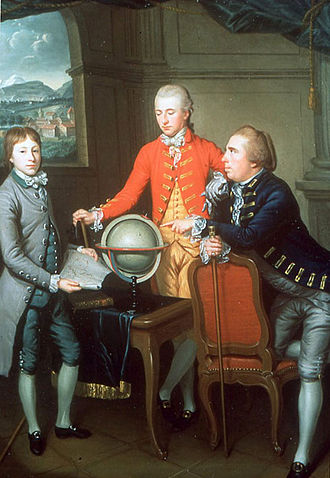
(on the Grand Tour with his son)
NAME: [Moore, Dr John](https://en.wikipedia.org/wiki/John_Moore_(Scottish_physician)
ACHIEVEMENT(S): Novelist and surgeon
NICKNAME/ALIAS: None
DATE AND PLACE OF BIRTH: December, 1729, Stirling, Scotland
DATE/PLACE OF DEATH/AGE AT DEATH: January 21, 1802, Richmond, Surrey, England. Aged 72.
DISCIPLINE: Surgeon/novelist
FIELD: Medicine
LANGUAGE: English
PARENTS: Charles Moore and Marion Anderson
SIBLINGS: One brother; two sisters
SPOUSE: ? Simpson
CHILDREN: One daughter; five sons: Sir John Moore, famous General; James,surgeon; Graham, Admiral; Francis, in the war office; Charles, lawyer.
EDUCATION: Glasgow Grammar School; Glasgow University, Scotland
MAJOR WORK: "Zeluco"
LIFE AND TIMES:
At Glasgow University one of Moore’s fellow-students was future novelist Smollett*.
In 1747, at 18, Moore completed his apprenticeship and was made surgeon's mate in the Duke of Argyll's regiment. He served at Maastricht, where the hospitals were filled with the wounded from the Battle of Lauffeld (July 2, 1747), in the War of Austrian Succession (1740-48).
Moore showed great skill as a surgeon and was appointed assistant surgeon to the Coldstream Guards. He tended the many wounded at Flushing and stayed in Breda over the winter of 1747-48 with General Braddock, with whom he returned to England when peace was declared in the spring.
In London, Moore attended the medical lectures of William Hunter*, and then went to Paris with Sir William Fordyce to continue his studies. There he again met the Earl of Albermarle, now British ambassador at Versailles, and became surgeon to his household, though he still worked in the hospitals with Fordyce.
In the summer of 1750, Smollett joined Moore in Paris, and together they visited Saint-Cloud and Versailles. In 1751, John Gordon, Moore's former teacher, invited him to become his partner in Glasgow. Moore accepted, but on his way back he attended another course of lectures by Hunter in London, and a course on midwifery.
Moore practiced in Glasgow with Gordon for two years and then set up a partnership with Hamilton, the professor of anatomy at the University of Glasgow.
In 1769, Moore tended James George, seventh Duke of Hamilton, on his deathbed, and wrote his epitaph. In 1770, at 41, Moore graduated as M.D. from the University of Glasgow, but two years later gave up his practice to travel for five years around Europe with Douglas, eight Duke of Hamilton, during which time he began writing.
Moore visited Ferney and met Voltaire*. In Berlin Moore talked with Frederick the Great*.
He also visited Switzerland, Germany, Bohemia and Austria. A tour of Italy ended up in Florence, where Moore had frequent meetings with Prince Charles Edward Stuart* (Bonnie Prince Charlie). Moore and Douglas returned to England in 1778. They remained friends for life.
Moore took up residence in a house in Clarges Street, London, where he established a medical practice and began to write travel pieces. In 1779, "A View of Society and Manners in France, Switzerland and Germany" was published, and in 1781 came "A View of Society and Manners in Italy", each in two volumes, both written in the form of letters, giving descriptions and relating incidents from his travels with the Duke of Hamilton.
The books were a success, and Moore gained a considerable reputation as a
writer. In 1784, he met Dr Johnson*, and wrote an account of the meeting in his preface to an edition of Smollett. In 1786, he published “Medical Sketches" in two parts, relating some of his impressions and experiences as a surgeon and general practitioner.
Later in 1786, Moore published his first novel, "Zeluco: Various Views of Human Nature, taken from Life and Manners, Foreign and Domestic". It is a lively history of a life of wickedness. The novel did well, with several editions appearing in both England and Ireland, and one translation into French. But it owes much of its fame to the fact that Byron*, in his preface to "Childe Harold", wrote that his hero was "perhaps a poetical Zeluco".
After publishing "Zeluco", Moore took a trip to Glasgow, where he stayed at Hamilton Palace. Robert Burns* wrote to him and the pair corresponded for some time. When he was 63, Moore and the Earl of Lauderdale and traveled to France, then in the grip of the Revolution. Moore was in Paris when the revolutionaries stormed the Tuileries Palace, overthrowing the French monarchy. After about a month in Calais, Moore returned to Paris in October and witnessed the opening of the new National Assembly.
On his return to England, he published in 1793 "A Journal During a Residence in France from the Beginning of August to the Middle of December 1792". A second volume the following year gave a simple but exact account of what he saw, his observations later being quoted often in Carlyle*'s "History of the French Revolution" (1837). In 1795, he published "A View of the Causes and Progress of the French Revolution" in two volumes
In 1796, Moore published his second novel, "Edward: Various Views of Human Nature, Taken from Life and Manners, Chiefly in England". It was the reverse of "Zeluco", dealing with the life of an invariably good man. Unsurprising, the book was a good deal less entertaining than its predecessor, and did far less well.
However, in 1797, Moore published his biography of Smollett, (who was now a patient as well as a friend,) as a preface to a complete edition of Smollett's works, and this proved far more popular. In 1800 came a third novel, "Mordaunt", but this was no more successful than "Edward."
By this time, Moore's health was failing. To find relief, he moved to Richmond, Surrey, for country air, but died there.
ASSESSMENT: A competent physician, Moore also intensely enjoyed life and writing about it, which he did astutely.
EXTRA CONNECTIONS: Sir Thomas Lawrence* painted his portrait.
ONELINER: Dr John Moore, novelist and pal of the famous
BIBLIOGRAPHY:
DNB
Anderson, Robert, Life of John Moore in The Works of John Moore, with Memoirs of his Life and Writings, vol 1, Edinburgh: Rodwell & Martin, 1820.