DNA / Genetics
Alternative Name/s: Deoxyribonucleic Acid, genetics, genetic engineering, Human Genome
Thanks to work by [discovered by] Crick and Watson* ( [inspired by] Schrodinger*) it is known that DNA is the primary building block of life on Earth. It is comprised of a repeating pattern of four different amino acids (adenine, thymine, guanine and cytosine, represented by the letters A, T, G and C) strung together in a double-helix shape (looking like a spiral staircase).
The genetic code for every organism, from humans to viruses, is locked in the combination and location of these amino acids on the DNA macromolecule. These sequences provide the programming code for each organism, determining how the organism looks, how it metabolizes food or fights off infection, how it behaves. Each organism has a unique DNA “fingerprint” which differentiates it from other members of its own species, as well as from other species.
DNA can be used in criminal forensics to identify whether someone is guilty, or innocent. It can be used in medical research to predict the occurrence of certain inherited diseases, like Down’s Syndrome, in children.
DNA manipulation has produced various strains of disease- and pest-resistant crops that may changed agriculture around the planet. Through the process of somatic cell nuclear transfer (a form of cloning), scientists have been able to produce offspring of sheep, mice, goats, pigs, cats, rabbits, and a wild ox called a gaur.
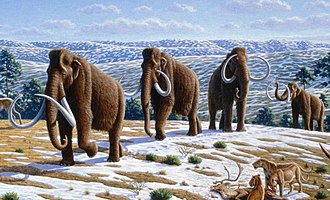
De-extinction (also known as resurrection biology, or species revivalism) is the process of generating an organism that either resembles or is an extinct species...The existence of preserved soft tissue remains and DNA from woolly mammoths has led to the idea that the species could be recreated by genetic engineering, such as CRISPR.
Questions concerning the ethics and morals related to cloning, genetic manipulation of plants and animals, the collection and storing of human DNA information, the use of this information for medical screening purposes, and how this information might impact families, insurance companies, and society as a whole are being asked, and answers are being debated.
Oneliner: DNA
Bibliography:
- Unknown, “A New Way to Compare Human and Other Primate Genomes,” 2/23/2003 press release, Lawrence Berkeley Laboratories; online version at Science Daily website,http://www.sciencedaily.com/releases/2003/02/030228072746.htm.
- Unknown, “Cloning Fact Sheet,” Human Genome Project online site, U.S. Dept. of Energy Office of Science, Office of Biological and Environmental Research, http://www.ornl.gov/TechResources/Human_Genome/elsi/cloning.html.**
- Sarah Webb, “IU graduate student made DNA discovery 50 years ago,” Indiana Digital Student News, online edition, © 2003 Indiana Daily Student,http://idsnews.com/print.php?id=15195.
- Unknown, “The Structure of DNA: Crick and Watson, 1953,” online site, 2003 Cavendish Laboratories, Cambridge University Physics Dept., Cambridge Universityhttp://www.phy.cam.ac.uk/camphy/outreach/dna/.