Beethoven 2
Ludwig van Beethoven[n 1] (baptised 17 December 1770 – 26 March 1827) was a German composer and pianist. Beethoven remains one of the most admired composers in the history of Western music; his works rank among the most performed of the classical music repertoire and span the transition from the Classical period to the Romantic era in classical music. His career has conventionally been divided into early, middle, and late periods. His early period, during which he forged his craft, is typically considered to have lasted until 1802. From 1802 to around 1812, his middle period showed an individual development from the styles of Joseph Haydn and Wolfgang Amadeus Mozart, and is sometimes characterized as heroic. During this time, he began to grow increasingly deaf. In his late period, from 1812 to 1827, he extended his innovations in musical form and expression.
Beethoven was born in Bonn. His musical talent was obvious at an early age. He was initially harshly and intensively taught by his father, Johann van Beethoven. Beethoven was later taught by the composer and conductor Christian Gottlob Neefe, under whose tutelage he published his first work, a set of keyboard variations, in 1783. He found relief from a dysfunctional home life with the family of Helene von Breuning, whose children he loved, befriended, and taught piano. At age 21, he moved to Vienna, which subsequently became his base, and studied composition with Haydn. Beethoven then gained a reputation as a virtuoso pianist, and was soon patronized by Karl Alois, Prince Lichnowsky for compositions, which resulted in his three Opus 1 piano trios (the earliest works to which he accorded an opus number) in 1795.
His first major orchestral work, the First Symphony, premiered in 1800, and his first set of string quartets was published in 1801. Despite his hearing deteriorating during this period, he continued to conduct, premiering his Third and Fifth Symphonies in 1804 and 1808, respectively. His Violin Concerto appeared in 1806. His last piano concerto (No. 5, Op. 73, known as the Emperor), dedicated to his frequent patron Archduke Rudolf of Austria, premiered in 1811, without Beethoven as soloist. He was almost completely deaf by 1814, and he then gave up performing and appearing in public. He described his problems with health and his unfulfilled personal life in two letters, his Heiligenstadt Testament (1802) to his brothers and his unsent love letter to an unknown "Immortal Beloved" (1812).
After 1810, increasingly less socially involved, Beethoven composed many of his most admired works, including later symphonies, mature chamber music and the late piano sonatas. His only opera, Fidelio, first performed in 1805, was revised to its final version in 1814. He composed Missa solemnis between 1819 and 1823 and his final Symphony, No. 9, one of the first examples of a choral symphony, between 1822 and 1824. Written in his last years, his late string quartets, including the Grosse Fuge, of 1825–1826 are among his final achievements. After some months of bedridden illness, he died in 1827. Beethoven's works remain mainstays of the classical music repertoire.
Life and career
Family and early life

Beethoven's birthplace at Bonngasse 20, Bonn, now the Beethoven House museum
Beethoven was the grandson of Ludwig van Beethoven,[n 2] a musician from the town of Mechelen in the Austrian Duchy of Brabant (in what is now the Flemish region of Belgium) who had moved to Bonn at the age of 21.[2][3] Ludwig was employed as a bass singer at the court of Clemens August, Archbishop-Elector of Cologne, eventually rising to become, in 1761, Kapellmeister (music director) and hence a preeminent musician in Bonn. The portrait he commissioned of himself toward the end of his life remained displayed in his grandson's rooms as a talisman of his musical heritage.[4] Ludwig had two sons, the younger of whom, Johann, worked as a tenor in the same musical establishment and gave keyboard and violin lessons to supplement his income.[2]
Johann married Maria Magdalena Keverich in 1767; she was the daughter of Heinrich Keverich (1701–1751), who had been the head chef at the court of Johann IX Philipp von Walderdorff, Archbishop of Trier.[5] Beethoven was born of this marriage in Bonn, at what is now the Beethoven House Museum, Bonngasse 20.[6] There is no authentic record of the date of his birth; but the registry of his baptism, in the Catholic Parish of St. Remigius on 17 December 1770, survives, and the custom in the region at the time was to carry out baptism within 24 hours of birth. There is a consensus (with which Beethoven himself agreed) that his birth date was 16 December, but no documentary proof of this.[7]
Of the seven children born to Johann van Beethoven, only Ludwig, the second-born, and two younger brothers survived infancy. Kaspar Anton Karl (generally known as Karl) was born on 8 April 1774, and Nikolaus Johann (generally known as Johann), the youngest, was born on 2 October 1776.[8]
Beethoven's first music teacher was his father. He later had other local teachers: the court organist Gilles van den Eeden (d. 1782), Tobias Friedrich Pfeiffer (a family friend, who provided keyboard tuition), Franz Rovantini (a relative, who instructed him in playing the violin and viola),[2] and court concertmaster Franz Anton Ries for the violin.[9] His tuition began in his fifth year. The regime was harsh and intensive, often reducing him to tears. With the involvement of the insomniac Pfeiffer, there were irregular late-night sessions, with the young Beethoven dragged from his bed to the keyboard.[10] His musical talent was obvious at a young age. Johann, aware of Leopold Mozart's successes in this area (with his son Wolfgang and daughter Nannerl), attempted to promote his son as a child prodigy, claiming that Beethoven was six (he was seven) on the posters for his first public performance in March 1778.[11]
1780–1792: Bonn

Christian Gottlob Neefe. Engraving after Johann Georg Rosenberg, c. 1798
In 1780 or 1781, Beethoven began his studies with his most important teacher in Bonn, Christian Gottlob Neefe.[12] Neefe taught him composition; in March 1783 Beethoven's first published work appeared, a set of keyboard variations (WoO 63).[8][n 3] Beethoven soon began working with Neefe as assistant organist, at first unpaid (1782), and then as a paid employee (1784) of the court chapel.[14] His first three piano sonatas, WoO 47, sometimes known as Kurfürst (Elector) for their dedication to Elector Maximilian Friedrich, were published in 1783.[15] In the same year, the first printed reference to Beethoven appeared in the Magazin der Musik – "Louis van Beethoven [sic] ... a boy of 11 years and most promising talent. He plays the piano very skilfully and with power, reads at sight very well ... the chief piece he plays is Das wohltemperierte Klavier of Sebastian Bach, which Herr Neefe puts into his hands".[2] Maximilian Friedrich's successor as Elector of Bonn was Maximilian Franz. He gave some support to Beethoven, appointing him Court Organist and paying towards his visit to Vienna of 1792.[5][16]
...
From 1790 to 1792, Beethoven composed several works (none were published at the time) showing a growing range and maturity. Musicologists have identified a theme similar to those of his Third Symphony in a set of variations written in 1791.[27] It was perhaps on Neefe's recommendation that Beethoven received his first commissions; the Literary Society in Bonn commissioned a cantata to mark the occasion of the death in 1790 of Joseph II (WoO 87), and a further cantata, to celebrate the subsequent accession of Leopold II as Holy Roman Emperor (WoO 88), may have been commissioned by the Elector.[28] These two Emperor Cantatas were not performed at the time and remained lost until the 1880s, when Johannes Brahms called them "Beethoven through and through" and as such prophetic of the style that marked his music as distinct from the classical tradition.[29]
Beethoven was probably first introduced to Joseph Haydn in late 1790 when the latter was travelling to London and stopped in Bonn around Christmas.[30] In July 1792, they met in Bonn on Haydn's return trip from London to Vienna, when Beethoven played in the orchestra at the Redoute in Godesberg. Arrangements were likely made at that time for Beethoven to study with Haydn.[31] Waldstein wrote to him before his departure: "You are going to Vienna in fulfilment of your long-frustrated wishes ... With the help of assiduous labour you shall receive Mozart's spirit from Haydn's hands."[17]
1792–1802: Vienna – the early years

Portrait of Beethoven as a young man, c. 1800, by Carl Traugott Riedel (1769–1832)
Beethoven left Bonn for Vienna in November 1792, amid rumours of war spilling out of France; he learned shortly after his arrival that his father had died.[32][33] Over the next few years, he responded to the widespread feeling that he was a successor to the recently deceased Mozart by studying Mozart's work and writing works with a distinctly Mozartian flavour.[34]
Beethoven did not immediately set out to establish himself as a composer, but rather devoted himself to study and performance. Working under Haydn's direction,[35] he sought to master counterpoint. He also studied violin under Ignaz Schuppanzigh.[36] Early in this period, he also began receiving occasional instruction from Antonio Salieri, primarily in Italian vocal composition style; this relationship persisted until at least 1802, and possibly as late as 1809.[37]
With Haydn's departure for England in 1794, Beethoven was expected by the Elector to return home to Bonn. He chose instead to remain in Vienna, continuing his instruction in counterpoint with Johann Albrechtsberger and other teachers. In any case, by this time it must have seemed clear to his employer that Bonn would fall to the French, as it did in October 1794, effectively leaving Beethoven without a stipend or the necessity to return.[38] But several Viennese noblemen had already recognised his ability and offered him financial support, among them Prince Joseph Franz Lobkowitz, Prince Karl Lichnowsky, and Baron Gottfried van Swieten.[39]
Assisted by his connections with Haydn and Waldstein, Beethoven began to develop a reputation as a performer and improviser in the salons of the Viennese nobility.[40] His friend Nikolaus Simrock began publishing his compositions, starting with a set of keyboard variations on a theme of Dittersdorf (WoO 66).[41] By 1793, he had established a reputation in Vienna as a piano virtuoso, but he apparently withheld works from publication so that their eventual appearance would have greater impact.[39]
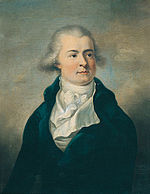 ]
Prince Lobkowitz: portrait by August Friedrich Oelenhainz
In 1795 Beethoven made his public debut in Vienna over three days,[42] beginning with a performance of one of his own piano concertos on 29 March at the Burgtheater[n 4] and ending with a Mozart concerto on 31 March, probably the D minor concerto, for which he had written a cadenza soon after his arrival in Vienna.
...
In May 1799, he taught piano to the daughters of Hungarian Countess Anna Brunsvik. During this time, he fell in love with the younger daughter, Josephine. Among his other students, from 1801 to 1805, he tutored Ferdinand Ries, who went on to become a composer and later wrote about their encounters. The young Carl Czerny, who later became a renowned music teacher himself, studied with Beethoven from 1801 to 1803. In late 1801, he met a young countess, Julie Guicciardi, through the Brunsvik family; he mentions his love for Julie in a November 1801 letter to a friend, but class difference prevented any consideration of pursuing it. He dedicated his 1802 Sonata Op. 27 No. 2, now commonly known as the Moonlight Sonata, to her.[55]
...
1802–1812: The 'heroic' period
Deafness

Beethoven in 1803, painted by Christian Horneman
Beethoven told the English pianist Charles Neate (in 1815) that he dated his hearing loss from a fit in 1798 induced by a quarrel with a singer.[59] During its gradual decline, his hearing was further impeded by a severe form of tinnitus.[60] As early as 1801, he wrote to Wegeler and another friend, Karl Amenda, describing his symptoms and the difficulties they caused in both professional and social settings (although it is likely some of his close friends were already aware of the problems).[61] The cause was probably otosclerosis, perhaps accompanied by degeneration of the auditory nerve.[62][n 5]
On his doctor's advice, Beethoven moved to the small Austrian town of Heiligenstadt, just outside Vienna, from April to October 1802 in an attempt to come to terms with his condition. There he wrote the document now known as the Heiligenstadt Testament, a letter to his brothers that records his thoughts of suicide due to his growing deafness and his resolution to continue living for and through his art. The letter was never sent and was discovered in his papers after his death.[65] The letters to Wegeler and Amenda were not so despairing; in them Beethoven commented also on his ongoing professional and financial success at this period, and his determination, as he expressed it to Wegeler, to "seize Fate by the throat; it shall certainly not crush me completely".[62] In 1806, Beethoven noted on one of his musical sketches: "Let your deafness no longer be a secret—even in art."[66]
Beethoven's hearing loss did not prevent him from composing music, but it made playing at concerts—an important source of income at this phase of his life—increasingly difficult. (It also contributed substantially to his social withdrawal.)[62] Czerny remarked that Beethoven could still hear speech and music normally until 1812.[67] Beethoven never became totally deaf; in his final years he was still able to distinguish low tones and sudden loud sounds.[68]
The heroic style

Titlepage of ms. of the Eroica Symphony, with Napoleon's name scored through by Beethoven
Beethoven's return to Vienna from Heiligenstadt was marked by a change in musical style, and is now often designated as the start of his middle or "heroic" period, characterised by many original works composed on a grand scale.[69] According to Czerny, Beethoven said: "I am not satisfied with the work I have done so far. From now on I intend to take a new way."[70]
An early major work employing this new style was the Third Symphony in E-flat, Op. 55, known as the Eroica, written in 1803–04. The idea of creating a symphony based on the career of Napoleon may have been suggested to Beethoven by General Bernadotte in 1798.[71] Sympathetic to the ideal of the heroic revolutionary leader, Beethoven originally gave the symphony the title "Bonaparte", but disillusioned by Napoleon declaring himself Emperor in 1804, he scratched Napoleon's name from the manuscript's title page, and the symphony was published in 1806 with its present title and the subtitle "to celebrate the memory of a great man".[72] The Eroica was longer and larger in scope than any previous symphony. When it premiered in early 1805 it received a mixed reception. Some listeners objected to its length or misunderstood its structure, while others viewed it as a masterpiece.[73]
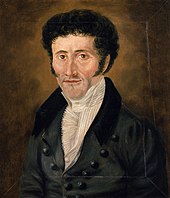 ]
E. T. A. Hoffmann, self-portrait, c. 1820
Other middle-period works extend in the same dramatic manner the musical language Beethoven had inherited. The Rasumovsky string quartets and the Waldstein and Appassionata piano sonatas share the Third Symphony's heroic spirit.[72] Other works of this period include the Fourth through Eighth Symphonies, the oratorio Christ on the Mount of Olives, the opera Fidelio, and the Violin Concerto.[74]
Beethoven was hailed in 1810 by the writer and composer E. T. A. Hoffmann, in an influential review in the Allgemeine musikalische Zeitung, as the greatest of (what he considered) the three Romantic composers (that is, ahead of Haydn and Mozart); in Beethoven's Fifth Symphony his music, wrote Hoffmann, "sets in motion terror, fear, horror, pain, and awakens the infinite yearning that is the essence of romanticism".[75]
During this time Beethoven's income came from publishing his works, from performances of them, and from his patrons, for whom he gave private performances and copies of works they commissioned for an exclusive period before their publication. Some of his early patrons, including Lobkowitz and Lichnowsky, gave him annual stipends in addition to commissioning works and purchasing published works.[76] Perhaps his most important aristocratic patron was Archduke Rudolf of Austria, the youngest son of Emperor Leopold II, who in 1803 or 1804 began to study piano and composition with him. They became friends, and their meetings continued until 1824.[77] Beethoven dedicated 14 compositions to Rudolf, including such major works as the *Archduke* Trio Op. 97 (1811) and Missa solemnis Op. 123 (1823).
...
Goethe

Goethe in 1808; portrait by Gerhard von Kügelgen
At the end of 1809 Beethoven was commissioned to write incidental music for Goethe's play Egmont. The result (an overture, and nine additional entractes and vocal pieces, Op. 84), which appeared in 1810, fit well with Beethoven's heroic style and he became interested in Goethe, setting three of his poems as songs (Op. 83) and learning about him from a mutual acquaintance, Bettina Brentano (who also wrote to Goethe at this time about Beethoven). Other works of this period in a similar vein were the F minor String Quartet Op. 95, to which Beethoven gave the subtitle Quartetto serioso, and the Op. 97 Piano Trio in B-flat major known, from its dedication to his patron Rudolph, as the Archduke Trio.[90]
In the spring of 1811, Beethoven became seriously ill, with headaches and high fever. His doctor Johann Malfatti recommended he take a cure at the spa of Teplitz (now Teplice in the Czech Republic), where he wrote two more overtures and sets of incidental music for dramas, this time by August von Kotzebue – King Stephen Op. 117 and The Ruins of Athens Op. 113.
Advised again to visit Teplitz in 1812, he met there with Goethe, who wrote: "His talent amazed me; unfortunately he is an utterly untamed personality, who is not altogether wrong in holding the world to be detestable, but surely does not make it any more enjoyable ... by his attitude." Beethoven wrote to his publishers Breitkopf and Härtel, "Goethe delights far too much in the court atmosphere, far more than is becoming in a poet."[90] But following their meeting he began a setting for choir and orchestra of Goethe's *Meeresstille und glückliche Fahrt* (Calm Sea and Prosperous Voyage), Op. 112, completed in 1815. After it was published in 1822 with a dedication to the poet, Beethoven wrote to him: "The admiration, the love and esteem which already in my youth I cherished for the one and only immortal Goethe have persisted."[91]
The Immortal Beloved

Antonie Brentano (1808) painted by Joseph Karl Stieler
While he was at Teplitz in 1812 he wrote a ten-page love letter to his "Immortal Beloved", which he never sent to its addressee.[92] The identity of the intended recipient was long a subject of debate, although the musicologist Maynard Solomon has convincingly demonstrated that the intended recipient must have been Antonie Brentano; other candidates included Julie Guicciardi, Therese Malfatti and Josephine Brunsvik.[93][n 6]
All of these had been regarded by Beethoven as possible soulmates during his first decade in Vienna. Guicciardi, although she flirted with Beethoven, never had any serious interest in him and married Wenzel Robert von Gallenberg in November 1803. (Beethoven insisted to his later secretary and biographer, Anton Schindler, that Gucciardi had "sought me out, crying, but I scorned her".)[95]
Josephine had, since Beethoven's initial infatuation with her, married the elderly Count Joseph Deym, who died in 1804. Beethoven began to visit her and commenced a passionate correspondence. Initially, he accepted that Josephine could not love him, but he continued to address himself to her even after she had moved to Budapest, finally demonstrating that he had got the message in his last letter to her of 1807: "I thank you for wishing still to appear as if I were not altogether banished from your memory".[96] Malfatti was the niece of Beethoven's doctor, and he had proposed to her in 1810. He was 40, and she was 19. The proposal was rejected.[97] She is now remembered as the recipient of the piano bagatelle Für Elise.[98][n 7]
Antonie (Toni) Brentano (née von Birkenstock), ten years younger than Beethoven, was the wife of Franz Brentano, the half-brother of Bettina Brentano, who provided Beethoven's introduction to the family. It would seem that Antonie and Beethoven had an affair during 1811–1812. Antonie left Vienna with her husband in late 1812 and never met with (or apparently corresponded with) Beethoven again, although in her later years she wrote and spoke fondly of him.[100] Some speculate that Beethoven was the father of Antonie's son Karl Josef, though the two never met.[101]
After 1812 there are no reports of any romantic liaisons of Beethoven; it is, however, clear from his correspondence of the period and, later, from the conversation books, that he occasionally met with prostitutes.[102]
1813–1822: Acclaim
Family problems

Karl van Beethoven, c. 1820: miniature portrait by unknown artist
In early 1813 Beethoven apparently went through a difficult emotional period, and his compositional output dropped. His personal appearance degraded—it had generally been neat—as did his manners in public, notably when dining.[103]
Family issues may have played a part in this. Beethoven had visited his brother Johann at the end of October 1812. He wished to end Johann's cohabitation with Therese Obermayer, a woman who already had an illegitimate child. He was unable to convince Johann to end the relationship and appealed to the local civic and religious authorities, but Johann and Therese married on 8 November.[104]
The illness and eventual death of his brother Kaspar from tuberculosis became an increasing concern. Kaspar had been ill for some time; in 1813 Beethoven lent him 1500 florins, to procure the repayment of which he was ultimately led to complex legal measures.[105] After Kaspar died on 15 November 1815, Beethoven immediately became embroiled in a protracted legal dispute with Kaspar's wife Johanna over custody of their son Karl, then nine years old.
Beethoven had successfully applied to Kaspar to have himself named the sole guardian of the boy. A late codicil to Kaspar's will gave him and Johanna joint guardianship.[106] While Beethoven was successful at having his nephew removed from her custody in January 1816, and had him removed to a private school,[107] in 1818 he was again preoccupied with the legal processes around Karl.
While giving evidence to the court for the nobility, the Landrechte, Beethoven was unable to prove that he was of noble birth and as a consequence, on 18 December 1818 the case was transferred to the civil magistrate of Vienna, where he lost sole guardianship.[107][n 8] He regained custody after intensive legal struggles in 1820.[108] During the years that followed, Beethoven frequently interfered in his nephew's life in what Karl perceived as an overbearing manner.[109]
Post-war Vienna

Beethoven in 1815: portrait by Joseph Willibrord Mähler
Beethoven was finally motivated to begin significant composition again in June 1813, when news arrived of the French defeat at the Battle of Vitoria by a coalition led by the Duke of Wellington. The inventor Mälzel persuaded him to write a work commemorating the event for his mechanical instrument the Panharmonicon. This Beethoven also transcribed for orchestra as Wellington's Victory (Op. 91, also known as the Battle Symphony).[n 9] It was first performed on 8 December, along with his Seventh Symphony, Op. 92, at a charity concert for victims of the war, a concert whose success led to its repeat on 12 December.
The orchestra included several leading and rising musicians who happened to be in Vienna at the time, including Giacomo Meyerbeer and Domenico Dragonetti.[111] The work received repeat performances at concerts staged by Beethoven in January and February 1814.[112] These concerts brought Beethoven more profit than any others in his career, and enabled him to buy the bank shares that were the most valuable assets in his estate at his death.[113]...
Resurgence

Beethoven in 1819: portrait by Ferdinand Schimon [de]
Despite the time occupied by his ongoing legal struggles over Karl, which involved continuing extensive correspondence and lobbying,[140] two events sparked off Beethoven's major composition projects in 1819. The first was the announcement of Archduke Rudolf's promotion to Cardinal-Archbishop as Archbishop of Olomouc (now in the Czech Republic), which triggered the Missa solemnis
Op. 123, intended to be ready for his installation in Olomouc in March 1820. The other was the invitation by the publisher Antonio Diabelli to 50 Viennese composers, including Beethoven, Franz Schubert, Czerny and the 8-year old Franz Liszt, to compose a variation each on a theme which he provided. Beethoven was spurred to outdo the competition and by mid-1819 had already completed 20 variations of what were to become the 33 Diabelli Variations op. 120.
Neither of these works was completed for a few years.[141][142] A significant tribute of 1819, however, was Archduke Rudolf's set of 40 piano variations on a theme written for him by Beethoven (WoO 200) and dedicated to the master.[143] Beethoven's portrait by Ferdinand Schimon [de] of this year, which was one of the most familiar images of him for the next century, was described by Schindler as, despite its artistic weaknesses, "in the rendering of that particular look, the majestic forehead ... the firmly shut mouth and the chin shaped like a shell, ... truer to nature than any other picture".[144]
Beethoven's determination over the following years to write the Mass for Rudolf was not motivated by any devout Catholicism. Although he had been born a Catholic, the form of religion as practised at the court in Bonn where he grew up was, in the words of Solomon, "a compromise ideology that permitted a relatively peaceful coexistence between the Church and rationalism".[145]
Beethoven's Tagebuch (a diary he kept on an occasional basis between 1812 and 1818) shows his interest in a variety of religious philosophies, including those of India, Egypt and the Orient and the writings of the Rig-Veda.[146] In a letter to Rudolf of July 1821, Beethoven shows his belief in a personal God: "God ... sees into my innermost heart and knows that as a man I perform most conscientiously and on all occasions the duties which Humanity, God, and Nature enjoin upon me." On one of the sketches for the Missa solemnis he wrote "Plea for inner and outer peace".[147]
Beethoven's status was confirmed by the series of Concerts sprituels given in Vienna by the choirmaster Franz Xaver Gebauer in the 1819/1820 and 1820/1821 seasons, during which all eight of his symphonies to date, plus the oratorio Christus and the Mass in C, were performed. Beethoven was typically underwhelmed: when in an April 1820 conversation book a friend mentioned Gebauer, Beethoven wrote in reply "Geh! Bauer" (Begone, peasant!)[148]
...
1823–1827: The final years

Beethoven in 1823 by Ferdinand Georg Waldmüller
The year 1823 saw the completion of three notable works, all of which had occupied Beethoven for some years: the Missa solemnis, the Ninth Symphony and the Diabelli Variations.[157]
Beethoven at last presented the manuscript of the completed Missa to Rudolph on 19 March (more than a year after the archduke's enthronement as archbishop). But he was in no hurry to get it published or performed as he had formed a notion that he could profitably sell manuscripts of the work to various courts in Germany and Europe at 50 ducats each. One of the few who took up this offer was Louis XVIII of France, who also sent Beethoven a heavy gold medallion.[158] The Symphony and the variations took up most of the rest of Beethoven's working year. Diabelli hoped to publish both works, but the potential prize of the Mass excited many other publishers to lobby Beethoven for it, including Schlesinger and Carl Friedrich Peters. (In the end, it was obtained by Schotts).[159]...
Beethoven's relations with his nephew Karl had continued to be stormy; Beethoven's letters to him were demanding and reproachful. In August, Karl, who had been seeing his mother again against Beethoven's wishes, attempted suicide by shooting himself in the head. He survived and after discharge from hospital went to recuperate in the village of Gneixendorf with Beethoven and his uncle Johann. In Gneixendorf, Beethoven completed a further quartet (Op. 135 in F major), which he sent to Schlesinger.
Under the introductory slow chords in the last movement, Beethoven wrote in the manuscript "Muss es sein?" (Must it be?); the response, over the faster main theme of the movement, is "Es muss sein!" (It must be!). The whole movement is headed Der schwer gefasste Entschluss (The difficult decision).[169] Following this in November Beethoven completed his final composition, the replacement finale for the op. 130 quartet.[162] Beethoven at this time was already ill and depressed;[162] he began to quarrel with Johann, insisting that Johann made Karl his heir, in preference to Johann's wife.[170]
Death
Main article: Death of Ludwig van Beethoven

Beethoven on his deathbed; sketch by Josef Danhauser
On his return journey to Vienna from Gneixendorf in December 1826, illness struck Beethoven again. He was attended until his death by Dr. Andreas Wawruch, who throughout December noticed symptoms including fever, jaundice and dropsy, with swollen limbs, coughing and breathing difficulties. Several operations were carried out to tap off the excess fluid from Beethoven's abdomen.[162][171]
Karl stayed by Beethoven's bedside during December, but left after the beginning of January to join the army at Iglau and did not see his uncle again, although he wrote to him shortly afterwards: "My dear father ... I am living in contentment and regret only that I am separated from you." Immediately following Karl's departure, Beethoven wrote a will making his nephew his sole heir.[172]
Later in January, Beethoven was attended by Dr. Malfatti, whose treatment (recognizing the seriousness of his patient's condition) was largely centred on alcohol. As the news spread of the severity of Beethoven's condition, many old friends came to visit, including Diabelli, Schuppanzigh, Lichnowsky, Schindler, the composer Johann Nepomuk Hummel and his pupil Ferdinand Hiller. Many tributes and gifts were also sent, including £100 from the Philharmonic Society in London and a case of expensive wine from Schotts.[162][173] During this period, Beethoven was almost completely bedridden despite occasional efforts to rouse himself. On 24 March, he said to Schindler and the others present "Plaudite, amici, comoedia finita est" ("Applaud, friends, the comedy is over"). Later that day, when the wine from Schott arrived, he whispered, "Pity – too late."[174]

Beethoven's funeral procession: watercolour by F. X. Stoeber
Beethoven died on 26 March 1827 at the age of 56; only his friend Anselm Hüttenbrenner and a "Frau van Beethoven" (possibly his old enemy Johanna van Beethoven) were present. According to Hüttenbrenner, at about 5 pm there was a flash of lightning and a clap of thunder: "Beethoven opened his eyes, lifted his right hand and looked up for several seconds with his fist clenched ... not another breath, not a heartbeat more."[175] Many visitors came to the death-bed; some locks of the dead man's hair were retained by Hüttenbrenner and Hiller, amongst others.[176][177] An autopsy revealed Beethoven had significant liver damage, which may have been due to his heavy alcohol consumption,[178] and also considerable dilation of the auditory and other related nerves.[179][180][n 14]
Beethoven's funeral procession in Vienna on 29 March 1827 was attended by an estimated 10,000 people.[185] Franz Schubert and the violinist Joseph Mayseder were among the torchbearers. A funeral oration by the poet Franz Grillparzer was read by the actor Heinrich Anschütz.[186] Beethoven was buried in the Währing cemetery, north-west of Vienna, after a requiem mass at the church of the Holy Trinity (Dreifaltigkeitskirche) in Alserstrasse. Beethoven's remains were exhumed for study in 1863, and moved in 1888 to Vienna's Zentralfriedhof where they were reinterred in a grave adjacent to that of Schubert.[178][187]
Music
Further information: Beethoven's musical style, Beethoven's compositional method, Beethoven and C minor, and List of compositions by Ludwig van Beethoven
The three periods...
| Ludwig van Beethoven | Ludwig van Beethoven |
|---|---|
Portrait by Joseph Karl Stieler, 1820 |
Portrait by Joseph Karl Stieler, 1820 |
| Born | Bonn |
| Baptised | 17 December 1770 |
| Died | 26 March 1827 (aged 56) |
| Occupations |
|
| Works | List of compositions |
| Parent(s) | |
| Signature | Signature |
 | |

Beethoven's pianos
Beethoven's earlier preferred pianos included those of Johann Andreas Stein; he may have been given a Stein piano by Count Waldstein.[205] From 1786 onwards there is evidence of Beethoven's cooperation with Johann Andreas Streicher, who had married Stein's daughter Nannette. Streicher left Stein's business to set up his own firm in 1803, and Beethoven continued to admire his products, writing to him in 1817 of his "special preference" for his pianos.[205] Amongst the other pianos Beethoven possessed was an Érard piano given to him by the manufacturer in 1803.[206]
The Érard piano, with its exceptional resonance, may have influenced Beethoven's piano style – shortly after receiving it he began writing his Waldstein Sonata[207] – but despite initial enthusiasm he seems to have abandoned it before 1810, when he wrote that it was "simply not of any use any more"; in 1824 he gave it to his brother Johann.[207][n 15] In 1818 Beethoven received, also as gift, a grand piano by John Broadwood & Sons. Although Beethoven was proud to receive it, he seems to have been dissatisfied by its tone (a dissatisfaction which was perhaps also a consequence of his increasing deafness), and sought to get it remodelled to make it louder.[209][n 16] In 1825 Beethoven commissioned a piano from Conrad Graf, which was equipped with quadruple strings and a special resonator to make it audible to him, but which failed in this task.[211][n 17]
Legacy
See also: Beethoven in film

Bust of Beethoven by Hugo Hagen, 1892, Library of Congress, Washington, D.C.
Museums
There is a museum—the Beethoven House, the place of his birth—in central Bonn. The same city has hosted a musical festival, the Beethovenfest, since 1845. The festival was initially irregular but has been organised annually since 2007.
The Ira F. Brilliant Center for Beethoven Studies, in the Dr. Martin Luther King Jr. Library, in the campus of San Jose State University, California, serves as a museum, research center, and host of lectures and performances devoted solely to Beethoven's life and works.[213]
Sculptures
Main article: List of sculptures of Ludwig van Beethoven
The Beethoven Monument in Bonn was unveiled in August 1845, in honour of the 75th anniversary of his birth. It was the first statue of a composer created in Germany, and the music festival that accompanied the unveiling was the impetus for the very hasty construction of the original Beethovenhalle in Bonn (it was designed and built within less than a month, on the urging of Franz Liszt). Vienna honoured Beethoven with a statue in 1880.[214]
Space
The third-largest crater on Mercury is named in his honour,[215] as is the main-belt asteroid 1815 Beethoven.[216]
Beethoven's music features twice on the Voyager Golden Record, a phonograph record containing a broad sample of the images, common sounds, languages, and music of Earth, sent into outer space with the two Voyager probes.[217]
Knowledge Web Content (see main node)
Name: Ludwig van Beethoven
Nickname/Alias: Louis
Achievements: One of the greatest composers ever.
Born: December 16/17, 1770; Bonn, Germany
Died: March 26, 1827; Vienna, Austria (Aged 56)
Field & Discipline: Music; Composer
Language: German; French
Father: Johann van Beethoven
Mother: Maria Magdalena Keverich (m. 1767)
Siblings: Caspar Anton Carl; Nicolaus Johann
Spouse: None
Children: None, but became guardian of his nephew, Karl, in 1815
Education: Tirocinium School, Bonn (age 6-11)
Major Work:
Symphonies:
No. 1 in C Major, op. 21 (1800)
No. 2 in D Major, op. 36 (1802)
No. 3 in E Flat Major, op. 55 (Eroica; 1804)
No. 4 in B Flat Major, op. 60 (1806)
No. 5 in C Minor, op. 67 (1808)
No. 6 in F Major, op. 68 (Pastoral; 1808)
No. 7 in A Major, op. 92 (1812)
No. 8 in F Major, op. 93 (1812)
No. 9 in D Minor, op. 125 (Choral; 1824)
Life & Times:
In 1783, at the age of 13, Beethoven was appointed continuo player to the Bonn Opera. By 1787, he had made such progress that he was sent to Vienna to study with [taught by] Mozart*. He arrived on April 7, but unfortunately the visit was cut short when, after only two weeks, Beethoven returned to Bonn because of the serious illness of his mother. Mozart was unimpressed by Beethoven's piano playing, but when the boy improvised, he is said to have said: “Mark that man; he will make himself a name in the world.”
For the next five years, Beethoven remained at court in Bonn and during this time, he made many important acquaintances. Among his new contacts was Count Ferdinand von Waldstein, who arrived at court in 1788, and was of high Viennese aristocracy and also a music lover.
In 1790 [taught by] Haydn* visited Bonn on his way to London and was so impressed by Beethoven that he offered to take him as a pupil. Beethoven accepted and left Bonn in the autumn of 1792 to join Haydn in Vienna.
In Vienna, his reputation as a piano virtuoso and, like Mozart, a great extemporizer, had preceeded him. Waldstein had prepared the Viennese aristocracy with the idea that Beethoven was a worthy successor to Mozart. While studying under Haydn, Beethoven also studied vocal composition with [taught by] Salieri*, the imperial Kappellmeister.
After 3 years of concert tours in Berlin and Prague, in 1800 he took part in a public concert on the grand scale, in which one of his own Piano Concertos, the Septet (Opus 20) and First Symphony were performed, together with works by Haydn and Mozart. The concert made him famous throughout Europe.
At the turn of the century, Beethoven’s style changed direction, with his first realisation that he was becoming deaf. By 1802 he was convinced that this was a serious and progressive condition.
In 1804 Beethoven completed his Third Symphony, considered by many to be his finest work. This period of Beethoven’s life was extremely productive, among many great works the opera “Fidelio,” written for the winter season of 1805. In 1806 he composed the Fourth Symphony.
In 1810, [reviewed by] E.T.A. Hoffmann* wrote an appreciation of the Fifth Symphony (composed in 1808, when Beethoven also wrote the Sixth), which undoubtedly did much to publicize the work and the composer around the world. In that same year, Beethoven met Bettina Brentano, the sister of the German poet and novelist [knew] Clemens Brentano* and, later, wife of [knew] Achim von Arnim*.
She was also instrumental in bringing together Beethoven and [met] Goethe* at Teplitz in 1812. The meeting was not particularly successful. Beethoven later wrote to Breitkopf and Härtel, the music publishers, "Goethe is too fond of the atmosphere of the courts, more so than is becoming to a poet.” Goethe, in turn, considered Beethoven "an utterly untamed personality, who is not altogether in the wrong in holding the world to be detestable, but surely does not make it any the more enjoyable either for himself or for others by his attitude."
Beethoven’s main compositions of 1811 and 1812 were his Seventh and Eighth Symphonies, with the Seventh being premiered in 1813. The audience were stunned and demanded a repeat of the allegretto movement.
When France fell and the Congress of Vienna assembled in 1814, the city enjoyed a short period of its old glory, but the economy collapsed and Vienna became relegated to the position of a provincial town. Beethoven was, however, by this time courted by the crowned heads of Europe.
With the start of the long and relatively stable administration of [knew] Metternich*, Beethoven entered what can be considered the third period of his life, from 1814 to 1827. During this period, his creative output dropped, partly because of his deafness and partly because he had become something of a recluse. In 1815, one of Beethoven’s former pupils, Ferdinand Ries, became a founder member of the London Philharmonic Society. English music lovers, already very aware of Beethoven’s work because of the efforts of [commissioned by] George Thomson*, his English agent and publisher, now began to actively promote Beethoven in London society.
In 1822, [visited by] Rossini* travelled from his native Naples to visit Beethoven in Vienna, together with his wife, the soprano Isabella Colbran. He apparently hoped to set up a financially lucrative arrangement of some sort with Beethoven, but he returned to Italy disappointed.
Meanwhile, the Ninth Symphony had begun to take shape and, by 1824, it was finished, to be performed with great success at the Kärntnertor Theatre.
The Ninth Symphony was Beethoven's last single major work. His last commission was in 1823, from Prince Nikolas Galitzin. Beethoven took the commission, but in fact produced not three, but five, quartets. The last quartet was finished in 1826 and Beethoven spent that summer on the estate of his surviving brother, Nicolaus Johann.
On his return to Vienna he contracted pneumonia and never fully recovered. He remained bedridden and died from cirrhosis of the liver.
Three days later, 20,000 people attended Beethoven’s funeral. [funeral attended by] Schubert* was among the torchbearers, and Franz Grillparzer, Austria's greatest living dramatist, wrote the funeral oration.
Extra Connections: Beethoven also met: [met] Czerny*, [met] Cherubini*, [met] CPE Bach*, [met] Victor Hugo*, [met] Beaumarchais*, [met] Donzetti*, the [met] Duke of Wellington* and [met] Verdi*.
Used verse by [used verse by] Schiller*
Was visited by [visited by] Von Weber*
His music was later choreographed by [choreographed by] Isidora Duncan*
He set [set work of] Kotzebue*’s work to music.
Assessment: Regarded as the greatest composer who ever lived.
Oneliner: Ludwig van Beethoven, great composer
Bibliography:
- Jones, David Wyn, The Life of Beethoven, Cambridge: Cambridge University Press, 1998.