Photography
Camera
Photography is the science, art and practice of creating durable images by recording light or other electromagnetic radiation, either electronically by means of an image sensor, or chemically by means of a light-sensitive material such as photographic film.[1]
Typically, a lens is used to focus the light reflected or emitted from objects into a real image on the light-sensitive surface inside a camera during a timed exposure. With an electronic image sensor, this produces an electrical charge at each pixel, which is electronically processed and stored in a digital image file for subsequent display or processing.
The result with photographic emulsion is an invisible latent image, which is later chemically "developed" into a visible image, either negative or positive depending on the purpose of the photographic material and the method of processing. A negative image on film is traditionally used to photographically create a positive image on a paper base, known as a print, either by using an enlarger or by contact printing.
Photography is employed in many fields of science, manufacturing (e.g. photolithography) and business, as well as its more direct uses for art, recreational purposes, and mass communication.
Contents
Etymology
The word "photography" was created from the Greek roots φωτός (phōtos), genitive of φῶς (phōs), "light"[2] and γραφή (graphé) "representation by means of lines" or "drawing",[3] together meaning "drawing with light". The root of photo means "light" while graphos mean "drawing".[4]
Several people may have coined the same new term from these roots independently. Hercules Florence, a French painter and inventor living in Campinas, Brazil, used the French form of the word, photographie, in private notes which a Brazilian photography historian believes were written in 1834.[5]
Johann von Maedler, a Berlin astronomer, is credited in a 1932 German history of photography as having used it in an article published on 25 February 1839 in the German newspaper Vossische Zeitung.[6] Both of these claims are now widely reported but apparently neither has ever been independently confirmed as beyond reasonable doubt. Credit has traditionally been given to Sir John Herschel both for coining the word and for introducing it to the public. His uses of it in private correspondence prior to 25 February 1839 and at his Royal Societylecture on the subject in London on 14 March 1839 have long been amply documented and accepted as settled facts.
History
Main article: History of photography
See also: History of the camera
Precursor technologies

A camera obscura used for drawing images
Photography is the result of combining several technical discoveries. Long before the first photographs were made, Chinese philosopher Mo Di and Greek mathematiciansAristotle and Euclid described a pinhole camera in the 5th and 4th centuries BCE.[7][8] In the 6th century CE, Byzantine mathematician Anthemius of Tralles used a type of camera obscura in his experiments,[9]
Ibn al-Haytham (Alhazen) (965–1040) studied the camera obscura and pinhole camera,[8][10] Albertus Magnus (1193–1280) discovered silver nitrate,[11] and Georg Fabricius (1516–71) discovered silver chloride.[12] Techniques described in the Book of Optics are capable of producing primitive photographs using medieval materials.[13][14][15]
Daniele Barbaro described a diaphragm in 1566.[16] Wilhelm Homberg described how light darkened some chemicals (photochemical effect) in 1694.[17] The fiction bookGiphantie, published in 1760, by French author Tiphaigne de la Roche, described what can be interpreted as photography.[16]
The discovery of the camera obscura that provides an image of a scene dates back to ancient China. Leonardo da Vinci mentions natural cameras obscura that are formed by dark caves on the edge of a sunlit valley. A hole in the cave wall will act as a pinhole camera and project a laterally reversed, upside down image on a piece of paper. So the birth of photography was primarily concerned with inventing means to fix and retain the image produced by the camera obscura.
Renaissance painters used the camera obscura which, in fact, gives the optical rendering in color that dominates Western Art. The camera obscura literally means "dark chamber" in Latin. It is a box with a hole in it which allows light to go through and create an image onto the piece of paper.
The first success of reproducing images without a camera occurred when Thomas Wedgwood, from the famous family of potters, obtained copies of paintings on leather using silver salts. Since he had no way of permanently fixing those reproductions (stabilizing the image by washing out the non-exposed silver salts), they would turn completely black in the light and thus had to be kept in a dark room for viewing.
Plate photography
Main article: Photographic plate
[
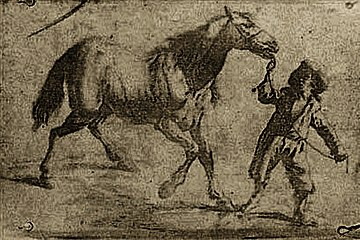
Earliest known surviving heliographic engraving, 1825, printed from a metal plate made by Joseph Nicéphore Niépce with his"heliographic process".[18] The plate was exposed under an ordinary engraving and copied it by photographic means. This was a step towards the first permanent photograph from nature taken with a camera obscura, in 1826.
Invented in the early decades of the 19th century, photography by means of the camera seemed able to capture more detail and information than traditional media, such as painting and sculpture.[19] Photography as a usable process dates to the 1820s with the discovery of chemical photography. The first medium was photographic plate.
The first permanent photoetching was an image produced in 1822 by the French inventor Nicéphore Niépce, but it was destroyed in a later attempt to make prints from it.[18]Niépce was successful again in 1825. In 1826 or 1827, he made the View from the Window at Le Gras, the earliest surviving photograph from nature (i.e., of the image of a real-world scene, as formed in a camera obscura by a lens).[20]
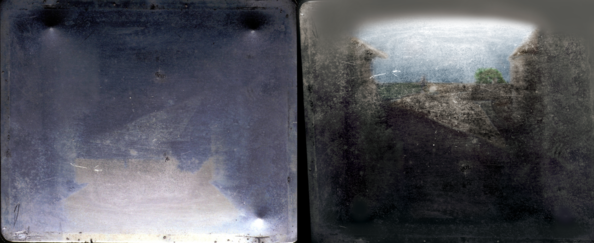
World's earliest surviving camera photograph, 1826 or 1827: View from the Window at Le Gras (Saint-Loup-de-Varennes, France)
Because Niépce's camera photographs required an extremely long exposure (at least eight hours and probably several days), he sought to greatly improve his bitumen process or replace it with one that was more practical. Working in partnership withLouis Daguerre, he discovered a somewhat more sensitive process that produced visually superior results, but it still required a few hours of exposure in the camera. Niépce died in 1833 and Daguerre then redirected the experiments toward the light-sensitive silver halides, which Niépce had abandoned many years earlier because of his inability to make the images he captured with them light-fast and permanent.
Daguerre's efforts culminated in what would later be named the daguerreotypeprocess, the essential elements of which were in place in 1837. The required exposure time was measured in minutes instead of hours. Daguerre took the earliest confirmed photograph of a person in 1838 while capturing a view of a Paris street: unlike the other pedestrian and horse-drawn traffic on the busy boulevard, which appears deserted, one man having his boots polished stood sufficiently still throughout the approximately ten-minute-long exposure to be visible. Eventually, France agreed to pay Daguerre a pension for his process in exchange for the right to present his invention to the world as the gift of France, which occurred on 19 August 1839.
...
http://en.wikipedia.org/wiki/Photography
Research Notes:
http://en.wikipedia.org/wiki/Digital_camera
CCD: The charge-coupled device was invented in 1969 at AT&T Bell Labs by Willard Boyle and George E. Smith.[1] The lab was working on semiconductor bubble memory when Boyle and Smith conceived of the design of what they termed, in their notebook, "Charge 'Bubble' Devices".[2] The device could be used as a shift register. The essence of the design was the ability to transfer charge along the surface of a semiconductor from one storage capacitor to the next. The concept was similar in principle to the bucket-brigade device (BBD), which was developed at Philips Research Labs during the late 1960s. The first patent (4,085,456) on the application of CCDs to imaging was assigned to Michael Tompsett.[3]