Trollope, Anthony
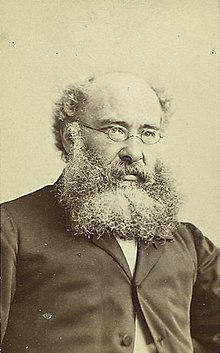
Trollope, Anthony.
ACHIEVEMENT(S): Major British novelist, who also introduced the red mailbox into Great Britain.
NICKNAME/ALIAS: None.
DATE/PLACE OF BIRTH: 24th April 1815, at London, England.
DATE/PLACE/AGE AT DEATH: 6th December 1882, London, England. Aged 67.
DISCIPLINE: Novelist.
FIELD: Literature.
LANGUAGE: English.
PARENTS: Thomas Anthony Trollope and Frances Milton (became well-known writer Frances Trollope).
SIBLINGS: Thomas Adolphus, Arthur, Henry, Emily and one other.
SPOUSE: Rose Heseltine, married in 1844.
CHILDREN: Henry and one other son.
EDUCATION: Harrow; Winchester.
MAJOR WORK: 'Barchester Chronicles', 1855-67.
LIFE AND TIMES:
In 1834, Trollope took a job as a junior clerk in the General Post Office, a miserable position which he endured until 1841. Meanwhile, old debts had caught up with Trollope's father, and his parents escaped to Bruges, where his father died. Thanks to the success of her first book, his mother lived for the next few years on the European mainland, publishing successful works, and becoming friends with the Robert Browning* and Elizabeth Barrett Browning*, Dickens* and Landor.
Trollope stayed behind in London until 1841, when he was transferred as a postal surveyor to Ireland. In 1844, he married Rose Heseltine, an Englishwoman with whom he had two sons, and set up house at Clonmel, in Tipperary. While working for the Post Office, he embarked on a literary career. This began with the publishing of 'The Macdermots of Ballycloran' in 1847 and continued with three other novels published during the last years of his time in Ireland, none of which made any real impact on the British public.
In 1851, Trollope was engaged on the reorganisation of postal arrangements in south Wales and south-west England including the Channel Islands and it was from the island of Guernsey that he wrote, in November 1851, suggesting the red iron mailboxes for letters, which soon became a familiar feature of the British streets. He sought promotion in the Post Office, trying to gain the Superintendency in 1852 and ultimately being appointed Surveyor in 1854. He also continued to write, and his time in south-west England inspired 'The Warden' (1855), the first of the ‘Barset Chronicles’ and which was his first novel of distinction.
During the 1850s Trollope continued to work for the Post Office and travelled a great deal. Transferred again to Ireland in 1853, after visiting his brother in Florence, Trollope moved first to Belfast and then to Donnybrook. He published 'Barchester Towers' In 1857 and 'Doctor Thorne' in 1858. In the same year, he was sent on a postal mission to Egypt and later to the West Indies, which resulted in the entertaining travel book 'The West Indies and the Spanish Main' (1859).
In 1859, Trollope moved back to London to supervise the Eastern postal district in England. Although he was enjoying his work, an animosity began to grow between Trollope and the secretary of the Post Office, Rowland Hill*. In 1861, he published 'Framley Parsonage', after which he was sent to the United States in 1862 and his account of his travels, entitled 'North America' was published later that year. During the 1860s Trollope was hugely successful and, from 1859, his association with the 'Cornhill Magazine' opened the doors to literary London and he became good friends with Thackeray*, who edited the new periodical.
Through Thackeray he met George Eliot*, whose work he admired and who said that her own novel, 'Middlemarch' owed much to Trollope. At their house he met the poets Browning and Tennyson*, the philosopher Spencer* and others prominent in the intellectual life of the time. He also stayed with the artist Millais*, at his house in the Scottish Highlands, through whom he met the writer Wilkie Collins*.
After having been passed over for an assistant-secretaryship, Trollope resigned from the Postal Service in 1867 and edited the 'St. Paul's Magazine' from 1867-70. During this time he stood, unsuccessfully, as a Liberal parliamentary candidate. Other works of the period were 'The Small House at Allington' (1864) and 'The Last Chronicle of Barset' (1867). Trollope then began his series of political novels that introduced the character of the Duke of Omnium, and wrote other novels including 'Sir Harry Hotspur of Humblethwaite' (1871), 'The Eustace Diamonds,' serialised between 1871 and 1873 and 'The Way We Live Now,' serialized between 1874 and 1875.
Meanwhile, Trollope travelled widely, visiting his son in Australia, returning to write his autobiography before leaving for a trip to South Africa. He returned to England, settling in the Sussex village of Harting in 1880. Here he spent his last years working on 'Kept in the Dark' (1882) and 'Mr. Scarborough's Family', but his popularity was waning. On a trip to London in 1882, he was struck with paralysis and he died there on 6th December and was buried a few days later at Kensal Green Cemetery.
ASSESSMENT: His popularity was not recognized until long after his death.
EXTRA CONNECTIONS:
Satirized Carlyle* in ‘The Warden.’
Met US writer Harte*
He was a friend of Bigelow
ONELINER; Anthony Trollope, major British novelist
BIBLIOGRAPHY:
Pollard, Arthur, Anthony Trollope, London: Routledge & Kegan Paul, 1978.
Wikipedia: https://en.wikipedia.org/wiki/Anthony_Trollope
10/16