Thackeray
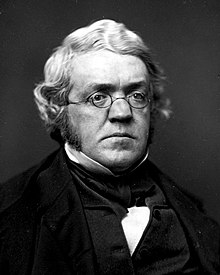
ACHIEVEMENT(S): “Vanity Fair”
DATE AND PLACE OF BIRTH: July 18, 1811, Calcutta, India
DATE/PLACE OF DEATH/AGE AT DEATH: December 24, 1863, London, England. Aged 52
DISCIPLINE: Novelist
FIELD: Literature
LANGUAGE: English
EDUCATION: Two preparatory boarding schools; Charterhouse School, London; Cambridge University
MAJOR WORK: "Vanity Fair", "The Luck of Barry Lyndon", "The History of Henry Esmond"
LIFE AND TIMES:
After the death of his father, who worked for the East India Company, he was sent to England (on the way seeing Napoleon in exile on St. Helena). At Cambridge in 1829, Thackeray’s tutor was Whewell* and future poet Tennyson* a fellow student. After university he traveled to Weimar, Germany, where he studied the German language and literature and mixed with the local society, including the aging Goethe*. Schiller* was his favorite German writer.
Back in Britain in 1833 Thackeray bought a newspaper, the "National Standard and Journal of Literature," then went to France to be its Paris reporter and to study painting. When the financial house in which he had invested most of his money collapsed, he was left with a severely-reduced income. With help from his stepfather he revived the London newspaper: the "Constitutional and Public Ledger", and again went to Paris to be its correspondent. But even with extra money from his stepfather, the paper folded.
In 1837, a dozen of Thackeray's anonymous literary reviews appeared in the "London Times". Even though he took exception to Carlyle*'s "French Revolution," he and Carlyle eventually became friends. Thackeray began writing for "Fraser's Magazine", in what was to become a long association.In his anonymous first piece, "The Yellowplush Correspondence," he wrote in the voice of a footman relating the way of life of his fashionable employers. Under the pen-name, "the Professor," he wrote a series of 12 stories, titled "The Tremendous Adventures of Major Gahagan", for the "New Monthly Magazine." In 1840 his wife was deeply depressed after the birth of their third child; he took her to Ireland when she tried to take her life by jumping overboard; she never recovered, leaving him effectively a widower, though she outlived him by thirty years and he never remarried.
Thackeray contributed to Punch, a "very low paper" in his eyes, but it paid well. In 1844 "The Luck of Barry Lyndon" began to appear in "Fraser's". In August of the same year, he accepted an offer by the Peninsular and Oriental Co. to sail to Cairo, all expenses paid. "Notes of a Journey from Cornhill to Grand Cairo" (1846) was a success with critics and the public. But the work that solidly established Thackeray's reputation was "The Snobs of England", which appeared anonymously in installments in Punch. The series followed the social calendar of England's upper crust, detailing the petty concerns of the clerical, scholastic, literary, political, military, country and club worlds. Thackeray's authorship was revealed only when publishers Bradbury and Evans were ready to bring out the author's masterwork: "Vanity Fair."
Thackeray began "Vanity Fair" on his return from Cairo in 1844, but put it aside for about two years. The title was taken from Bunyan's "Pilgrim's Progress" and was printed in 20 installments over 19 months, beginning in January, 1847. The last two installments came out together with title plates. Emily Bronte* was so taken with the novel, she dedicated the second edition of "Jane Eyre" to him. By the summer of 1848, Thackeray was regarded as one of England's leading novelists.
Thackeray's next novel was: "The History of Pendennis. His Fortunes and Misfortunes, His Friends and His Greatest Enemy", after which came one of several Christmas books, "Rebecca and Rowena" (1849).
Always worried about not having enough money, Thackeray accepted a speaking tour of Great Britain, lecturing on 18th-century British humorists. "The History of Henry Esmond", the only novel Thackeray did not write in serial form, came out in 1852, after which he set out on a highly-successful year-long lecture tour of the United States. On his return, he began: "The Newcomes. Memoirs of a Most Respectable Family," completed in 1855.
While on a trip to the Continent in the winter of 1853-54, Thackeray contracted malaria in Rome. It left his health permanently damaged. A final Christmas story, a highly popular fairy tale: "The Rose and the Ring," came out in 1854. In the autumn of 1855, he set off on another lecture series to North America, taking as his subject the lives and times of the first four Hanoverian kings. He began "The Virginians", another 24-part serial towards the end of 1857. In 1859, a new monthly, the "Cornhill Magazine" offered Thackeray an editorship. The first issue sold an amazing 120,000 copies, largely due to his success in persuading many of his literary connections to contribute. He ran his own fiction in the magazine, and promoted Trollope*'s: "Framley Parsonage".
In 1860, Thackeray's novel, "Lovel the Widower" ran in the "Cornhill" magazine. He went on another lecture tour, then in 1861 published his last completed novel: "The Adventures of Philip on His Way through the World."
Illness forced him to retire from the "Cornhill" in 1862. He loved food and could not bear to give up spicy peppers; he died of a stroke at 52.
ASSESSMENT: A witty observer of the middle- and upper-class social scene, his work reflected the trend to naturalism*
EXTRA CONNECTIONS: When the first illustrator for "Pickwick Papers" died, he applied to Dickens* for the job, but was turned down
His work related to that of Rowland Hill* and Burne-Jones*
He knew Oliphant*, and Swinburne*
Met poets Robert Browning* and his wife Elizabeth Barrett Browning*, Turgenev*, and De Vigny*
Member of “Portwiners” group, which included painter Landseer*.
Was friend of Millais*, andBigelow*
At Cambridge, knew mover and shaker Monckton Milnes*
Went to opening of conductor/composer Offenbach’s* London season in 1857
Stopped publication of essays by Ruskin*
He met Benjamin Richardson*
He contributed to Punch* magazine
He met Ellen Terry*
He was critical of Bulwer-Lytton*
He was a fan of the tragedian Macready*
Barry Lyndon, a film adaptation by Stanley Kubrick
ONELINER: William Makepeace Thackeray, major Victorian novelist
BIBLIOGRAPHY:
Monsarrat, Ann, An Uneasy Victorian: Thackeray the Man 1811-1863, Cassell; London, 1980.
PARENTS: Richmond Makepeace Thackeray; Anne Becher
SIBLINGS: None
SPOUSE: Isabella Gethin Shawe
CHILDREN: Anne Isabella Ritchie (novelist, critic); Jane (died in infancy); Harriet Marian