Eliot, George
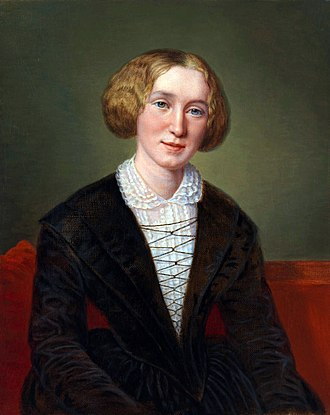
Nickname/Alias: born Mary Ann (later Marian) Evans
Achievements: English Victorian novelist who developed the method of psychological analysis, characteristic of modern fiction.
Born: November 22, 1819; Chilvers Coton, England
Died: December 22, 1880; London, England (Aged 61)
Field & Discipline: Literature; Writer
Language: English
Education: Mrs Wallington's Boarding School, Nuneaton, England; Misses
Franklins' Boarding School, Coventry, England
Major Works:
"Middlemarch"
"Silas Marner"
"Mill on the Floss"
"Adam Bede"
"Scenes of Clerical Life"
"Romola"
Life & Times:
In 1850 John Chapman, the publisher of Eliot’s translation from the German: "The Life of Jesus Critically Examined,” asked her to review a book, "The Progress of the Intellect,” for "The Westminster Review.” Eliot made up her mind to go to London and become a freelance writer. Now calling herself Marian, rather than Mary Ann, she took lodgings in 1851, at Chapman’s, a kind of literary hotel. A few months later, Chapman bought "The Westminster Review,” and for three years she served as sub-editor. At the Chapman’s parties, she met literary figures in an atmosphere of political and religious radicalism.
She became friends with [a pal of] Spencer*, sub-editor of "The Economist,” whose "Social Statics" had just been published by Chapman. Spencer was to introduce Eliot to her future lover, George Henry Lewes, and her future husband, John Walter Cross. George Henry Lewes was a Victorian journalist, whose unconventional life made him fascinating to some and repulsive to others. [knew] Meredith* called him "a mercurial little showman."
In 1850, Lewes met Eliot and they became inseparable companions. Aware that Lewes could not get a divorce, Eliot eventually agreed to live openly with Lewes as his wife. In 1854, after the publication of her translation of Ludwig Feuerbach's "Essence of Christianity,” the couple went to Germany, where for the first time Eliot identified herself as Lewes's wife.
Eliot and Lewes stayed in Germany for the best part of a year and met friends and relatives of the poet [husband wrote biography of] Goethe*, whose biography Lewes was writing. In Weimar, they also visited composer [visited] Liszt*. In this period, Eliot wrote some of her best essays for "The Westminster" and translated philosopher [translated] Spinoza's* "Ethics" (to this day still unpublished), while Lewes worked on his life of Goethe.
Back in England, Lewes encouraged Eliot to try her hand at fiction. She turned to early memories and wrote a story about a childhood episode in Chilvers Coton parish. In "Blackwood' s Magazine" in 1857 as "The Sad Fortunes of the Reverend Amos Barton," it was an instant success. Two more tales, "Mr. Gilfil' s Love-Story" and "Janet's Repentance," also based on local events, appeared serially and "Blackwood" republished all three in1858 as "Scenes of Clerical Life,” under the pseudonym, George Eliot. Eliot was not to keep her pen-name secret for long. She confessed in confidence to Herbert Spencer, and then told John Blackwood. She maintained the pseudonym, though it was generally known who George Eliot really was.
At 39 Eliot produced "Adam Bede,” which she described as "a country story.” It went through eight printings in one year, and established her as a leading novelist. "The Mill on the Floss,” in 1860, in which Eliot returns to scenes of her childhood, reinforced her literary reputation. "Silas Marner" (1861), became one of her best-known works. Before writing "Silas Marner,” Eliot became intrigued by the life of the radical Italian priest Savonarola and in 1860, during a trip to Florence, Lewes suggested she write a book about him, since historical novels were in vogue.
Eliot planned "Romola" as a serial, initially for Blackwood's, but then a better offer from "The Cornhill Magazine" induced her to desert her old publisher. "Romola" was published in 14 parts between July, 1862, and August,1863. It was not well received. Eliot and Lewes were now enjoying considerable wealth. In 1863, they bought The Priory on the Regent's Park Canal in London. The house was decorated and furnished by designer Owen Jones, and it became a social center on Sunday afternoons. Among the guests were: author [a pal of] Trollope*, novelist [a pal of] Wilkie Collins*, and famous writer [a pal of] Dickens*, who gave his last reading there in 1870, three months before his death.
Eliot's next two novels were set in England at the time, earlier in the nineteenth century, of agitation for passage of the Parliament Reform Bill. "Felix Holt, the Radical,” was published in 1866, and "Middlemarch" was published in eight parts over 1871-72. "Middlemarch" is widely considered Eliot's masterpiece. In "Daniel Deronda,” published in eight parts in 1876, Eliot came closest to the contemporary scene.
The death of Lewes from bowel cancer in 1878 devastated Eliot. For months, she saw no one but his son Charles Lee Lewes. She devoted herself to completing the last volume of his "Problems of Life and Mind" and founded the George Henry Lewes Studentship in Physiology at Cambridge. She began to depend more and more on John Walter Cross, a banker who had been handling her investments and who had been introduced to her by Herbert Spencer. Cross's mother had died a week after Lewes and the two found solace in each other. In May, 1880, they were married. Cross was 40; she was 60. Seven months later, in December, Eliot died of a kidney infection.
Extra Connections:
She admired [ a fan of] Elizabeth Barret Browning*
She knew [knew] Burne-Jones*, [knew] Carlyle* and [knew] G&A Combe*
[ a fan was] Emma Lazarus* dedicated a play to her
She was associated with [associated with] naturalism*
She admired [admired] Cardinal Newman*
Her magazine criticized [published criticism of] Schopenhauer*
She saw [saw performance by] Henry Irving* perform.
When the American Civil War broke out in 1861, Eliot expressed sympathy for the Union cause, something which historians have attributed to her abolitionist sympathies.
Assessment: Eliot embodied many of the things Victorians admired: her rise to intellectual eminence, her role as a translator of German theology, her achievement as a new kind of novelist, and her faith in human beings and in the ultimate progress of the species.
Oneliner: George Eliot (Mary Ann Evans), major Victorian novelist
Bibliography:
- Encyclopedia Britannica.
- Oxford Companion to English Literature.
- Purkis, John, A Preface to George Eliot, London & New York: Longman, 1985.
Father: Robert Evans
Mother: Christiana Pearson
Siblings: Christiana; Isaac
Spouse: John Walter Cross
Children: None