Trevithick
ACHIEVEMENTS: The first steam railway locomotive
DATE AND PLACE OF BIRTH: 13 April 1771, Illogan, Cornwall, England.
DATE AND PLACE OF DEATH AND AGE AT DEATH: 22 April 1833, Dartford, Kent, England. Aged 62.
DISCIPLINE: Engineer
FIELD: Engineering
LANGUAGE: English
EDUCATION: Village school, Illogan
MAJOR WORK: None
LIFE AND TIMES:
At the age of nineteen Trevithick was employed as an engineer to several mines. The tin, copper and lead found in Cornwall were in great demand deeper mining meant problems with drainage. The engines used for pumps ran on coal and as there was no local coal in Cornwall they had to import it. The cost of imports was high so mine owners were anxious to keep fuel costs down. This meant improving the efficiency of the steam engines used in the mines for pumping and hoisting.
One of the ways of doing this would be to use high-pressure steam but Watt*, whose low-pressure steam engines had been used in Cornwall since 1777, believed that the use of high-pressure steam was dangerous. Trevithick disagreed and he had plenty of support in his attempt to build alternative engines because most Cornishmen resented the Watt monopoly and for years they had been by-passing Murdock*, the agent who installed Watt engines in the county.
Trevithick designed and constructed a new type of water-pressure engine for pumping which had more than double the power of the Watt steam engine but it was not always suitable for mines because it depended on a nearby source of water.
However, its success encouraged Trevithick to experiment and in 1797 he designed a model high-pressure steam engine. It worked and he then built a full-scale high-pressure steam engine for winding ore which was installed in a mine. The higher pressure made all the difference and Trevithick installed thirty similar engines in Cornwall.
However, pumping apparatus could remain in one site, but smaller engines used for hoisting needed to be moved from one working shaft to another. This led Trevithick to get rid of the condenser and design an engine driven solely by the power of high-pressure steam which was expelled into the atmosphere when it had released its energy in the cylinder.
These engines became known as ‘puffer whims’ because they blew their steam out into the open air. They were very neat and could be carried on an ordinary farm wagon to the mines. For the first time, mechanical power was available in a portable and fairly compact form. It was twice as economic as the Watt type of engine and rapidly replaced it. In 1800 the Watt patent at last expired in Cornwall.
Trevithick was now thinking about a locomotive engine. Murdoch had experimented with this idea in 1784 but had been discouraged by Watt. On Christmas Eve 1801, Trevithick completed the construction of a steam carriage, using wrought iron plates and forgings from Darby’s* ironworks at Coalbrookdale in Shropshire.
He was determined to try it out there and then ,and in the cold, dark, rainy evening, lit the boiler and successfully drove his steam carriage on the road up a hill outside his smithy. The locals called it the ‘puffing devil.’
In 1804 he built the first steam locomotive* in the world for an ironworks in south Wales. It hauled a load of ten tons of iron and seventy men along ten miles of tramway and the water did not need replenishing.
Trevithick built another locomotive engine in the north-east in 1805 to transport coal from the colliery to the river but the colliery owner refused to accept it because it was too heavy and would have smashed his wooden wagon-way. On visits to Tyneside Trevithick met local engineers including George Stephenson*.
In 1805 he adapted his high-pressure engine for driving an iron-rolling mill and operating a barge with the aid of paddle wheels. Trevithick engines were also used to drive the first steam dredgers in 1806 and to drive an agricultural threshing machine. In 1814 one of his engines was ordered for a Peruvian silver mine.
Again, Trevithick hoped to make his fortune but transportation difficulties in Sout America and the slowness of communication were holding up the project. He decided to go to South America himself, and set sail in October 1816. He spent the next ten years wandering about, prospecting for minerals, supervising mining operations, and indulging in a successful salvage operation, the profits of which he lost in an abortive pearl-fishing scheme. He was found in Cartagena, penniless, by Robert Stephenson* who paid for his return fare to England.
In 1827 he returned to England to find that George Stephenson’s locomotives were being used to haul coal in the north-east and that the construction of the first steam passenger railway had begun.
In 1828 Trevithick visited Holland and on his return wrote a report outlining a scheme for reclaiming the Zuyder Zee, on the strength of which a company was formed in London and Trevithick was commissioned to design drainage machinery. The trials went well but the directors of the company fell out and the project was abandoned.
He continued to think up schemes, and in 1832 undertook some experimental work for John Hall* who later became famous for his firm’s marine steam engines. While staying in Kent near Hall’s firm, Trevithick became ill and died.
ASSESSMENT: He built the world’s first steam railway locomotive
EXTRA CONNECTIONS:
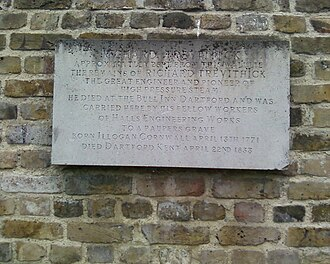
J & E Hall is strongly associated with the late career (and death) of steam engine pioneer Richard Trevithick. In 1832, he was invited by John Hall to work on a steam engine at Dartford, and lodged at The Bull (today The Royal Victoria and Bull Hotel) in Dartford. In early 1833, Trevithick was taken ill with pneumonia and died at the Bull pub on the morning of 22 April 1833. Colleagues at Hall's works made a collection for his funeral expenses, acted as bearers, and paid a night watchman to guard his grave at night to deter grave robbers.
ONELINER: Richard Trevithick, who built the first locomotve
BIBLIOGRAPHY:
Burton, Anthony, Richard Trevithick, Giant of Steam, Aurum Press, London, 2000
Rolt, LTC, The Cornish Giant, Lutterworth Press, London, 1960
PARENTS:
Father: Richard Trevithic
Mother: Anne Teague
SIBLINGS: 4 sisters
SPOUSE: Jane Harvey
CHILDREN: 6