Roebling, JA
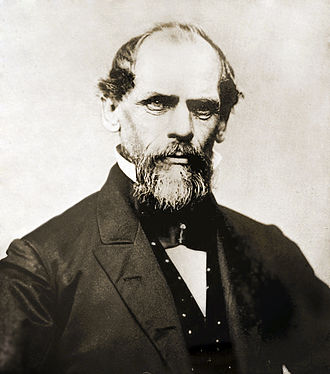
Nickname/Alias: born: Johann August Röbling
Achievements: Brooklyn Bridge
Born: June 12, 1806; Muhlhausen, Germany
Died: July 22. 1869; Brooklyn Heights, NY (Aged 63)
Field & Discipline: Engineering; Engineer
Language: German; English
Father: Christoph Polycarpus Roebling
Mother: Friedrike Dorothea
Siblings: 2 brothers; 1 sister
Spouse: Johanna Herring
Children: 9
Education: High School, Muhlhausen; Royal Polytechnic Institute, Berlin
Life & Times:
Roebling, the son of a tobacco merchant and shop keeper, studied construction work, particularly bridge and dike building, at the technical school in Berlin. He also took a course in modern languages at Berlin University where he attended the lectures of the philosopher [taught by] Hegel* whom he revered.
He obtained a government job in construction after graduating. He had made a special trip to see a recent chain-held suspension bridge over the river Regnitz in Bamberg and he was anxious to try out new technology. He moved among a crowd of young liberals and was also dismayed by the need for political reform in Germany.
In 1831, at the age of twenty-five, persuaded by Hegel, he and his brother Karl emigrated to America and settled with other German immigrants to form a colony at Germania, later named Saxonburg, about twenty miles from Pittsburgh. Roebling married the daughter of another immigrant and remained in the colony, building roads, digging wells and designing and erecting houses.
In 1837 he went to Harrisburg and applied for a state government job as an engineer. He was accepted and began work building dams and locks on the Sandy and Beaver canal. In the same year, he became a naturalized US citizen.
While making surveys over mountains, he introduced a major technical advance. It was impracticable to lift canal boats to the heights necessary to cross mountains by locks, so at that time, transport over the Allegheny mountains involved constructing tracks on which canal boats (emptied of their passengers) were placed on railroad cars and hauled to the top of the mountain.
They were hauled up by hemp cables worked by a stationary engine. Engines were installed at the top of every inclined plane and the cars were pulled up by a huge number of ropes. The English novelist [work related to] Dickens* recorded a journey over the Allegheny mountains made in this way.
Roebling had read in a foreign scientific journal that a German wire-worker had twisted a number of wires together in one strand to produce a wire rope of great strength and flexibility, and after much badgering, he persuaded the State Board of Public Works to allow him to experiment with this idea. He developed a method for stranding and weaving wire cables, and designed the machinery to make them.
The first wire rope was made in 1841 in a workshop in a meadow behind Roebling’s farm. After being successfully used for the portage over the mountains, wire cables were soon demanded for the rigging of vessels, for ferries, tow-lines and dredges.
Roebling was keen to develop the business of making wire ropes commercially and he wrote to [turned down by] Washburn & Co*, the leading makes of wire in America, about possible co-operation in manufacturing wire rope. They declined to enter what they saw as a risky business, so Roebling set up a small wire rope factory at Saxonburg which eventually grew into a vast industrial complex in New Jersey.
Roebling was meanwhile continuing his work for the State. In 1844 he constructed the first wire cable suspension aqueduct across the Allegheny River and in 1846 he built his first suspension bridge, the Monongahela, at Pittsburgh.
Roebling was now in demand as a designer and constructor and in 1848 constructed four suspension aqueducts on the Delaware and Hudson canal. In that year he moved his wire cable factory to Trenton, New Jersey.
In 1850 he was appointed chief engineer of a project to improve and enlarge Niagara Falls suspension bridge so that it could take railroad cars. The bridge at Niagara would be the first such bridge capable of bearing the weight of a moving locomotive and train. Roebling was convinced this could be done and despite being warned that it was not possible by the English railroad engineer [disregarded advice from] Robert Stephenson*, he persisted with his ambition and successfully completed the bridge.
In 1850, he wrote a letter to the “Journal of Commerce” in which he stated his belief in the feasibility of a transatlantic cable. He also detailed a method for conducting and laying the cable, thus anticipating the work of [anticipated work of] Field* which did not begin until 1854.
In 1859 Roebling erected another suspension bridge at Pittsburgh, working with his son Washington A. Roebling who had just graduated. During the Civil War, Roebling, an ardent abolitionist, set up a public subscription to equip State troops and encouraged his son to join the military.
After the war ended, he completed his suspension bridge across the Ohio river between Cincinnati, OH and Covington, KY which had a span of 1,051 feet (320 metres) and was at that time the longest wire-cable suspension bridge in the world.
In 1867 the New York Bridge Company was given authority to build a bridge over the East River between the cities of New York and Brooklyn. Roebling was appointed chief engineer. His fame was now at its height and he was acknowledged as the foremost expert of wire-cable suspension bridges in America and probably in the world. He designed a bridge with a span of 1,595 feet (468 m) and his plans were accepted in the spring of 1869.
The preliminary surveys had been made and the work was just about to begin when Roebling suffered a fatal accident on June 28. He was taking observations on the waterfront at Brooklyn when his foot was caught between a boat and the piles running along the river front. A number of his toes were severed and Roebling was taken to his son’s house near the site of the projected bridge. Tetanus set in and Roebling became seriously ill. The day before he died, he designed an apparatus for lifting himself up in bed. After his death, his son completed the bridge with which Roebling’s name is associated.
Assessment: Roebling was the foremost pioneer of his time in the design of steel suspension bridges.
Extra Connections:
Lindberg planes used cables for controls; OPEC oil embargo put plant out of business.
His grandson Washington A. Roebling II died as a passenger on the RMS *Titanic*
His company provided cable for the Golden Gate Bridge.
Oneliner: John Roebling, builder of the Brooklyn Bridge
Bibliography:
- Steinman, D. B., The Builders of the the Bridge, The Story of John Roebling and His Son, Harcourt, Brace and Company, New York, 1950.
- Schuyler, Hamilton, The Roeblings, A Century of Engineers, Bridge-builders and Industrialists, Princeton University Press, Princeton, 1931.
- Zink , Clifford The Roebling Legacy (video)
Multimedia
Connections II #8 Separate Ways