Froebel, FWA
Froebel, Friedrich Wilhelm August
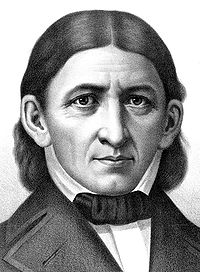
ACHIEVEMENTS:
Introduced the concept of the kindergarten school for small children.
DATE AND PLACE OF BIRTH:
21 April 1782, Oberweissbach, Thuringia, Germany
DATE AND PLACE OF DEATH AND AGE AT DEATH:
21 June 1852, Marienthal, near Bad Leibenstein, Thuringia, Germany. Aged 70
DISCIPLINE: Educationalist
FIELD: Education
LANGUAGE: German
EDUCATION:
Village school, Oberweissbach
Grammar school, Stadt Ilm
MAJOR WORK:
(1826) "The Education of Man")
LIFE AND TIMES:
Froebel was the youngest of five children. His mother died when he was an infant and his father, a strict Lutheran pastor, married again and had another son. Froebel was a lonely child who did not do well at the village school although he was passionately fond of nature and had a good knowledge of wildlife around his home in the Thuringian forest. At the age of eleven Froebel was rescued from his rather unhappy life by his maternal uncle, an Archdeacon from the nearby town of Stadt Ilm.
The Archdeacon, a childless widower, took Froebel to live with him and his elderly mother-in-law. After a few years attending grammar school in Stadt Ilm, Froebel had to return to his father's house. Unwilling to pay for the university education Froebel wanted, his father apprenticed him to a forester. After two years he was sent to Jena, where his father hoped he would get a forestry job. Instead, Froebel lodged with one of his brothers, who was a student at the university. He was able to study botanical science in the library and attend some lectures but after being imprisoned for debt he had to leave Jena and took a number of odd jobs before becoming a teacher at a progressive school in Frankfurt in 1805.
The school was run according to the methods of the Swiss educationalist, Pestalozzi* and Froebel was sent to Yverdon in Switzerland to study Pestalozzi's methods at first hand. He was impressed by Pestalozzi's modern ideas about making education more accessible and relevant and in the two years he spent at the Frankfurt school Froebel developed his own methods, in which he concentrated on encouraging the active participation of his pupils.
In 1809-10 he accompanied some private pupils on a long stay at Yverdon where he told Pestalozzi of his plans to introduce a new system of teaching. In 1811 he joined the University of Gottingen but his studies were interrupted by the rise of national feeling against Napoleon in Germany. In 1813 Froebel joined an infantry division and saw active service (which he intensely disliked).
In 1816, after the end of the Napoleonic wars, Froebel opened his own school at Griesheim in Thuringia. In 1818 he moved the school to Keilhau, Thuringia where he formed a small community with likeminded friends and their families and began to put his own educational theories into practice.
His method of education aimed at developing each child's individual creativity. Froebel was something of a nature mystic and was influenced by the German idealist philosopher, Fichte* and by the French writer Rousseau*. In 1826 he set out his educational theory and wrote about his experiences at Keilhau in his most important work, "The Education of Man." At the time it was either ignored or was given very unfavourable reviews.
However, Froebel's ideas spread and in 1831 the Swiss government invited him to Switzerland to train elementary school teachers in his methods. His work there was well received and he was invited to run a new orphans' asylum at Burgdorf, Switzerland. This experience convinced Froebel of the importance of education in the early years of childhood. He saw infant education as the crucial first step in the education process, which, followed by progressive secondary education, would eventually lead to social reform.
When he returned to Keilhau in 1837 Froebel opened an infant school in Bad Blankenburg, Prussia. It was originally called the Child Nurture and Activity Institute and later named the kindergarten* (literally, the "children’s gardens"). Teachers were trained to use play activities, songs and music to release the children's creativity.
He set up a company to produce the play-and-educational materials he developed, and published a collection of "Mother-Play and Nursery Songs" for mothers of small children. The songbook was a huge success and translated into many foreign languages. Kindergartens became the accepted for children of four to six years old but in 1851 they were banned by the Prussian government because of the association with one of Froebel's nephews, who had socialist views.
One of his disciples, the Baroness von Marenholtz Bulow, travelled to England and through Europe to publicize Froebel's ideas.
In 1854, after his death, the first kindergarten opened in England, followed by others in Ireland, Russia, Canada and Italy, and later in the United States where Froebel's ideas were adopted by the educationalist John Dewey*.
ASSESSMENT: Froebel introduced kindergartens, education for small children, to the educational system. His philosophy of allowing children's natural creativity to develop through directed play activity has been adopted all over the world.
EXTRA CONNECTIONS: Ford Madox Ford* attended a Froebel school.
Inspired Frank Lloyd Wright, whose son made Lincoln Logs construction set toy.
ONELINER: Friedrich Froebel, developer of the kindergarten
BIBLIOGRAPHY:
Denny, Barbara, The Paymaster of Blankenburg, the story of Friedrich Froebel the founder of the kindergarten,Autolycus Publications, London, 1982
https://en.wikipedia.org/wiki/Froebel_gifts
PARENTS:
Father:
Mother:
SIBLINGS:
4 brothers: Christoph, Christian, August, Traugott
SPOUSE:
- Henrietta Hoffmeister
- Luise Levin
CHILDREN:
None