Siemens, Werner
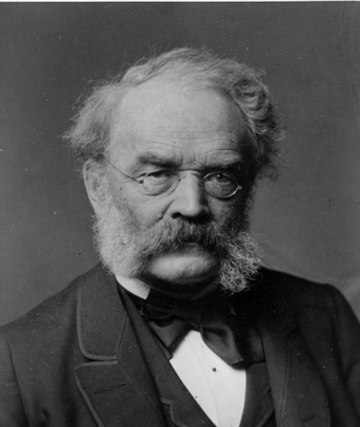
ACHIEVEMENTS: Improvements to electrical telegraphy and early pioneering in the use of gutta-percha for cables.
NICKNAME/ALIAS: None.
DATE AND PLACE OF BIRTH: 13thDecember 1816, Lenthe, Prussia (Germany).
DATE/PLACE OF DEATH/AGE AT DEATH: 6thDecember 1892, Charlottenburg, Berlin, Germany. Aged 76.
DISCIPLINE: Electrical engineer. FIELD: Engineering.
PARENTS: Father, Christian Ferdinand Siemens, mother, Eleanore Deichmann.
SIBLINGS: 10 brothers (Carl) and 3 sisters.
SPOUSE: Matilda Drumann Antonie Siemens.
CHILDREN: 3 sons and 3 daughters.
EDUCATION: High school, Lubeck.
MAJOR WORK: Scientific presentations.
LIFE AND TIMES:
Siemens joined the Prussian Artillery at the age of seventeen as a trainee engineer, and studied for three years at the Military School in Berlin. In 1838, while he was stationed in Magdeburg, he carried out experiments privately. One of these was influenced by work he and his brother, William von Siemens*, had done some time previously in Gottingen. While producing pictures using Daguerre*’s method, Siemens had noticed that hyposulphite of soda had dissolved salts of gold and silver, previously thought insoluble. He experimented with various solutions for electrolysis and found that he could gold-plate a silver spoon within minutes by using a solution of hyposulphite of gold. Siemens immediately contacted a jeweller in Magdeburg who bought his process, enabling Siemens to fund further experiments.
The army moved him to the technical division of the Artillery at Spandau, where he was given charge of a huge pyrotechnic display, staged on Havel Lake in the Glienicke estate near Potsdam to celebrate the birthday of the Russian Empress. Siemens was then transferred to the ordnance department in Berlin, where, in partnership with a silver manufacturer, he set up the first electro-plating factory in Germany, using his process for gilding and plating.
The army was thinking about modernising the semaphore forms of communication they were using, and Siemens began to study wireless telegraphy.
At the house of a friend, he had seen a model of Wheatstone’s* electric telegraph, but had been unable to make it work. He realised that part of the problem was that there were too many fluctuations in the current, and tried to find a solution, using old cigar boxes, tin-plate and insulated copper wire. One of the stumbling blocks he came across was finding the right material for insulation.
Russian scientists had experimented with resin, glass and India-rubber, but none was ideal. By pure coincidence, William had come across a product called gutta-percha* in Britain and had recently sent him a sample. Siemens told the army about his work and, in 1847, was ordered to take charge of the installation of an underground line for military use. He tried using gutta-percha and found it was very effective. The following year, Siemens was given the job of laying a telegraph line from Berlin to Frankfurt, where the National Assembly sat. At the same time, Siemens thought of the novel idea of laying mines under the sea and exploding them with an electrical impulse sent down his gutta-percha-covered lines.
Siemens resigned from the army in 1849 and set up in full-time business. Among his early projects, he was commissioned to install telegraph lines for the railway in Germany and Russia. In 1850, Siemens presented his work: "Memoir on the Electric Telegraph", to the Paris Academy of Sciences. In 1852, Siemens went to Russia for the first time and the following year, laid the first submarine telegraphy line in the world, running from Oranienbaum to Kronstadt. When the Crimean War broke out in 1854, Siemens was given the job of constructing an overhead line from Warsaw to St Petersburg. Russia was connected to Berlin and Western Europe.
By now, industrialists were recognising the value of the wireless telegraph and, in 1857, Siemens went to Genoa to take part in a combined operation with the British and French to lay a deep-sea cable to Sardinia. As well as other commissions in the Mediterranean, he was involved in laying a cable under the Red Sea and the Indian Ocean, which ran from Suez, Egypt to Karachi, India. In 1864 Siemens was made Parliamentary Deputy for the district of Solingen-Remscheid and for three years was politically active, after which he decided not to stand for re-election. In 1865, he travelled via Budapest, Constantinople and on to Trebizond to the Caucasus, to inspect a copper mine.
The company had already opened a Russian branch at Tiflis, to carry out work on the Indo-European telegraph and Siemens’s brother Walter, who ran the Tiflis branch, had proposed that they buy the mine. The war had given the company impetus in developing new products, such as magneto-electric mine-exploders, electric range finders, and electric remote controls used to steer boats in mined waters. Business boomed and Siemens opened new branches, among them Vienna, Paris and St Petersburg.
In 1866, Siemens invented a self-excited generator using a powerful electromagnet with enough residual magnetism to start the dynamo in the generator.
ASSESSMENT: Werner von Siemens played a significant part in the industrial development of electric telegraphy, in pioneering the use of gutta-percha for insulating telegraphic cables and in the practical application of theory.
EXTRA CONNECTIONS: Was a friend of Helmholtz*
Validated Fritts’* photovoltaics
He employed Tykociner*
Influenced by JFW Herschel*
ONELINER: Werner Siemens, who laid first submarine telegraph cable
BIBLIOGRAPHY:
Siemens, Werner von, Personal Recollections, Asher & Co., London, 1893.
Encyclopaedia Britannica.
Busse, Kurt, Werner von Siemens, 1966.