Elevator
An elevator (US and Canada) or lift (UK and Ireland) is a type of vertical transportation device that moves people or goods between floors (levels, decks) of a building, vessel, or other structure. Elevators are typically powered by electric motors that drive traction cables and counterweight systems like a hoist, although some pump hydraulic fluid to raise a cylindrical piston like a jack.
In agriculture and manufacturing, an elevator is any type of conveyor device used to lift materials in a continuous stream into bins or silos. Several types exist, such as the chain and bucket elevator, grain auger screw conveyor using the principle of Archimedes' screw, or the chain and paddles or forks of hay elevators. Languages other than English may have loanwords based on either elevator or lift. Because of wheelchair access laws, elevators are often a legal requirement in new multistory buildings, especially where wheelchair ramps would be impractical.
There are also some elevators which can go sideways in addition to the usual up-and-down motion.[1]
Contents
- 1History
- 2Design
- 3Types of hoist mechanisms
- 4Controlling elevators
- 5Special operating modes
- 6Modernization
- 7Safety
- 8Uses
- 8.1Passenger service
- 8.2Freight elevators
- 8.3Sidewalk elevators
- 8.4Stage lifts
- 8.5Vehicle elevators
- 8.6Boat lift
- 8.7Aircraft elevators
- 8.8Limited use and limited application
- 8.9Residential elevator
- 8.10Dumbwaiter
- 8.11Paternoster
- 8.12Scissor lift
- 8.13Rack-and-pinion elevator
- 8.14Material handling belts and belt elevators
- 9Social impact
- 10Convenience features
- 11ISO 22559
- 12Unique installations
- 13IOT elevators
- 14World's fastest elevators
- 15See also
- 16References
- 17Further reading
- 18External links
History
Pre-industrial era[edit]
[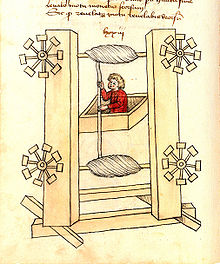 ](https://en.wikipedia.org/wiki/File:Konrad_Kyeser,_Bellifortis,_Clm_30150,_Tafel_09,_Blatt_38v_%28Ausschnitt%29.jpg)
Elevator design by the German engineer Konrad Kyeser (1405)
The earliest known reference to an elevator is in the works of the Roman architect Vitruvius, who reported that Archimedes (c. 287 BC – c. 212 BC) built his first elevator probably in 236 BC.[2] Some sources from later historical periods mention elevators as cabs on a hemp rope powered by hand or by animals.
In 1000, the Book of Secrets by al-Muradi in Islamic Spain described the use of an elevator-like lifting device, in order to raise a large battering ram to destroy a fortress.[3] In the 17th century the prototypes of elevators were located in the palace buildings of England and France. Louis XV of France had a so-called 'flying chair' built for one of his mistresses at the Chateau de Versailles in 1743.[4]
Ancient and medieval elevators used drive systems based on hoists or windlasses. The invention of a system based on the screw drive was perhaps the most important step in elevator technology since ancient times, leading to the creation of modern passenger elevators. The first screw drive elevator was built by Ivan Kulibin and installed in the Winter Palace in 1793. Several years later another of Kulibin's elevators was installed in the Arkhangelskoye near Moscow.
Industrial era[edit]
The development of elevators was led by the need for movement of raw materials including coal and lumber from hillsides. The technology developed by these industries and the introduction of steel beam construction worked together to provide the passenger and freight elevators in use today.
Starting in the coal mines, by the mid-19th century elevators were operated with steam power and were used for moving goods in bulk in mines and factories. These steam driven devices were soon being applied to a diverse set of purposes—in 1823, two architects working in London, Burton and Hormer, built and operated a novel tourist attraction, which they called the "ascending room". It elevated paying customers to a considerable height in the center of London, allowing them a magnificent panoramic view of downtown.[5]
Early, crude steam-driven elevators were refined in the ensuing decade; in 1835, an innovative elevator called the "Teagle" was developed by the company Frost and Stutt in England. The elevator was belt-driven and used a counterweight for extra power.[6]
The hydraulic crane was invented by Sir William Armstrong in 1846, primarily for use at the Tyneside docks for loading cargo. These quickly supplanted the earlier steam driven elevators: exploiting Pascal's law, they provided a much greater force. A water pump supplied a variable level of water pressure to a plunger encased inside a vertical cylinder, allowing the level of the platform (carrying a heavy load) to be raised and lowered. Counterweights and balances were also used to increase the lifting power of the apparatus.
Henry Waterman of New York is credited with inventing the "standing rope control" for an elevator in 1850.[7]
In 1845, the Neapolitan architect Gaetano Genovese installed in the Royal Palace of Caserta the "Flying Chair", an elevator ahead of its time, covered with chestnut wood outside and with maple wood inside. It included a light, two benches and a hand operated signal, and could be activated from the outside, without any effort on the part of the occupants. Traction was controlled by a motor mechanic utilizing a system of toothed wheels. A safety system was designed to take effect if the cords broke. It consisted of a beam pushed outwards by a steel spring.

Elisha Otis demonstrating his safety system, Crystal Palace, 1854
In 1852, Elisha Otis introduced the safety elevator, which prevented the fall of the cab if the cable broke. He demonstrated it at the New York exposition in the Crystal Palace in a dramatic, death-defying presentation in 1854,[7][8] and the first such passenger elevator was installed at 488 Broadway in New York City on 23 March 1857.

Elisha Otis's elevator patent drawing, 15 January 1861
The first elevator shaft preceded the first elevator by four years. Construction for Peter Cooper's Cooper Union Foundation building in New York began in 1853. An elevator shaft was included in the design, because Cooper was confident that a safe passenger elevator would soon be invented.[9] The shaft was cylindrical because Cooper thought it was the most efficient design.[10] Later, Otis designed a special elevator for the building.
The Equitable Life Building completed in 1870 in New York City was thought to be the first office building to have passenger elevators.[11] However Peter Ellis, an English architect, installed the first elevators that could be described as paternoster elevators in Oriel Chambers in Liverpool in 1868.[12]
The first electric elevator was built by Werner von Siemens in 1880 in Germany.[13] The inventor Anton Freissler developed the ideas of von Siemens and built up a successful enterprise in Austria-Hungary. The safety and speed of electric elevators were significantly enhanced by Frank Sprague who added floor control, automatic elevators, acceleration control of cars, and safeties. His elevator ran faster and with larger loads than hydraulic or steam elevators, and 584 electric elevators were installed before Sprague sold his company to the Otis Elevator Company in 1895. Sprague also developed the idea and technology for multiple elevators in a single shaft.
In 1882, when hydraulic power was a well established technology, a company later named the London Hydraulic Power Company was formed by Edward B. Ellington and others. It constructed a network of high-pressure mains on both sides of the Thames which, ultimately, extended to 184 miles and powered some 8,000 machines, predominantly elevators and cranes.[14]
Schuyler Wheeler patented his electric elevator design in 1883.[15][16][17]
In 1874, J. W. Meaker patented a method which permitted elevator doors to open and close safely.[18] In 1887, American Inventor Alexander Miles of Duluth, Minnesota patented an elevator with automatic doors that would close off the elevator shaft.
The first elevator in India was installed at the Raj Bhavan in Calcutta (now Kolkata) by Otis in 1892.[19]
By 1900, completely automated elevators were available, but passengers were reluctant to use them. A 1945, elevator operator strike in New York City, and adoption of an emergency stop button, emergency telephone, and a soothing explanatory automated voice aided adoption.[20]
In 2000, the first vacuum elevator was offered commercially in Argentina.[21]
...