Helmholtz
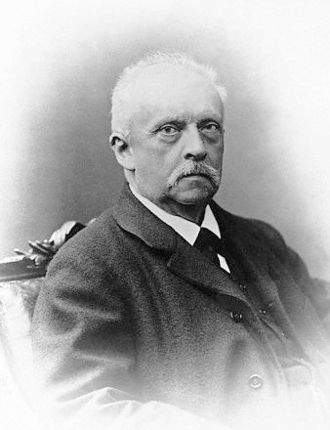
Name: Hermann von Helmholtz
Achievements: Conservation of Energy law
Born: August 31, 1821; Potsdam, Germany
Died: September 8, 1894; Berlin, Germany (Aged 73)
Field & Discipline: Science; Physiology; Physics; Mathematics
Language: German
Father: August Helmholtz
Mother: Caroline Penne
Siblings: 1 brother; 2 sisters
Spouse: 1) Olga von Velten; 2) Anna von Mohl
Children: 5
Education: Normal school, Potsdam; Potsdam High School; Friedrich Wilhelm Medical Institute, Berlin
Major Work:
"On the Conservation of Force" (1847)
"Handbook of Physiological Optics" (1856-67)
"On the Sensation of Tone As a Psychological Basis for the Theory of Music" (1863)
"Popular Lectures on Scientific Subjects" (1873-81)
Life & Times:
At Berlin Helmholtz was taught by the great physiologist [taught by] Johannes Muller*. When he graduated in medicine in 1843 he was sent on military duties to Potsdam. He set up his own laboratory in his barracks and was frequently visited by his former student friends, the physiologists [a pal of] Du Bois-Reymond* and [a pal of] Brucke*.
All three young scientists were opposed to the theory of vitalism (which held that a mysterious vital fluid was the fundamental explanation for the processes of nature) and instead held that all life processes could be explained by each organism's physiology. Helmholtz's proficiency in mathematics and physics set him apart from other physiologists.
For his doctoral thesis, he investigated the connection between nerve fibres and nerve cells. During his research he did electro-physiological experiments on live frogs and studied the origin of body heat and energy.
He demonstrated that chemical changes occur in the working muscle and that heat is generated by muscle contraction, disproving the idea that heat is produced from reaction between chemical elements in the body, and said that all heat was subject to mechanical forces, and that all forces could be reduced ultimately to matter and motion.
He published his theory in his paper "On the Conservation of Force" (1847) which included on of the first mathematical formulations of the principle of the conservation of energy.
In 1849 he became assistant professor of physiology at Konigsberg. In 1850, during experiments on the frog sciatic nerve, he became the first to measure the speed of nervous impulses with the myograph he invented for the purpose.
Helmholtz then began his work on physiological optics. He developed ideas put forward by earlier physiologists like [developed ideas of] Thomas Young* in England and the Czech physiologist [developed ideas of] Purkinje*. He was also influenced by the work of the psychologist [influenced by] Fechner* and his colleague [influenced by] WE Weber* who introduced the idea that mental processes and unconscious judgements are involved in the optical system.
In 1851, during the course of his optical research, Helmholtz invented the opthalmoscope and the opthalmometer. Among other discoveries, he found that light which falls directly on the optic nerve does not produce any sensation and has to fall on a nerve ending in the retina before it can be seen. He also began research into the sensory aspects of the acoustic process.
In 1855 Helmholtz moved to Bonn as professor of anatomy and physiology. In 1856 he published the first volume of his book on the physiology of optics. In 1858 he wrote another mathematical paper, this time on the hydrodynamics of vortex motion. Although his conclusions did not result in an answer to the problem of the fundamental structure of
matter, his paper later formed the basis of William Thomson's ([influenced] Lord Kelvin*) theory of the vortex atom.
In 1858 Helmholtz moved to Heidelberg University, where he remained for the next thirteen years and presided over a specially built physiology institute. [work related to] Wilhelm Wundt's* first psychological papers (1862) had made Fechner's ideas central to the debate on sensation and Helmholtz continued his work in this area.
In 1863 he published "On the Sensation of Tone As a Psychological Basis for the Theory of Music" in which he attempted to link the transmission of sound through the sensory nerves and the structures of the ear to receptors in the brain. The book laid the foundations of the modern science of acoustics.
Among the pupils who were influenced by Helmholtz's idea of psychological input in perception was the American psychiatrist [influenced] William James* who studied under Helmholtz at Heidelburg.
The debate about psychological input into sensation led Helmholtz to reject [rejected ideas of] Kant's* argument that Euclidean geometry dictates perception of space. Helmholtz investigated non-Euclidean geometry and stated that the idea of space was a learned concept. His geometrical investigations provided a valuable basis for later scientific research, including that of [laid basis for work of] Einstein*.
In 1871, after he moved Berlin as professor of physics, Helmholtz began investigating competing theories of electrodynamic action. He was one of the first scientists in
Germany to recognise the work of the British scientist [promoted ideas of] Maxwell*, which he brought to the notice of European scientists.
In 1871, Helmholtz started work on the speed of propagation of electromagnetic induction and assigned to his pupil [taught] Hertz* the problem of detecting electromagnetic radiation.
In 1881 Helmholtz introduced the concept of the electron when he deduced from [influenced by] Michael Faraday's* laws of electrolysis that electricity was probably made of particles.
In 1887 Helmholtz's eminence was recognised by his appointment as president of new Institute of Science and Precision Technology, largely funded by his friend [a pal of] Werner von Siemens*.
Extra Connections:
His wife was a descendant of [wife was descendent of] William Penn*.
He superseded [superseded work of] Brewster 2’s* work on the color spectrum
His work related to that of [work related to] AG Bell*, and [work related to] Marey*
Met [met] Boll*, [met] Lodge*, and [met] Ludwig*
He influenced [influenced] Freud*, [influenced] Charles Henry* and [influenced] Rayleigh*
His assistant was [assistant was] Goldstein*
He was succeeded by [succeeded by] Kuhne*
Taught [taught] Lenard*, [taught] Nernst*, [taught] Nipkow*, and [taught] Pringsheim*
His work was lectured on by [work lectured on by] Mach*
He was a friend of [a pal of] Zeppelin*
Assessment: Helmholtz is best known for his mathematical formulation of the law of the conservation of energy. He also made fundamental contributions to the study the physiology of the optic and auditory sensory systems and to electromagnetism.
Oneliner: Hermann von Helmholtz, 19th century physics biggie
Bibliography:
- Cahan David, Hermann von Helmholtz and the Foundations of Nineteenth-Century Science, University of California Press, Berkeley, Los Angeles, London, 1993.
- Dictionary of Scientific Biography.
- Encylopedia Brittanica.
- Koenisberger, Leo, trans. Welby, FA, Hermann von Helmholtz, Clarendon Press, Oxford, 1906.
Hermann von Helmholtz - Wikipedia