O’Keeffe, Georgia
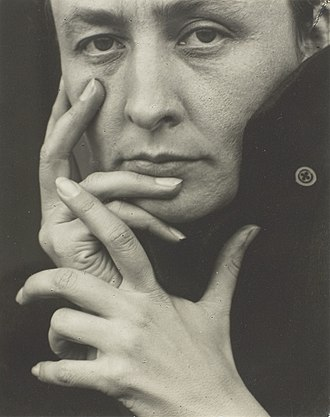
Georgia Totto O'Keeffe (November 15, 1887 – March 6, 1986) was an American modernist painter and draftswoman whose career spanned seven decades and whose work remained largely independent of major art movements. Called the "Mother of American modernism", O'Keeffe gained international recognition for her meticulous paintings of natural forms, particularly flowers and desert-inspired landscapes, which were often drawn from and related to places and environments in which she lived.[1][2]
From 1905, when O'Keeffe began her studies at the School of the Art Institute of Chicago, until about 1920, she studied art or earned money as a commercial illustrator or a teacher to pay for further education.[3][4] Influenced by Arthur Wesley Dow, O'Keeffe began to develop her unique style beginning with her watercolors from her studies at the University of Virginia and more dramatically in the charcoal drawings that she produced in 1915 that led to total abstraction. Alfred Stieglitz, an art dealer and photographer, held an exhibit of her works in 1917.[5] Over the next couple of years, she taught and continued her studies at the Teachers College, Columbia University.
She moved to New York in 1918 at Stieglitz's request and began working seriously as an artist.[6] They developed a professional and personal relationship that led to their marriage in 1924. O'Keeffe created many forms of abstract art, including close-ups of flowers, such as the Red Canna paintings, that many found to represent vulvas,[7] though O'Keeffe consistently denied that intention.[8] The imputation of the depiction of women's sexuality was also fueled by explicit and sensuous photographs of O'Keeffe that Stieglitz had taken and exhibited.
O'Keeffe and Stieglitz lived together in New York until 1929, when O'Keeffe began spending part of the year in the Southwest, which served as inspiration for her paintings of New Mexico landscapes and images of animal skulls, such as Cow's Skull: Red, White, and Blue (1931) and *Summer Days* (1936). After Stieglitz's death, she lived in New Mexico at the Georgia O'Keeffe Home and Studio in Abiquiú until the last years of her life, when she lived in Santa Fe. In 2014, O'Keeffe's 1932 painting Jimson Weed/White Flower No. 1 sold for $44,405,000.[9] After her death, the Georgia O'Keeffe Museum was established in Santa Fe.
Early life and education (1887–1916)
 Hilda Belcher, The Checkered Dress, 1907, Frances Lehman Loeb Art Center at Vassar College. The painting is likely a portrait of Georgia O'Keeffe.[a]
Georgia O'Keeffe was born on November 15, 1887,[14][15] in a farmhouse in the town of Sun Prairie, Wisconsin.[16][17] Her parents, Francis Calyxtus O'Keeffe and Ida (Totto) O'Keeffe, were dairy farmers. Her father was of Irish descent. Her maternal grandfather, George Victor Totto, for whom O'Keeffe was named, was a Hungarian count who came to the United States in 1848.[14][18]
O'Keeffe was the second of seven children.[14] She attended Town Hall School in Sun Prairie.[19] By age 10, she had decided to become an artist.[20] With her sisters, Ida and Anita,[21] she received art instruction from local watercolorist Sara Mann. O'Keeffe attended high school at Sacred Heart Academy in Madison, Wisconsin, as a boarder between 1901 and 1902. In late 1902, the O'Keeffes moved from Wisconsin to the close-knit neighborhood of Peacock Hill in Williamsburg, Virginia, where O'Keeffe's father started a business making rusticated cast concrete block in anticipation of a demand for the block in the Virginia Peninsula building trade, but the demand never materialized.[22] O'Keeffe stayed in Wisconsin attending Madison Central High School[23] until joining her family in Virginia in 1903. She completed high school as a boarder at Chatham Episcopal Institute in Virginia (now Chatham Hall), graduating in 1905. At Chatham, she was a member of Kappa Delta sorority.[14][19]
O'Keeffe taught and headed the art department at West Texas State Normal College, watching over her youngest sibling, Claudia, at her mother's request.[24] In 1917, she visited her brother, Alexis, at a military camp in Texas before he shipped out for Europe during World War I. While there, she created the painting The Flag,[25] which expressed her anxiety and depression about the war.[18]
- Early life and education (1887–1916)
- New York (1918–1930s)
- New Mexico (1930s–1986)
- Reception
- Personal life
- Legacy
- Publications
- Notes
- Citations
- References
- Further reading
- External links
New York (1918–1930s)
Stieglitz circle
In 1918, O'Keeffe moved to New York as Stieglitz offered to provide financial support,[34] a residence, and place for her to paint. They developed a close personal relationship, and later married, while he promoted her work.[14] Stieglitz also discouraged her use of watercolor, which was associated with amateur women artists.[34] According to art historian Charles Eldredge, "the couple enjoyed a prominent position in the ebullient art of New York throughout the 1920s".[35]
O'Keeffe came to know the many early American modernists who were part of Stieglitz's circle of artists, including painters Charles Demuth, Arthur Dove, Marsden Hartley, John Marin, and photographers Paul Strand and Edward Steichen. Strand's photography, as well as that of Stieglitz, inspired O'Keeffe's work. Stieglitz, whose 291 Gallery closed down in 1917, was now able to spend more time on his own photographic practice, producing a series of photographs of natural forms, cloud studies (a series known as Equivalents), and portraits of O'Keeffe.[35] Prior to her marriage to Stieglitz, O'Keeffe's drawings and paintings were frequently abstract, although she began to expand her visual vocabulary from 1924 onward to include more representational imagery "usually taken from nature and often painted in series".[36]
Flower paintings
Further information: Flower paintings of Georgia O'Keeffe
O'Keeffe began creating simplified images of natural things, such as leaves, flowers, and rocks.[37] Inspired by Precisionism, The Green Apple, completed in 1922, depicts her notion of simple, meaningful life.[38] O'Keeffe said that year, "it is only by selection, by elimination, and by emphasis that we get at the real meaning of things."[38] Blue and Green Music expresses O'Keeffe's feelings about music through visual art, using bold and subtle colors.[39]
Also in 1922, journalist Paul Rosenfeld commented "[the] Essence of very womanhood permeates her pictures", citing her use of color and shapes as metaphors for the female body.[40] This same article also describes her paintings in a sexual manner.[40] O'Keeffe, most famous for her depiction of flowers, made about 200 flower paintings,[41] which by the mid-1920s were large-scale depictions of flowers, as if seen through a magnifying lens, such as Oriental Poppies[42][43] and several Red Canna paintings.[44] She painted her first large-scale flower painting, Petunia, No. 2, in 1924 and it was first exhibited in 1925.[14] Making magnified depictions of objects created a sense of awe and emotional intensity.[37] In 1924, Stieglitz arranged a show displaying O'Keeffe's works of art alongside his photographs at Anderson Galleries and helped organized other exhibitions over the next several years.[45]
....
New Mexico (1930s–1986)
By 1929, she traveled to Santa Fe for the first time,[55] accompanied by her friend Rebecca (Beck) Strand and stayed in Taos with Mabel Dodge Luhan, who provided the women with studios.[56] From her room she had a clear view of the Taos Mountains as well as the morada (meetinghouse) of the Hermanos de la Fraternidad Piadosa de Nuestro Padre Jesús Nazareno, also known as the Penitentes.[57] She subsequently visited New Mexico on near annual basis from 1929 onward, often staying there several months at a time, returning to New York each winter to exhibit her work at Stieglitz's gallery.[58] O'Keeffe went on many pack trips, exploring the rugged mountains and deserts of the region that summer and later visited the nearby D. H. Lawrence Ranch,[56] where she completed her now famous oil painting, The Lawrence Tree, currently owned by the Wadsworth Athenaeum in Hartford, Connecticut.[59] O'Keeffe visited and painted the nearby historical San Francisco de Asís Mission Church at Ranchos de Taos. She made several paintings of the church, as had many artists, and her painting of a fragment of it silhouetted against the sky captured it from a unique perspective.[60][61]
In New Mexico, she collected rocks and bones from the desert floor and made them and the distinctive architectural and landscape forms of the area subjects in her work.[37] Known as a loner, O'Keeffe often explored the land she loved in her Ford Model A, which she purchased and learned to drive in 1929. She often talked about her fondness for Ghost Ranch and Northern New Mexico, as in 1943, when she explained, "Such a beautiful, untouched lonely feeling place, such a fine part of what I call the 'Faraway'. It is a place I have painted before ... even now I must do it again."[61] O'Keeffe did not work from late 1932 until about the mid-1930s[61] due to nervous breakdowns.[34] She was a popular artist, receiving commissions while her works were being exhibited in New York and other places.[62]
Skull and desert motifs
In 1933 and 1934, O'Keeffe recuperated in Bermuda and returned to New Mexico in 1934.[61] In August 1934, she moved to Ghost Ranch, north of Abiquiú. In 1940, she moved into a house on the ranch property. The varicolored cliffs surrounding the ranch inspired some of her most famous landscapes.[61] Between 1934 and 1936, she completed a series of landscape paintings inspired by the New Mexico desert, often with prominent depictions of animal skulls, including Rams Head with Hollyhock (1935) and Deer's Head with Pedernal (1936) as well as Summer Days (1936).[63] In 1936, she completed what would become one of her best-known paintings, Summer Days. It depicts a desert scene with a deer skull with vibrant wildflowers. Resembling Ram's Head with Hollyhock, it depicted the skull floating above the horizon.[62][64]
- Skulls and desert motif
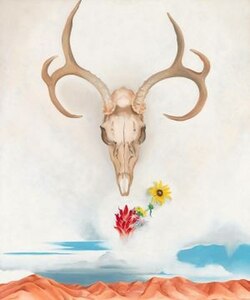

Summer Days, 1936, oil on canvas, Whitney Museum of American Art

Ram's Head White Hollyhock and Little Hills, 1935, oil on canvas, Brooklyn Museum
Pineapple Bud, 1939, oil on canvas[
O'Keeffe's "White Place", the Plaza Blanca cliffs and badlands near Abiquiú
In 1938, the advertising agency N. W. Ayer & Son approached O'Keeffe about creating two paintings for the Hawaiian Pineapple Company (now Dole Food Company) to use in advertising.[65][66][67] Other artists who produced paintings of Hawaii for the Hawaiian Pineapple Company's advertising include Lloyd Sexton, Jr., Millard Sheets, Yasuo Kuniyoshi, Isamu Noguchi, and Miguel Covarrubias.[68] The offer came at a critical time in O'Keeffe's life: she was 51, and her career seemed to be stalling (critics were calling her focus on New Mexico limited, and branding her desert images "a kind of mass production").[69]
She arrived in Honolulu February 8, 1939, aboard the SS *Lurline* and spent nine weeks in Oahu, Maui, Kauai, and the island of Hawaii. By far the most productive and vivid period was on Maui, where she was given complete freedom to explore and paint.[69][70] She painted flowers, landscapes, and traditional Hawaiian fishhooks. Back in New York, O'Keeffe completed a series of 20 sensual, verdant paintings. However, she did not paint the requested pineapple until the Hawaiian Pineapple Company sent a plant to her New York studio.[71]
During the 1940s, O'Keeffe had two one-woman retrospectives, the first at the Art Institute of Chicago (1943).[37] Her second was in 1946, when she was the first woman artist to have a retrospective at the Museum of Modern Art (MoMA) in Manhattan.[41] Whitney Museum began an effort to create the first catalogue of her work in the mid-1940s.[62]
...
Late career and death
| External images |
|---|
 *Sky above Clouds IV*, 1965, oil on canvas, The Art Institute of Chicago.[b] |
 *Waterfall, End of Road, Iao Valley*, 1939, oil on canvas, Honolulu Museum of Art. |
In 1972, O'Keeffe lost much of her eyesight due to macular degeneration, leaving her with only peripheral vision. She stopped oil painting without assistance in 1972.[82] In 1973, O'Keeffe hired John Bruce "Juan" Hamilton as a live-in assistant and then a caretaker. Hamilton was a potter.[83] Hamilton taught O'Keeffe to work with clay, encouraged her to resume painting despite her deteriorating eyesight, and helped her write her autobiography. He worked for her for 13 years.[37] The artist's autobiography, Georgia O'Keeffe, published in 1976 by Viking Press, featured Summer Days (1936) on the cover. It became a bestseller.[45] During the 1970s, she made a series of works in watercolor.[84] She continued working in pencil and charcoal until 1984.[82]
O'Keeffe became increasingly frail in her late 90s. She moved to Santa Fe in 1984, where she died on March 6, 1986, at the age of 98.[85] Her body was cremated and her ashes were scattered, as she wished, on the land around Ghost Ranch.[86] Following O'Keeffe's death, her family contested her will because codicils added to it in the 1980s had left most of her $65 million estate to Hamilton. The case was ultimately settled out of court in July 1987.[86][87] The case became a famous precedent in estate planning.[88][89]
Reception
Awards and honors
| External video |
|---|
 |
 *Life and Artwork of Georgia O'Keeffe*, the Georgia O'Keeffe Museum (11:00), C-SPAN[1] |
In 1938, O'Keeffe received an honorary degree of "Doctor of Fine Arts" from the College of William & Mary.[90] Later, O'Keeffe was elected to the American Academy of Arts and Letters[30] and in 1966 was elected a Fellow of the American Academy of Arts and Sciences.[91] Among her awards and honors, O'Keeffe received the M. Carey Thomas Award at Bryn Mawr College in 1971 and two years later received an honorary degree from Harvard University.[30]
In 1977, President Gerald Ford presented O'Keeffe with the Presidential Medal of Freedom, the highest honor awarded to American civilians.[92] In 1985, she was awarded the National Medal of Arts by President Ronald Reagan.[45] In 1993, she was inducted into the National Women's Hall of Fame.[93]
...
Popular culture
In 1991, PBS aired the American Playhouse production A Marriage: Georgia O'Keeffe and Alfred Stieglitz, starring Jane Alexander as O'Keeffe and Christopher Plummer as Alfred Stieglitz.[128] In 1996, the U.S. Postal Service issued a 32-cent stamp honoring O'Keeffe.[129] In 2013, on the 100th anniversary of the Armory Show, the USPS issued a stamp featuring O'Keeffe's Black Mesa Landscape, New Mexico/Out Back of Marie's II, 1930 as part of their Modern Art in America series.[130]
Lifetime Television produced a biopic of Georgia O'Keeffe starring Joan Allen as O'Keeffe, Jeremy Irons as Alfred Stieglitz, Henry Simmons as Jean Toomer, Ed Begley Jr. as Stieglitz's brother Lee, and Tyne Daly as Mabel Dodge Luhan. It premiered on September 19, 2009.[131][132]
On November 20, 2014, O'Keeffe's Jimson Weed/White Flower No 1 (1932) sold for $44,405,000 in 2014 at auction to Walmart heiress Alice Walton, more than three times the previous world auction record for any female artist.[133][134]
Women's suffrage and feminism
In Equal Under the Sky: Georgia O'Keeffe and Twentieth Century Feminism, Linda M. Grasso documents O'Keeffe's life-long involvement in feminism and women's issues. O'Keeffe came of age as a woman and an artist in the 1910s, at the height of the women's suffrage movement and the intense artistic ferment of modernism. Grasso notes that "Modernists championed rupture, innovation, and daring in art forms, styles, and perspectives," and that O'Keeffe "first created herself as an artist when feminism and modernism were interlinked"
...
In 1932, Frida Kahlo and her husband moved from NYC to Detroit. Here, Kahlo painted the famous Self Portrait on the Borderline Between Mexico and the United States. Many historians have noted the jack-in-the-pulpit flowers which lie on the Mexico side of the painting. These flowers, which are not native to Mexico, were the feature of a series of paintings by O'Keeffe just two years prior in which she painted the flowers at different periods of growth: one fully closed, one open, etc. This same series of growth is featured in Kahlo's painting.[123]