Copland
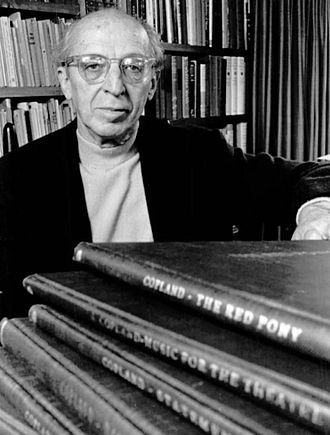
Name: Aaron Copland
Achievements: Doyen of modern American classical music.
Born: November 14, 1900; Brooklyn, New York
Died: December 2, 1990; North Tarrytown, New York (Aged 90)
Field & Discipline: Art; Music; Composer
Language: English
Father: Harris Morris Copland
Mother: Sarah Mittenthal Copland
Siblings: Four; one older sister named Laurine
Spouse: None
Children: None
Education: American Conservatory at Fontainebleau, France
Major Work:
“Music for the Theater” (1925)
“Piano Concerto” (1927)
“El Salon Mexico” (1932)
“Lincoln Portrait” (1942)
“Fanfare for the Common Man” (1942)
“Appalachian Spring” (1945)
“Third Symphony” (1946)
“Clarinet Concerto” (1948)
“The Red Pony” (1948)
“The Tender Land” (1954)
“Connotations” (1962)
Life & Times:
Aaron Copland was born at the turn of the last century, the youngest of five children of Russian-Jewish immigrants, in Brooklyn, New York. Harris and Sarah Copland, who demonstrated little or no musical ability or interest, owned a department store in New York where Aaron would help out as a child. He enjoyed listening to music on his cousin’s phonograph player at a young age but showed no interest in becoming a student of music until his early teens. At that point he began to pester his older sister Laurine to teach him the piano. After only a year he had surpassed her abilities and once again began to pester, this time his father, asking him to pay for formal lessons.
Upon attending his first formal concert at the age of 15, however, Aaron decided that he wanted to be a composer more than a performer. He studied composition primarily through a correspondence course until in 1920 when he was granted a scholarship to attend the new American Conservatory at Fontainebleau, France.
Once he arrived in France he discovered a much wider range of musical possibilities than just what was offered at that school. Soon he became the first of many American students of [taught by] Boulanger*, considered by many to have been the one of the best composition teachers of the last century. She was to have a very profound effect on his life, both through her teaching and through the introductions she made for him to influential musical talents such as the conductor Serge Koussevitsky.
Boulanger’s approach involved composition in many musical formats: choral works and ballet, as well as practice in orchestration, score reading and analysis. These exercises often included translating the music of other composers from one instrument, such as the piano, to that for a full orchestra. Harmony, counterpoint, form and rhythm were foremost in these exercises, providing Copland with a solid foundation for his future work.
While in Paris he also absorbed as much as he could of the new music being created in Europe by composers such as [influenced by] Stravinsky*, [influenced by] Hindemith* and [influenced by] Prokofiev*. It was perhaps Stravinsky’s style that had the strongest impact on Copland in these early years, with its use of “biting harmonies and poly-rhythms” as well as “an unusual sense of texture…and striking counterpoint, sometimes quite dissonant.”
After studying in France for three years he returned to the United States and began to compose in earnest. His first piece to be performed was the Symphony for Organ and Orchestra, commissioned by Boulanger. It premiered at Carnegie Hall and was played by the New York Symphony Orchestra. After that performance Copland spent many months composing new pieces, all strongly influenced by jazz rhythms, which he termed symphonic jazz. These included Music for the Theater (1925) and Piano Concerto (1926).
He soon began to compose more abstract pieces, such as Piano Variations (1930) and Statements for Orchestra (1935). He did not become the popular composer we are more familiar with until he once again made another creative shift, this time moving towards a more simple, melodic or lyrical style.
This shift was inspired in part by a visit to Mexico in 1935, during which he became enchanted by the folk melodies he heard being played regularly in that very musical culture. That visit lead directly to the creation of El Salon Mexico (1937), which was an instant success. He then began to incorporate influences from American folk sources into his works, including the ballets Billy the Kid (1938) and Rodeo (1942).
Copland had already caught the attention of the most famous female dancer of the time, [work choreographed by] Martha Graham*, who had performed a choreographed version of his Piano Variations. In 1944 she commissioned from Copland what turned out to be the most famous work for both of them, Appalachian Spring (1945). Copland received the Pulitzer Prize in Music for an orchestral suite based on that ballet in 1945.
During this same time Copland wrote scores for eight movies, including Of Mice and Men (1939), The Red Pony (1949) and The Heiress (1949). He was awarded an Oscar for his scoring of The Heiress.
Probably his most enduring piece is Fanfare for the Common Man (1942), the only composition of his that directly borrowed from an existing theme, in this case from the Shaker tune, “Simple Gifts.” It was, most likely, the pastoral qualities of many of these works that endeared them to audiences. This most prolific period of his career ended with the creation of the opera The Tender Land in 1954.
After that phase of his career he devoted most of his time to teaching – a task he had been very actively and happily involved with since 1940 - primarily at the Berkshire Music Center until 1965, and to conducting. What little music he wrote during this last period is considered more “austere” or sparse in comparison to his earlier works as he experimented with the twelve-tone style then popular.
Throughout his life he was a tireless promoter of young American composers especially and made it a point to present their works along with his own at many of the concerts he conducted, which he continued to do into the 1980s. One of the more significant of these composers was [promoted work of] Bernstein*, the creator of West Side Story. Copland also wrote a number of informative and influential books on music, including What to Listen for in Music (1939) and Music and Imagination (1952). He died quietly in his home in North Tarrytown, New York in 1990, shortly after his 90th birthday.
Assessment: A pioneer in the development of a uniquely American style of classical music composition.
Oneliner: Aaron Copeland, the major American classical composer
Bibliography:
- Pollack, Howard, Aaron Copland: The Life and Work of an Uncommon Man, Henry Holt and Company, 1999. 690pp.
- Venezia, Mike, Aaron Copland, Children’s Press, 1995. 32pp.
- WilsonWeb: 1969 Biography from Composers Since 1900, First Supplement - 1981 Update.