Duncan, Isadora
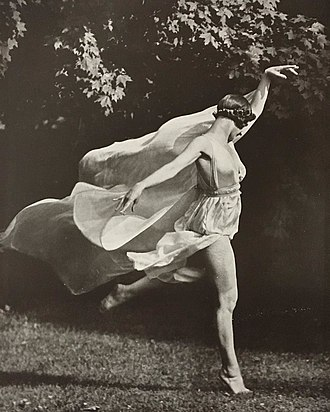
ACHIEVEMENT(S): Influential in raising interpretive dance to the status of creative art
NAME: Duncan, Angela
DATE AND PLACE OF BIRTH: May 26, 1877, San Francisco, CA
DATE/PLACE OF DEATH/AGE AT DEATH: September 14, 1927, Nice, France. Aged 50 (accident)
DISCIPLINE: Dancer
FIELD: Theater
LANGUAGE: English
EDUCATION: Little formal education
MAJOR WORK: "The Art of the Dance"
LIFE AND TIMES:
Duncan's early dance training seems to have been gymnastics lessons at the Oakland "Turnverein" (see Jahn*) and the occasional ballet lesson. But early on, she rejected the rigidity of classical ballet and preferred more natural rhythms and movements. She learned the popular dances of the day -- the polka, waltz, and schottische -- and elaborated upon them.
Her mind already set on a career in dance, Duncan achieved modest success as a dance teacher, but no success as a performer.
In 1895, Duncan moved with her mother to Chicago, where she met a theatrical producer, Augustin Daly, who offered her a place in a New York show. She enthusiastically accepted, and from 1895 to 1897 danced in such shows as Daly's "Miss Pygmalion" and "A Midsummer Night's Dream", and even toured briefly in England. Seeking more recognition, Duncan decided to give private dance performances in New York and Newport, and to give dance classes and lectures. Her highly personal program "Done into Dance", featured her dance interpretations of poetry (such as Omar Khayyam's "Rubaiyat") and music (such as Ethelbert Nevin's "Water Scenes" and "Shepherd's Tale").
In 1899, Duncan moved to London, where she studied the sculptures at the British Museum and incorporated the gestures of the ancient Greece statues into her classical dance movements. Through the patronage of actress Mrs. Patrick Campbell, Duncan was invited to appear at high class private receptions. Her fame grew. The phenomenon of a young woman dancing barefoot and scantily clad brought crowds of admirers. She began to perform in small theaters and concert halls.
After a series of performances at the New Gallery in London, where her dances included interpretations of paintings by Botticelli ("Primavera") and Titian ("Bacchus and Ariadne"), Duncan went to Paris in 1901, where she achieved the same success. In 1902, she danced in Berlin, Vienna, and in Budapest, where she was hailed as a genius of interpretive dance. In Berlin, Duncan's performances raised eyebrows. Invited to speak at the Berlin Press Club in 1903, she lectured on "The Dance of the Future", delivering a cogent explanation of her theory of dance, stating that its purpose was to "express what is the most moral, healthful and beautiful in art."
In 1904, Duncan was invited by Cosima Von Bulow*, the wife of composer Wagner*, to dance to Wagner's music at the Bayreuth Festival. In Russia, in 1905, her performance caught the eye of Russian art critic Diaghilev*, who in a few years as an impresario was to lead a resurgence of ballet throughout western Europe.
The next eight years saw Duncan at the apex of her artistic fame. She choreographed music by Schubert*, Wagner, Tchaikovsky*, Brahms* and Beethoven*, but was at her best in her interpretations of Polish composer Chopin*.
Duncan's personal life, as well as her art, kept her in the public eye. In 1906, she gave birth to her first child, Deirdre, the daughter of stage designer Gordon Craig*, who shared her resistance to marriage. In 1910, she had a second child, Patrick Augustus, with art patron Paris Singer, heir to the sewing-machine fortune of his grandfather, Singer*. In 1913, both children died when the car they and their governess were in accidentally rolled into the Seine. Duncan never fully recovered from the tragedy.
In early 1914, after the death of a third newborn (father unknown), Duncan opened a dancing school in Bellevue, outside Paris, but when the First World War broke out, she donated the school as a hospital and returned to the United States. After the War, she returned to France, where she supervised dance courses and choreographed Hungarian composer Franz Liszt*'s "Les Funerailles" and "Benediction de Dieu dans la solitude".From Chopin's works, she created the trilogy "Poland Tragic", "Poland Heroic" and "Poland Languorous and Gay".
In 1920, she was invited to establish a dancing school in Moscow, and was promised an enrollment of 1,000 children. Shortly afterwards, the school opened and then closed when the New Economic Policy cancelled funding.
Duncan married poet Sergei Aleksandrovich Yesenin in 1922. Fear of the "Red Menace" was at its height in the U.S., and on her next tour of the US she and her husband were unjustly labeled as Bolshevik agents. The tour ended prematurely, and the couple left America in February, 1923. Her citizenship was revoked, technically for having married a Soviet citizen. Duncan returned briefly to the Soviet Union. She choreographed a number of group works and several solos by Russian composer Alexander Scriabin, but her relationship with Yesenin was fast deteriorating. He was becoming mentally unstable, (and committed suicide in Moscow in 1925).
Duncan fled to Berlin, then settled again in Paris in 1924. Now well into her forties and dogged by bad luck and scandal, Duncan was in much less demand and in constant debt. Her last public performance was on July 8, 1927, at the Theatre Mogador in Paris. Duncan died tragically in Nice, when a shawl she had wrapped around her neck became caught in a wheel of a sports car, and she was strangled.
ASSESSMENT: Duncan remains a key figure in the history of American modern dance.
EXTRA CONNECTIONS: She influenced Ashton*
She knew explorer RF Scott*
ONELINER: Isadora Duncan, one of the first interpretative dancers.
BIBLIOGRAPHY:
EB
Blair, Frederika, Isadora: Portrait of the Artist as a Woman, Wellingborough: Equation, 1986.
ANB
PARENTS: Joseph Charles Duncan; Mary Isadora Gray
SIBLINGS: Mary Elizabeth; Augustin; Raymond
SPOUSE: Sergey Aleksandrovich Yesenin
CHILDREN: Deidre (died at seven in car accident, father Gordon Craig);
Patrick Augustus (died at three in same car accident, father Paris Singer)