Kahlo, Frida
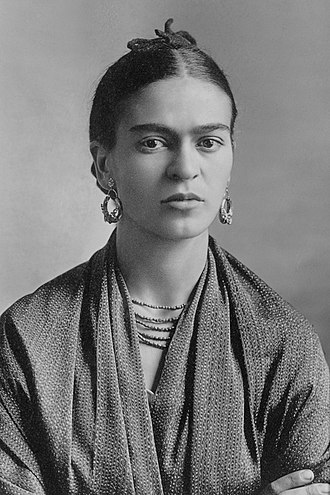
Magdalena Carmen Frida Kahlo y Calderón (Spanish pronunciation: [ˈfɾiða ˈkalo]; 6 July 1907 – 13 July 1954[1]) was a Mexican painter known for her many portraits, self-portraits, and works inspired by the nature and artifacts of Mexico. Inspired by the country's popular culture, she employed a naïve folk art style to explore questions of identity, postcolonialism, gender, class, and race in Mexican society.[2] Her paintings often had strong autobiographical elements and mixed realism with fantasy. In addition to belonging to the post-revolutionary Mexicayotl movement, which sought to define a Mexican identity, Kahlo has been described as a surrealist or magical realist.[3] She is also known for painting about her experience of chronic pain.[4]
Born to a German father and a mestiza mother, Kahlo spent most of her childhood and adult life at La Casa Azul, her family home in Coyoacán – now publicly accessible as the Frida Kahlo Museum. Although she was disabled by polio as a child, Kahlo had been a promising student headed for medical school until being injured in a bus accident at the age of 18, which caused her lifelong pain and medical problems. During her recovery, she returned to her childhood interest in art with the idea of becoming an artist.
Kahlo's interests in politics and art led her to join the Mexican Communist Party in 1927,[1] through which she met fellow Mexican artist Diego Rivera. The couple married in 1929[1][5] and spent the late 1920s and early 1930s travelling in Mexico and the United States together. During this time, she developed her artistic style, drawing her main inspiration from Mexican folk culture, and painted mostly small self-portraits that mixed elements from pre-Columbian and Catholic beliefs.
Her paintings raised the interest of surrealist artist André Breton, who arranged for Kahlo's first solo exhibition at the Julien Levy Gallery in New York in 1938; the exhibition was a success and was followed by another in Paris in 1939. While the French exhibition was less successful, the Louvre purchased a painting from Kahlo, The Frame, making her the first Mexican artist to be featured in their collection.[1] Throughout the 1940s, Kahlo participated in exhibitions in Mexico and the United States and worked as an art teacher. She taught at the Escuela Nacional de Pintura, Escultura y Grabado ("La Esmeralda") and was a founding member of the Seminario de Cultura Mexicana. Kahlo's always-fragile health began to decline in the same decade. She had her first solo exhibition in Mexico in 1953, shortly before her death in 1954 at the age of 47.
Kahlo's work as an artist remained relatively unknown until the late 1970s, when her work was rediscovered by art historians and political activists. By the early 1990s, not only had she become a recognized figure in art history, but she was also regarded as an icon for Chicanos, the feminism movement, and the LGBTQ+ community. Kahlo's work has been celebrated internationally as emblematic of Mexican national and indigenous traditions and by feminists for what is seen as its uncompromising depiction of the female experience and form.[6]
Artistic career
Early career
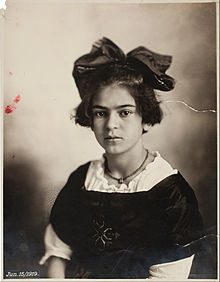 Kahlo on 15 June 1919, aged 11
Kahlo enjoyed art from an early age, receiving drawing instruction from printmaker Fernando Fernández (who was her father's friend)[7] and filling notebooks with sketches.[8] In 1925, she began to work outside of school to help her family.[9] After briefly working as a stenographer, she became a paid engraving apprentice for Fernández.[10] He was impressed by her talent,[11] although she did not consider art as a career at this time.[8]
A severe bus accident at the age of 18 left Kahlo in lifelong pain. Confined to bed for three months following the accident, Kahlo began to paint.[12] She started to consider a career as a medical illustrator, as well, which would combine her interests in science and art. Her mother provided her with a specially-made easel, which enabled her to paint in bed, and her father lent her some of his oil paints. She had a mirror placed above the easel, so that she could see herself.[13][12] Painting became a way for Kahlo to explore questions of identity and existence.[14] She explained, "I paint myself because I am often alone and I am the subject I know best."[12] She later stated that the accident and the isolating recovery period made her desire "to begin again, painting things just as [she] saw them with [her] own eyes and nothing more."[15]
Most of the paintings Kahlo made during this time were portraits of herself, her sisters, and her schoolfriends.[16] Her early paintings and correspondence show that she drew inspiration especially from European artists, in particular Renaissance masters such as Sandro Botticelli and Bronzino[17] and from avant-garde movements such as Neue Sachlichkeit and Cubism.[18]
On moving to Morelos in 1929 with her husband Rivera, Kahlo was inspired by the city of Cuernavaca where they lived.[19] She changed her artistic style and increasingly drew inspiration from Mexican folk art.[20] Art historian Andrea Kettenmann states that she may have been influenced by Adolfo Best Maugard's treatise on the subject, for she incorporated many of the characteristics that he outlined – for example, the lack of perspective and the combining of elements from pre-Columbian and colonial periods of Mexican art.[21] Her identification with La Raza, the people of Mexico, and her profound interest in its culture remained important facets of her art throughout the rest of her life.[22]
Work in the United States
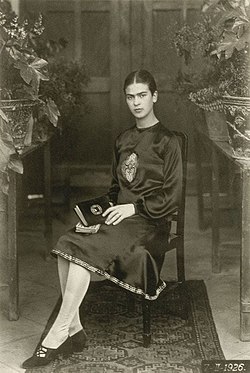 Kahlo in 1926
When Kahlo and Rivera moved to San Francisco in 1930, Kahlo was introduced to American artists such as Edward Weston, Ralph Stackpole, Timothy L. Pflueger, and Nickolas Muray.[23] The six months spent in San Francisco were a productive period for Kahlo,[24] who further developed the folk art style she had adopted in Cuernavaca.[25] In addition to painting portraits of several new acquaintances,[26] she made Frieda and Diego Rivera (1931), a double portrait based on their wedding photograph,[27] and The Portrait of Luther Burbank (1931), which depicted the eponymous horticulturist as a hybrid between a human and a plant.[28] Although she still publicly presented herself as simply Rivera's spouse rather than as an artist,[29] she participated for the first time in an exhibition, when Frieda and Diego Rivera was included in the Sixth Annual Exhibition of the San Francisco Society of Women Artists in the Palace of the Legion of Honor.[30][31]
...
1931–1933: Travels in the United States
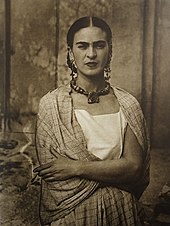 Frida photographed in 1932 by her father, Guillermo
After Rivera had completed the commission in Cuernavaca in late 1930, he and Kahlo moved to San Francisco, where he painted murals for the Luncheon Club of the San Francisco Stock Exchange and the California School of Fine Arts.[189] The couple was "feted, lionized, [and] spoiled" by influential collectors and clients during their stay in the city.[23] Her long love affair with Hungarian-American photographer Nickolas Muray most likely began around this time.[190]
Kahlo and Rivera returned to Mexico for the summer of 1931, and in the fall traveled to New York City for the opening of Rivera's retrospective at the Museum of Modern Art (MoMA). In April 1932, they headed to Detroit, where Rivera had been commissioned to paint murals for the Detroit Institute of Arts.[191] By this time, Kahlo had become bolder in her interactions with the press, impressing journalists with her fluency in English and stating on her arrival to the city that she was the greater artist of the two of them.[192]
"Of course he [Rivera] does well for a little boy, but it is I who am the big artist"
— Frida Kahlo in interview with the Detroit News, 2 February 1933.[193]
The year spent in Detroit was a difficult time for Kahlo. Although she had enjoyed visiting San Francisco and New York City, she disliked aspects of American society, which she regarded as colonialist, as well as most Americans, whom she found "boring".[194] She disliked having to socialize with capitalists such as Henry and Edsel Ford, and was angered that many of the hotels in Detroit refused to accept Jewish guests.[195] In a letter to a friend, she wrote that "although I am very interested in all the industrial and mechanical development of the United States", she felt "a bit of a rage against all the rich guys here, since I have seen thousands of people in the most terrible misery without anything to eat and with no place to sleep, that is what has most impressed me here, it is terrifying to see the rich having parties day and night while thousands and thousands of people are dying of hunger."[33]
Kahlo's time in Detroit was also complicated by a pregnancy. Her doctor agreed to perform an abortion, but the medication used was ineffective.[196] Kahlo was deeply ambivalent about having a child and had already undergone an abortion earlier in her marriage to Rivera.[196] Following the failed abortion, she reluctantly agreed to continue with the pregnancy, but miscarried in July, which caused a serious hemorrhage that required her being hospitalized for two weeks.[32] Less than three months later, her mother died from complications of surgery in Mexico.[197]
| External images |
|---|
 *Henry Ford Hospital* (1932) |
 *Self-portrait on the Border of Mexico and the United States* (1932) |
 *My Dress Hangs There* (1932) |
 *My Birth* (1932) |
Kahlo and Rivera returned to New York in March 1933, for he had been commissioned to paint a mural for the Rockefeller Center.[198] During this time, she only worked on one painting, My Dress Hangs There (1934).[198] She also gave further interviews to the American press.[198] In May, Rivera was fired from the Rockefeller Center project and was instead hired to paint a mural for the New Workers School.[199][198] Although Rivera wished to continue their stay in the United States, Kahlo was homesick, and they returned to Mexico soon after the mural's unveiling in December 1933.[200]
1934–1949: La Casa Azul and declining health
 Kahlo and Rivera's houses in San Ángel; they lived there from 1934 until their divorce in 1939, after which it became his studio
Back in Mexico City, Kahlo and Rivera moved into a new house in the wealthy neighborhood of San Ángel.[201] Commissioned from Le Corbusier's student Juan O'Gorman, it consisted of two sections joined by a bridge; Kahlo's was painted blue and Rivera's pink and white.[202] The bohemian residence became an important meeting place for artists and political activists from Mexico and abroad.[203]
Kahlo once again experienced health problems – undergoing an appendectomy, two abortions, and the amputation of gangrenous toes[204][151] – and her marriage to Rivera had become strained. He was not happy to be back in Mexico and blamed Kahlo for their return.[205] While he had been unfaithful to her before, he now embarked on an affair with her younger sister Cristina, which deeply hurt Kahlo's feelings.[206] After discovering the affair in early 1935, she moved to an apartment in central Mexico City and considered divorcing him.[207] She also had an affair of her own with American artist Isamu Noguchi.[208]
Kahlo was reconciled with Rivera and Cristina later in 1935 and moved back to San Ángel.[209] She became a loving aunt to Cristina's children, Isolda and Antonio.[210] Despite the reconciliation, both Rivera and Kahlo continued their infidelities.[211] She also resumed her political activities in 1936, joining the Fourth International and becoming a founding member of a solidarity committee to provide aid to the Republicans in the Spanish Civil War.[212] She and Rivera successfully petitioned the Mexican government to grant asylum to former Soviet leader Leon Trotsky and offered La Casa Azul for him and his wife Natalia Sedova as a residence.[213] The couple lived there from January 1937 until April 1939, with Kahlo and Trotsky not only becoming good friends but also having a brief affair.[214]
| External images |
|---|
 *A Few Small Nips* (1935) |
 *My Nurse and I* (1937) |
 *Four Inhabitants of Mexico* (1938) |
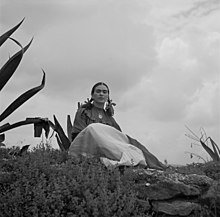 ]1937 photograph by Toni Frissell, from a fashion shoot for Vogue
After opening an exhibition in Paris, Kahlo sailed back to New York.[215] She was eager to be reunited with Muray, but he decided to end their affair, as he had met another woman whom he was planning to marry.[216] Kahlo traveled back to Mexico City, where Rivera requested a divorce from her. The exact reasons for his decision are unknown, but he stated publicly that it was merely a "matter of legal convenience in the style of modern times ... there are no sentimental, artistic, or economic reasons".[217] According to their friends, the divorce was mainly caused by their mutual infidelities.[218] He and Kahlo were granted a divorce in November 1939, but remained friendly; she continued to manage his finances and correspondence.[219]
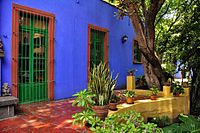 ]
La Casa Azul, Kahlo's childhood home and residence from 1939 until her death in 1954

The garden at La Casa Azul
Following her separation from Rivera, Kahlo moved back to La Casa Azul and, determined to earn her own living, began another productive period as an artist, inspired by her experiences abroad.[220] Encouraged by the recognition she was gaining, she moved from using the small and more intimate tin sheets she had used since 1932 to large canvases, as they were easier to exhibit.[221]
She also adopted a more sophisticated technique, limited the graphic details, and began to produce more quarter-length portraits, which were easier to sell.[222] She painted several of her most famous pieces during this period, such as The Two Fridas (1939), Self-portrait with Cropped Hair (1940), The Wounded Table (1940), and Self-Portrait with Thorn Necklace and Hummingbird (1940). Three exhibitions featured her works in 1940: the fourth International Surrealist Exhibition in Mexico City, the Golden Gate International Exposition in San Francisco, and Twenty Centuries of Mexican Art in MoMA in New York.[223][224]
On 21 August 1940, Trotsky was assassinated in Coyoacán, where he had continued to live after leaving La Casa Azul.[225] Kahlo was briefly suspected of being involved, as she knew the murderer, and was arrested and held for two days with her sister Cristina.[226] The following month, Kahlo traveled to San Francisco for medical treatment for back pain and a fungal infection on her hand.[227] Her continuously fragile health had increasingly declined since her divorce and was exacerbated by her heavy consumption of alcohol.[228]
Rivera was also in San Francisco after he fled Mexico City following Trotsky's murder and accepted a commission.[229] Although Kahlo had a relationship with art dealer Heinz Berggruen during her visit to San Francisco,[230] she and Rivera were reconciled.[231] They remarried in a simple civil ceremony on 8 December 1940.[232] Kahlo and Rivera returned to Mexico soon after their wedding. The union was less turbulent than before for its first five years.[233] Both were more independent,[234] and while La Casa Azul was their primary residence, Rivera retained the San Ángel house for use as his studio and second apartment.[235] Both continued having extramarital affairs; Kahlo, being bisexual, had affairs with both men and women, with evidence suggesting her male lovers were more important to Kahlo than her female lovers.[234][236]
Despite the medical treatment she had received in San Francisco, Kahlo's health problems continued throughout the 1940s. Due to her spinal problems, she wore twenty-eight separate supportive corsets, varying from steel and leather to plaster, between 1940 and 1954.[237] She experienced pain in her legs, the infection on her hand had become chronic, and she was also treated for syphilis.[238] The death of her father in April 1941 plunged her into a depression.[233] Her ill health made her increasingly confined to La Casa Azul, which became the center of her world. She enjoyed taking care of the house and its garden, and was kept company by friends, servants, and various pets, including spider monkeys, Xoloitzcuintlis, and parrots.[239]
 Kahlo (centre), Nayantara Sahgal (right) and Rita Dar at Casa Azul in 1947
While Kahlo was gaining recognition in her home country, her health continued to decline. By the mid-1940s, her back had worsened to the point that she could no longer sit or stand continuously.[240] In June 1945, she traveled to New York for an operation which fused a bone graft and a steel support to her spine to straighten it.[241] The difficult operation was a failure.[70] According to Herrera, Kahlo also sabotaged her recovery by not resting as required and by once physically re-opening her wounds in a fit of anger.[70] Her paintings from this period, such as The Broken Column (1944), Without Hope (1945), Tree of Hope, Stand Fast (1946), and The Wounded Deer (1946), reflect her declining health.[70]
1950–1954: Last years and death
 Kahlo's wheelchair and adjustable easel in La Casa Azul, with one of her still lifes from her final years
In 1950, Kahlo spent most of the year in Hospital ABC in Mexico City, where she underwent a new bone graft surgery on her spine.[242] It caused a difficult infection and necessitated several follow-up surgeries.[71] After being discharged, she was mostly confined to La Casa Azul, using a wheelchair and crutches to be ambulatory.[71] During these final years of her life, Kahlo dedicated her time to political causes to the extent that her health allowed. She had rejoined the Mexican Communist Party in 1948[73] and campaigned for peace, for example, by collecting signatures for the Stockholm Appeal.[243]
Kahlo's right leg was amputated at the knee due to gangrene in August 1953.[80] She became severely depressed and anxious, and her dependency on painkillers escalated.[80] When Rivera began yet another affair, she attempted suicide by overdose.[80] She wrote in her diary in February 1954, "They amputated my leg six months ago, they have given me centuries of torture and at moments I almost lost my reason. I keep on wanting to kill myself. Diego is what keeps me from it, through my vain idea that he would miss me. ... But never in my life have I suffered more. I will wait a while..."[244]
 Kahlo's death mask on her bed in La Casa Azul
In her last days, Kahlo was mostly bedridden with bronchopneumonia, though she made a public appearance on 2 July 1954, participating with Rivera in a demonstration against the CIA invasion of Guatemala.[245] She seemed to anticipate her death, as she spoke about it to visitors and drew skeletons and angels in her diary.[246] The last drawing was a black angel, which biographer Hayden Herrera interprets as the Angel of Death.[246] It was accompanied by the last words she wrote, "I joyfully await the exit – and I hope never to return – Frida" ("Espero Alegre la Salida – y Espero no Volver jamás").[246]
The demonstration worsened her illness, and on the night of 12 July 1954, Kahlo had a high fever and was in extreme pain.[246] At approximately 6 a.m. on 13 July 1954, her nurse found her dead in her bed.[247] Kahlo was 47 years old. The official cause of death was pulmonary embolism, although no autopsy was performed.[246] Herrera has argued that Kahlo, in fact, committed suicide.[84][246] The nurse, who counted Kahlo's painkillers to monitor her drug use, stated that Kahlo had taken an overdose the night she died. She had been prescribed a maximum dose of seven pills but had taken eleven.[248] She had also given Rivera a wedding anniversary present that evening, over a month in advance.[248]
On the evening of 13 July, Kahlo's body was taken to the Palacio de Bellas Artes, where it lay in state under a Communist flag.[249] The following day, it was carried to the Panteón Civil de Dolores, where friends and family attended an informal funeral ceremony. Hundreds of admirers stood outside.[249] In accordance with her wishes, Kahlo was cremated.[249] Rivera, who stated that her death was "the most tragic day of my life", died three years later, in 1957.[249] Kahlo's ashes are displayed in a pre-Columbian urn at La Casa Azul, which opened as a museum in 1958.[249]
Posthumous recognition and "Fridamania"
...