Huntington, Samuel
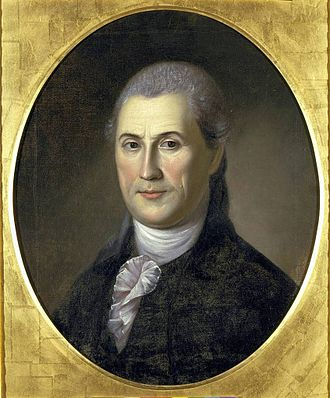
Samuel Huntington (July 16, 1731 [O.S. July 5, 1731] – January 5, 1796) was a Founding Father of the United States and a lawyer, jurist, statesman, and Patriot in the American Revolution from Connecticut.[1] As a delegate to the Continental Congress, he signed the Declaration of Independence and the Articles of Confederation.
He also served as President of the Continental Congress from 1779 to 1781, President of the United States in Congress Assembled in 1781, chief justice of the Connecticut Supreme Court from 1784 to 1785, and the 18th Governor of Connecticut from 1786 until his death. He was the first United States governor to have died while in office.
Personal life
Huntington was born to Nathaniel and Mehetabel Huntington on July 16,[2][3] 1731, in Windham, Connecticut Colony (his birthplace is now in Scotland, Connecticut, which broke off from Windham in 1857). His house is currently accessible off Route 14. He was the fourth of ten children and the oldest son. He had a limited education in the common schools, then was self-educated. When he was 16 he was apprenticed to a cooper but also continued to help his father on the farm. His education came from the library of Rev. Ebenezer Devotion and books borrowed from local lawyers.
In 1754 Huntington was admitted to the bar, and moved to Norwich, Connecticut, to begin practicing law. He married Martha Devotion (Rev. Devotion's daughter) in 1761. They remained together until her death in 1794. The couple did not birth any children, but when his brother (Rev. Joseph Huntington) died they adopted their nephew and niece. They raised Samuel Huntington "Jr." and Frances as their own. Samuel Huntington never owned slaves.[4]
Political career
After brief service as a selectman, Huntington began his political career in earnest in 1764 when Norwich sent him as one of their representatives to the lower house of the Connecticut Assembly, where he served until 1774. In 1775, he was elected to the upper house, the Governor's Council, where he served until 1784.[5] In addition to serving in the legislature, he was appointed king's attorney for Connecticut in 1768 and in 1773 was appointed to the colony's supreme court, then known as the Supreme Court of Errors. He was chief justice of the Superior Court from 1784 until 1787.[5][6]
Huntington was an outspoken critic of the Coercive Acts of the British Parliament. As a result, the assembly elected him in October 1775 to become one of their delegates to the Second Continental Congress. In January 1776 he took his place with Roger Sherman and Oliver Wolcott as the Connecticut delegation in Philadelphia. He voted for and signed the Declaration of Independence and the Articles of Confederation. He served in the Congress in the years 1776, 1778-1781, and 1783. He suffered from an attack of smallpox while in Congress.[5]
President of the Continental Congress
While not known for extensive learning or brilliant speech, Huntington's steady hard work and unfailing calm manner earned him the respect of his fellow delegates. As a result, when John Jay left to become minister to Spain, Huntington was elected to succeed him as President of the Continental Congress on September 28, 1779, which is one reason why he is sometimes considered the first president.
The President of Congress was a mostly ceremonial position with no real authority, but the office did require Huntington to handle a good deal of correspondence and sign official documents.[7] He spent his time as president urging the states and their legislatures to support the levies for men, supplies, and money needed to fight the Revolutionary War. The Articles of Confederation were ratified during his term.
Huntington remained as President of Congress until July 9, 1781, when ill health forced him to resign and return to Connecticut. In 1782, Connecticut again named him as a delegate, but his health and judicial duties kept him from accepting. He returned to the Congress as a delegate for the 1783 session to see the success of the revolution embodied in the Treaty of Paris. In that same year, he was elected a member of the American Philosophical Society.[8]
Governor of Connecticut
In 1785 he built his mansion house just off the Norwichtown Green at what is now 34 East Town Street and the current headquarters of United and Community Family Services, Inc. In 1785, he was elected as lieutenant governor of Connecticut, serving with Governor Matthew Griswold.[6] In 1786, he became governor.[6] He remained in charge of the Supreme Court during his tenure as lieutenant governor but vacated that position upon election to governor.[6]
In his first year as governor, in a reprise of his efforts in Congress, he brokered the Treaty of Hartford that resolved western land claims between New York and Massachusetts. In 1787, he lent his support to the Northwest Ordinance that completed the national resolution of these issues. In 1788, he presided over the Connecticut Convention that was called to ratify the United States Constitution. In later years he saw the transition of Connecticut into a U.S. state. He resolved the issue of a permanent state capital at Hartford and oversaw the construction of the state house.
He received two electoral votes in the first U.S. presidential election.
Death and legacy
Huntington died while in office at his home in Norwich on January 5, 1796.[9] His tomb, which was extensively restored in 2003, is located in the Old Norwichtown Cemetery behind his mansion house. Both Samuel and his wife Martha's remains were disinterred during the course of the project and then reinterred in a formal ceremony on November 23, 2003.
Huntington, Connecticut, was named in his honor in 1789 but was later renamed to Shelton when the town incorporated with Shelton to form a city in 1919.[10] He is the namesake of Huntington County, Indiana.[11] Huntington Mills is a small town in northeastern Pennsylvania which also derives its name in honor of Samuel Huntington.
The home that Samuel was born in was built by his father, Nathaniel, around 1732 and still stands. The area is now within the borders of the town of Scotland, Connecticut. In 1994, the home and some grounds were purchased by a local historic trust. The Samuel Huntington Birthplace is a National Historic Landmark.
His nephew and adopted son Samuel H. Huntington moved to the Ohio Country region that he had been instrumental in opening up, and later became the third governor of Ohio.
Because Huntington was the president of the Continental Congress when the Articles of Confederation were ratified, some unconventional biographers and civic groups in Connecticut claim that Huntington was actually the first President of the United States.[12][13]
His grandson Daniel was a painter who studied at Yale with FSB Morse and married a Trumbull. His maternal grandfather was Jedediah Huntington (1743–1818) of Norwich, Connecticut, who served as a General in the American Revolutionary War.
Another grandson Collis P was one of the Big Four (along with Stanford, who often made their fortune by “mining the miners” during the California Gold Rush) of the Transcontinental Railroad.
See also
Samuel Huntington (Connecticut politician) - Wikipedia
American Connections
SAMUEL HUNTINGTON (CT) was forty-five. And first
President of the United States (in Congress Assembled) for four months
in 1781. He was also one of the early examples of rags-to-riches
America, starting as a self-taught plowboy and ending honorary doctor,
chief justice of Connecticut, and state governor.
A consummate politico, while in office he did nifty work dealing with
rebellions, mutinies, land grabs, and foreign territorial claims. He
also drafted the first U.S. copyright law (thank you). He put a foot
wrong only once, when he caused matters to hit the Protestant fan after
he took holy water at the Catholic funeral of a Spanish grandee.
Don Juan de Mirelles, a merchant from Havana, was also a bosom pal of
Washington and on April 24, 1780, visited the American army camp in
Philadelphia, where he got a thirteen-gun salute and was due for a
parade and maneuvers followed by fireworks but then suddenly went down
with a fever and died four days later.
Washington was a chief mourner. The reason this overdressed Hispanic person got the treatment was that he represented Spanish King Carlos III. Who was rooting for an American win and the eventual return of ex-Spanish, now-British real estate
including Gibraltar, Jamaica, Bermuda, and Honduras. So Carlos was
helping things American along with a fortune in weapons and cash sneaked
across the pond via the French after closed-door meetings with B.
Franklin. To this day the Spanish money-laundering exercise remains the
war's best-kept secret.
Back home Carlos played the benevolent despot, persuading Madrid
residents to stop throwing their slops out of the window, generally (if
chaotically) helping the Spanish economy, toning down the Inquisition,
chucking out the Jesuits, building the Prado, and (in 1789) hiring
Francisco Goya as court painter. Goya had hung around Madrid for five
years designing tapestries and schmoozing anybody who might offer a leg
up. Finally, through a royal favorite, he got an invite to the palace
and was in like Flynn, enjoying bed and board at the crown prince's
house. In next to no time Goya was becoming an international fave and
being friendly ("very," it was said) with the Duchess of Alba. When he
painted a nude (the Maja Desnuda) and then repainted the head
it was rumored that the body in question was guess who.
Almost from the start Goya's work caught the eye of a man whose art
collection was growing so fast it needed bigger and bigger palaces to
hang it in. No problem if you were an Esterhazy prince like Miklos II of
Hungary and "money" wasn't a word you knew. Miklos's collection finally
hit over one thousand, including works by Da Vinci, Canova, Lorrain,
Raphael, Rembrandt, Correggio, Poussin, and others too ordinary to list.
Miklos was also pretty cool on the baryton (a kind of cello). So, being
insanely rich, he got his in-house composer to dash off 125 little
numbers to play.
This workload didn't seem to cramp the style of Franz Joseph Haydn, who
somehow also found time to teach Beethoven, encourage Mozart, and
scribble 108 symphonies, 150 trios, 445 arrangements of Scottish songs
(yes!), and the rest. Starting in 1791 came a couple of visits to London
(where he pulled off a mere twelve symphonies), during which Haydn
became a superstar with the British royals and had many little
flirtations. Back in Vienna after 1792 he produced "Deutschland Uber
Alles" and, some say, his greatest opus: The Creation
oratorio. With words by a Scot, translated for Haydn by the Austrian
court librarian, Baron Gottfried van Swieten.
The baron wrote ten forgotten symphonies and is remembered because he
was fired in 1791 for being part of a world conspiracy run by a bunch of
weirdos based in Bavaria and known as the Illuminati, a subset of the
Masonic Order. Those who believe in such guff maintain that these guys
caused the French Revolution, the American War of Independence, the
Bolshevik Russian Revolution, and many other world-changing events you'd
know about if these guys hadn't covered their tracks so well throughout
history. And (if you look carefully and watch your back) They Are Still
At It Today.
In 1797 the whistle was blown on these "plotters" by an Edinburgh
professor of science, John Robison, with his modestly titled: Proof of
a Conspiracy Against All the Religions and Governments.
Instantly into four editions, it was eaten up by churches and
governments at a time when (thanks to crazy left-wingers ushering in
Armageddon with stuff like voting rights and freedom of speech and
secular humanism) the world was clearly going to hell in a handbasket.
Robison got extra space to express his views when offered the editorship
of the third edition of the Encyclopedia Britannica. Apart
from including over three hundred articles on theology, Robison also
introduced the idea of specialist articles and set the form of all
future encyclopedias.
In 1762, he joined the Board of Longitude — a team of scientists who tested John Harrison's marine chronometer on a voyage to Jamaica.
Subsequently, he settled in Glasgow engaging in the practical science of James Watt and Joseph Black in opposition to the systematic continental European chemistry of Antoine Lavoisier and its adherents such as Joseph Priestley.
As an Episcopal bishop with Anglican unity in mind (not easy in
Scotland), Robison was also part of his own little conspiratorial group:
the "Hackney Phalanx." Among several stop-the-rot aims, this high-church
Anglican coven committed everything including slander to counter the
democratizing effects of the kind of schools being introduced by Joseph
Lancaster, who taught poor street children by the simple method of doing
without teachers and paper.
Each class was taught to read (using big cards with words on them) by
children who could already read. And everybody wrote in sand because
paper cost money. Toys rewarded success and punishment for misbehavior
was washing. Children took to the system with the enthusiam of pigs in
manure. So did royalty. Alas, Lancaster peaked early, then lost the plot
After initial successes, the Lancasterian schools were criticized for poor standards and harsh discipline. Lancaster had rejected corporal punishment, but misbehaving children might find themselves tied up in sacks, or hoisted above the classroom in cages.[5] Robert Southey was an opponent of corporal punishment, also: but he wrote in 1812, after giving examples of shaming punishments listed in Lancaster's writings:
However objectionable the rod may be [...] it becomes a wise and humane engine of punishment when compared to the yokes and shackles, the cords, and fetters, and cages of Mr. Lancaster.[24]
In 1818 he went bankrupt, was run out of town, headed for America (A Lancasterian school was set up in New Haven in 1822, with the help of Timothy Dwight IV, president of Yale, and another by Clinton DeWitt, who built the Erie Canal), and ended up in Caracas, where Venezuelan head of state Simón Bolívar (who'd visited Lancaster's London school) came to his wedding.
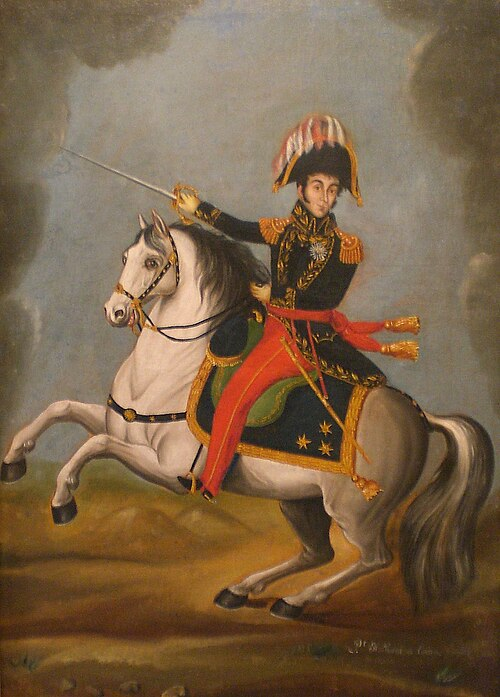
Bolívar was variously president or dictator with "limitless powers" of
various South American countries and in the process extracted from
Spanish clutches Bolivia, Peru, Ecuador, Colombia, Venezuela, and
Panama. And for this reason was known as the Liberator. When he met
Lancaster he'd been in England to raise support for his revolutionary
adventures. He had some success, attracting to his side more than two
thousand Irish disaffected (given the English treatment of the Irish at
the time, "disaffection" was the natural condition of the Irish).
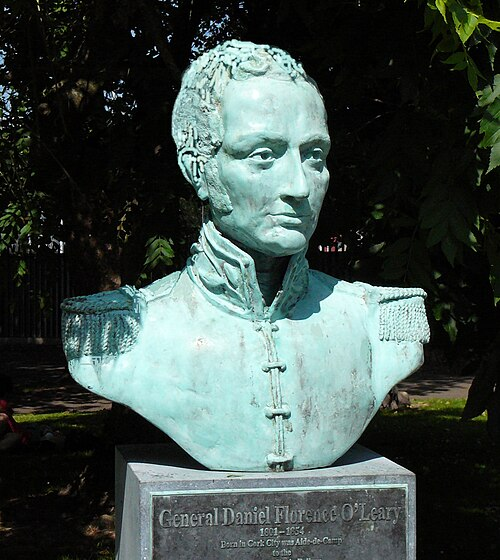
One of these, Daniel Florence O'Leary, briefly became Bolívar's aide de
camp, leaving behind a precarious Irish existence on potatoes and dreams
to become one of the heroes of South America and ending up general in
Bolívar's army. When Bolívar left for exile in 1831, O'Leary shipped out
for Europe, where he failed to get diplomatic recognition for Venezuela.
He then moved back to Caracas, and in 1841 the outgoing Brit
consul-general recommended him as temporary replacement.
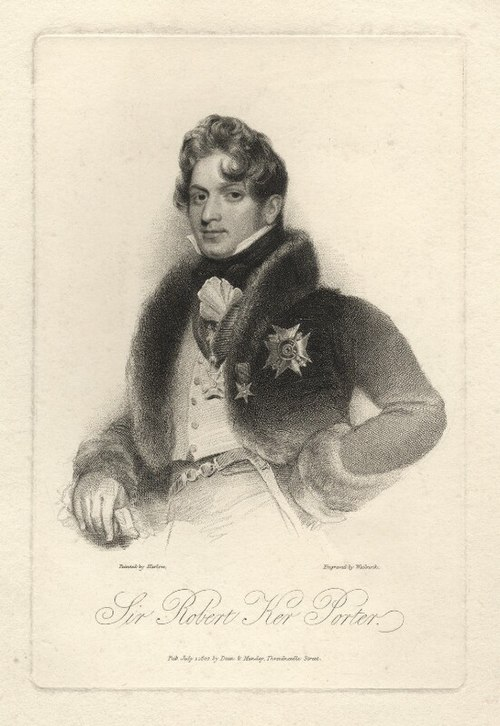
Consul Robert Ker Porter intended to return to Venezuela after a quick
trip to Russia but died there. Earlier on he'd made his mark as the
painter of giant canvases (first and most spectacular the 120-foot,
700-people, 2,500-square-foot Battle of Seringapatam). By
1803 Ker was internationally known for such big military set pieces, so
the Tsar Alexander I of Russia ordered several dozen yards for the St. Petersburg
Naval Academy. While working on this job Porter married a Russian
princess and traveled extensively in Russia. Then got the Caracas
consulship.
He was the first person to locate the tomb of Cyrus the Great in Pasargadae near Shiraz. 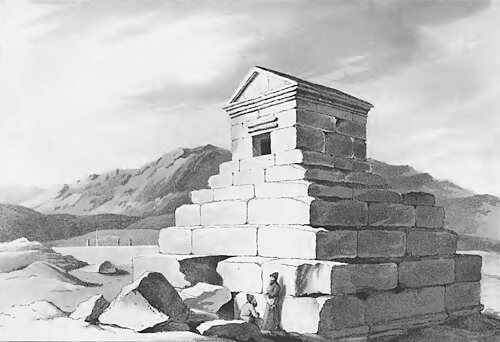
Porter's sister Jane (who brought back his body, and often paid his debts with her pioneering and best-selling historical novels) wrote romantic but
inaccurate historical novels (best: The Scottish Chiefs about William Wallace, which influenced family friend Sir Walter Scott and was banned by Napoleon Bonaparte), all
of which were slaughtered by the critics.
When she tried her hand at drama (Switzerland), the play opened at Drury Lane and
closed the same night, deliberately tanked by Edmund Kean. Late in life she had a (motherly?) thing with a young American writer, Nathaniel Willis, visiting Europe as social correspondent for the New York Mirror. Nathaniel was Yale and
poetry and did best with light pieces about social glitz, which went
over like a lead balloon with the British upper-crust elite whose
parties he crashed in search of material. At one point he fought a bloodless duel with Captain Frederick Marryat, then editor of the Metropolitan Magazine, after Willis sent a private letter of Marryat's to George Pope Morris, who had it printed.[21] Still, in 1835 Willis was popular enough to introduce Henry Wadsworth Longfellow to important literary figures in England, including Ada Byron, daughter of Lord Byron.[22]
He later met Dickens in London. He published EA Poe's The Raven, and participated in the resulting Longfellow Wars. He also boosted Julia Ward Howe, Hawthorne and Thoreau.
In 1833 Willis went on a junket around the Mediterranean on board the
USS Delaware, showing the flag to various potentates in Egypt
and Syria and taking in the sights of Jerusalem. Running the trip was
Commodore Todd Patterson, who'd spent twenty years in New Orleans (he Patterson raided the base of the pirate Jean Laffite ) after
doing good work in the 1812 war (and at one particularly scary moment
saving the life of Andrew Jackson). Patterson's chaplain was George
Jones. After the trip was over he went back to the United States and
agitated successfully for the establishment of a naval academy so that
more flag-showing could be accomplished. In 1851 the U.S. Naval Academy
at Annapolis opened with Jones as chaplain.
In 1853 Jones was on Commodore Perry's historic voyage to open up Japan, serving not only in a ministerial capacity but also as a chronicler of the expedition, amateur naturalist, and astronomer. He spent much of the two-year trip making 328 drawings of the mysterious zodiacal light: the glow in the sky seen just after dusk or
before dawn, which is caused by light from the hidden sun reflecting off
tiny dust particles in space (In 2007, Brian May, lead guitarist with the band Queen, completed his thesis, A Survey of Radial Velocities in the Zodiacal Dust Cloud, thirty-six years after abandoning it to pursue a career in music).
A few years later Jones's work came to the attention of a major Italian astronomer at the Milan Observatory, Giovanni Schiaparelli. Who would become famous for the greatest piece of misinterpretation in astronomical history. In 1877 Schiaparelli
described lines he had discovered on Mars as canali ("channels").
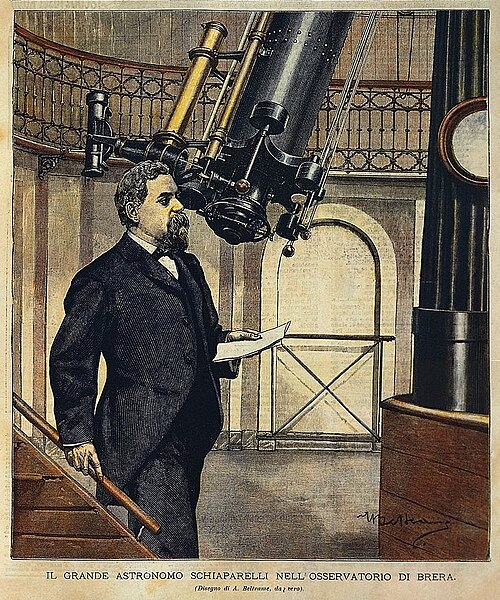
Decades later these lines turned out to be an optical
illusion, but not before Schiaparelli's word had been translated wrongly
into English as "canals." Front-page stuff when the papers decided this
meant there were people on the Red Planet. Among the most fervent supporters of the artificial-canal hypothesis was the American astronomer Percival Lowell, who spent much of his life trying to prove the existence of intelligent life on the red planet
Which gladdened the heart of those who published books by H. G. Wells
and especially Jules Verne, who'd almost invented the science-fiction
genre with his Journey to the Center of the Earth. Many great
novels later in 1885 he (or perhaps his son Michel) was commissioned to
do a piece on the life of an American journalist living in
A.D 2889. The piece was full of predictions like video
phones, color photography, lasers, and the internet and was set in a
world where the United Kingdom was a U.S. colony. Verne (or son) got the
commission from a flamboyant playboy millionaire American newspaper
proprietor living in France.
James Gordon Bennett provided the financial backing for the 1869 expedition by Henry Morton Stanley into Africa to find David Livingstone. He also backed George W. De Long's voyage to the North Pole on the USS *Jeannette* via the Bering Strait.
He was nuts about women, parties, and sport in that order and sponsored any event involving high tech and high speed. In 1911 at a Paris banquet following the latest Gordon Bennett balloon and airplane race, French industrialist Jacques Schneider announced the Schneider Trophy for seaplane races.
The race was significant in advancing aeroplane design, particularly in the fields of aerodynamics and engine design, and showed its results in the best fighters of World War II. The streamlined shape and the low drag, liquid-cooled engine pioneered by Schneider Trophy designs are obvious in the British Supermarine Spitfire, key to the Battle of Britain, and the American North American P-51 Mustang, responsible for downing nearly five thousand enemy aircraft.
In 1935 the trophy was won by an American, Lieutenant Jimmy Doolittle. Who progressed to greater fame on April 18, 1942, when he led the daring raid by sixteen B-25 bombers flying eight hundred miles off a carrier to hit Tokyo, Osaka, Nagoya,
and Kobe.
All the more daring because as the planes arrived over target the
business of opening the hydraulically operated bomb-bay doors, dropping
the bombs, and then closing the doors involved slowing to 250 miles per
hour and taking nearly three minutes to do it all. During which time,
the phrase "sitting duck" took on urgent new meaning. Not long after
this the problem was solved by using high-pressure air to operate the
doors, thus reducing the time to twenty seconds.
Cheers all round for the guys who provided the air pump: the Weatherhead
Company. In 1993 the Weatherhead Foundation endowed the Albert J.
Weatherhead III Professorship at Harvard's Faculty of Arts and Sciences.
In 2005 the holder of the chair was political scientist SAMUEL
HUNTINGTON, best known for his clash of civilizations.