Webster, Noah
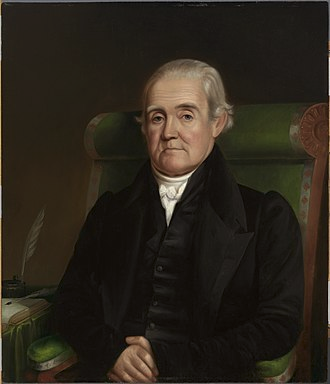
ACHIEVEMENTS: Compiled dictionary of American English
DATE AND PLACE OF BIRTH: 16 October 1758, West Hartford, CT
DATE AND PLACE OF DEATH AND AGE AT DEATH: 28 May 1843, New Haven, CT. Aged 85
DISCIPLINE: Lexicographer, essayist, educationalist
FIELD: Lexicography, education, journalism
LANGUAGE: English
PARENTS: Father: Noah Webster Mother: Mary Steele
SIBLINGS: 2 brothers: Abram, Charles 2 sisters: Mercy, Jerusha
SPOUSE: Rebecca Greenleaf
CHILDREN: 2 sons: William Greenleaf, Henry Bradford 6 daughters: Eliza, Emily, Frances, Harriet, Louisa, Mary
EDUCATION: Local village school Yale College, New Haven
MAJOR WORK: "American Dictionary of the English Language" (1828)
LIFE AND TIMES:
In 1781 Webster qualified as a lawyer but there was very little work for lawyers and his practice failed. Webster then decided to open a private school (in Sharon, NY) which would give him an income and allow him to experiment with educational reforms. He believed that girls should not just be taught "the ornamental arts" but should be educated in the same way as boys.
Most American literature at that time was published in Britain and English spelling and usage were the norm. Webster wanted to instil a feeling of national identity in children by teaching them about their own country and history.
Meanwhile he achieved some degree of fame, or notoriety, by writing a series of essays under the title "Observations on the Revolution of America" in which he denounced any idea that the end to fighting meant restoring the old relationship with Britain, declaring that such an action would amount to a return to slavery. He also attacked established religion and called for religious tolerance and a separation of church and state. In 1782 Webster opened a school in Goshen, New York.
In 1783 he brought out his "American Spelling Book", which became famous as the "Blue-Backed Speller". By standardizing spelling, Webster hoped to promote unity across America. He moved back to Connecticut and the following year published the "American Grammar". In 1785 he brought out the "American Reader" with texts about the recent Revolution and the patriotic heroism of those who had fought for America. This was a startling contrast to the old "New England Primer" which had been in use since 1690 and had a strongly religious theme.
All three books were an immediate success and once he had fought for his copyright Webster's royalties put an end to his financial troubles. In his essays in "Sketches of American Policy" (1785), he set out a form of social contract which echoed the writings of Rousseau*, whom he had just read, and outlined a constitution for the new America in which the main planks were compulsory public education of all and the abolition of slavery.
He was a committed Federalist and although he did not agree totally with the constitution drafted in 1787, he was persuaded by Franklin* to support it. Webster wrote a pamphlet ("Examination into the Leading principles of the Federal Constitution") aimed at the ordinary people of the United States in which he used plain language to analyse and defend the constitution. The pamphlet, dedicated to Franklin and published anonymously, was distributed throughout the nation and was influential in the eventual ratification of the Constitution.
Webster became a prominent citizen in Hartford where he had settled with his wife and growing family. He was drawn back into federal politics by his support of Washington's* policy of neutrality in the war which broke out between Britain and France during the French Revolution.
In 1793 he left Hartford for New York, where he founded two federalist newspapers, "The American Minerva" and "The Herald". In 1795 during an epidemic of yellow fever in New York, the "Minerva" ran what has been called the first newspaper campaign to improve public health.
There was a lot of controversy among doctors about how to treat yellow fever, and during the epidemic in Philadelphia in 1793 as a result of which the eminent doctor Rush*, had been forced to resign from the College of Physicians. Webster called for an epidemiological study by physicians who had experience of previous epidemics and presented them with a detailed questionnaire to answer. There was a huge response from overseas as well as in America, where doctors recorded their observations and ministers in churches kept records of deaths. In Philadelphia, Rush produced a study showing that the disease was contagious.
In 1798 Webster published a record of the responses to his questionnaire, which he later developed into a substantial work on epidemic diseases. He called for improved sanitation measures such as the filling of swamps and cleaning of streets and at the end of 1796 new sanitation laws were introduced in New York.
After John Quincy Adams* became president of the United States in 1797, Webster supported Adams's policy of neutrality and was vilified for doing so by Cobbett*, the English editor of the Philadelphia "Porcupine's Gazette".
In 1801 Webster retired from journalism and began working on a new dictionary. In 1806 he published his "Compendious Dictionary of the English Language" and the following year began work on his masterpiece, the "American Dictionary". The project occupied him for over twenty years and involved travelling to England and France for philological research (in 1824-5), and learning twenty different alphabets and languages.
The first two-volume edition of "An American Dictionary of the English Language" came out in 1828. It introduced the spelling reforms he had long urged, such as 'defense' for 'defence', 'jail' for 'gaol', 'mold' for 'mould' and 'center' for 'centre'. He included the contemporary technical terms used in crafts and industry, but his most valuable contribution was to include many words which had come into common usage in America because of the country's unique landscape and natural history, and the influence of American immigrants.
These included words such as 'prairie', the naming of native plants such as squash and corn, and animals such as caribou and porcupine. 'Strudel' came from the German immigrants and 'crib', 'pumpkin' and 'cookie' from the Dutch. Americanisms such as 'kids' for children were included, as well as new words such as 'dime', 'dollar' and 'minuteman'.
Altogether, Webster's dictionary contained 12,000 words and 30-40,000 definitions that had not appeared in any earlier dictionary. An engraving of an original portrait of Webster by Samuel Morse* (executed in 1823) was used as the frontispiece in the first edition of the dictionary.
ASSESSMENT: Webster produced the first comprehensive dictionary of American English.
EXTRA CONNECTIONS: None
ONELINER: Noah Webster, writer of first American English dictionary
BIBLIOGRAPHY:
Unger, Harlow Giles,Noah Webster, The Life and Times of an American Patriot, John Wiley & Sons, Inc., New York, 1998
Sandbox: TheBrain