Washington G Pres
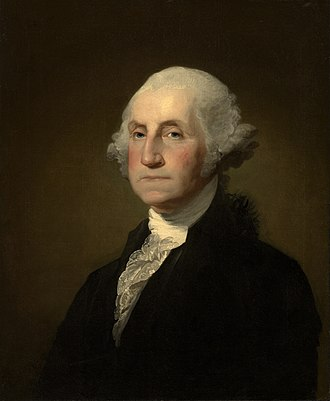
Name: George Washington
Achievements: First US President
Born: February 22, 1732 (February 11, old style); Westmoreland County, Virginia.
Died: December 14, 1799; Mount Vernon, Virginia (Aged 67)
Field & Discipline: Politics; President
Language: English
Father: Augustine Washington (d. 1743)
Mother: Mary Ball (married 1731)
Siblings: Four half-siblings (by father's first wife, Jane Butler),
including two half-brothers, Lawrence and Augustine; and five younger
siblings, Elizabeth, Samuel, John Augustine, Charles, and Mildred (who died
in infancy)
Spouse: Martha Dandridge Custis (married 1759)
Children: Two step-children: John Custis; Martha Custis
Education: Irregular elementary education
Life & Times:
George Washington was born in 1732 in Westmoreland County, Virginia, the eldest son of Augustine Washington and his second wife, Mary Ball, who were prosperous Virginia gentry of English descent. Washington spent his early years on the family estate on Pope's Creek along the Potomac River, and attended school irregularly from the ages of seven to fourteen, first with the local church sexton and later with a local schoolmaster. His early education included the study of mathematics, the classics, and "rules of civility."
When his father died in 1743, Washington became a ward of his half-brother Lawrence, and went to Mount Vernon to live on his plantation on the Potomac. In 1748 Washington was taken on a surveying expedition by George William Fairfax in the Shenandoah Valley wilderness.
During this month-long expedition, Washington began to appreciate the uses and value of land, and on his return studied surveying and became licensed by the College of William and Mary. In 1749 he was appointed Culpeper County surveyor, and helped lay out the Virginia town of Belhaven (now Alexandria).
In 1751, Washington accompanied Lawrence to Barbados in an effort to cure his tuberculosis. Lawrence failed to recover and died on his return home in 1752. Soon afterwards Washington leased the Mount Vernon estate from Lawrence's widow, and by 1761 had acquired the property outright.
Meanwhile, with Lawrence's death Virginia's colonial governor Robert Dinwiddie appointed Washington adjutant commander of one of Virginia's four militia districts with
the rank of major. By 1753 the growing rivalry between the British and French over control of the Ohio Valley, soon to erupt into the French and Indian War (1754-63), created new opportunities for the ambitious young Washington, and in October 1753 he was dispatched by Dinwiddie on a fruitless mission to warn the French commander at Fort Le Boeuf against further encroachment on territory claimed by Britain.
Washington's diary account of the dangers and difficulties of his journey was published at the colonial capital of Williamsburg on his return in early 1754, and helped to win him promotion to lieutenant colonel.
In April 1754, Dinwiddie ordered Washington to lead a detachment of 159 militia into the Ohio River valley in order to defend an English fort under construction at the present site of Pittsburgh. On his arrival Washington learned that the French, numbering more than a thousand, had captured the fort (which they named Fort Duquesne). Washington built a small fort he named Fort Necessity, about forty miles away at Great Meadows, Pennsylvania, and marched to intercept any French troops.
On 28 May 1754 he met a small French and Indian party, and in the resulting skirmish the French commander, Joseph Coulon, sieur de Jumonville, was killed and most of his men captured. The French party had in fact been charged with issuing a peaceful warning, and the French were outraged, calling the killing an "assassination", and sending a party of 1200 to attack Fort Necessity.
After several hours of fierce fighting, on 3 July Washington was forced to surrender when driving rain flooded the fort and ruined his ammunition. The French agreed to lenient terms, allowing Washington to march his remaining troops back to Williamsburg. Washington’s fearless conduct in battle, and his dramatic descriptions of these engagements -- which were written to a younger brother, but subsequently published all over America-- made him a hero of English-speaking America.
As full-scale war between Britain and France became inevitable, Washington was eager to participate, but when he learned that the British government had ordered that colonials could hold a rank no higher than captain, he resigned his commission at the end of 1754. The following year, however, he joined British general Edward Braddock's expedition against the French as a volunteer.
After a series of errors of judgement, Braddock was ambushed by the French and their Indian allies on the Monongahela River. Washington, although seriously ill, managed to lead the survivors to safety, again enhancing his military reputation. As a result, in 1755, at the age of 23, he was promoted to colonel and appointed commander-in-chief of the Virginia militia, with responsibility for defending the frontier.
Washington left the army in 1758 and returned to Mount Vernon. In January 1759, he married Martha Dandridge Custis, a wealthy young widow with two small children and the same year, with the support of an ever-growing circle of influential friends, he entered politics, serving (1759-74) in Virginia's House of Burgesses (the colonial assembly), and also as a county justice and vestryman in his parish. After 1769, Washington became a leader of Virginia's opposition to Great Britain's colonial policies.
In 1774-75, Washington acted as a delegate to the First and Second Continental Congress where he joined ranks with such revolutionaries as [collaborated with] Samuel Adams*. Fighting broke out in spring 1775, and in June Washington was unanimously appointed as commander-in-chief of the rebel forces besieging British-occupied Boston.
On July 3. Washington took command of the troops surrounding Boston, devoting the next few months to training the undisciplined 14,000-man army and trying to secure urgently needed ammunition and other supplies.
Early in March 1776, using cannon brought down from Ticonderoga by Henry Knox, Washington occupied Dorchester Heights, effectively commanding the city and forcing the British to evacuate. He then moved to defend New York City against the combined land and sea forces of Sir William Howe, but eventually retreated from Manhattan through New Jersey into Pennsylvania.
Washington briefly revived morale and bought time by his brilliantly-conceived attack on Trenton, New Jersey in which he crossed the Delaware River with 2,400 colonial troops in a snowstorm on Christmas night 1776 and captured 1,000 Hessian mercenaries. Advancing to Princeton, he routed the British there on 3 January 1777, but in September and October 1777 he suffered losses at Brandywine and Germantown.
Meanwhile, the major success of that year, the defeat in October 1777 of the British at Saratoga, had belonged not to Washington but to Benedict Arnold and General Horatio Gates. The contrast between Washington's record and Gates's brilliant victory was one factor that led to the so-called "Conway Cabal" - an intrigue by some members of Congress and army officers to replace Washington with a more successful commander, probably Gates.
Washington acted quickly, and the plan eventually collapsed due to the lack of public support and Washington's overall superiority to his rivals. After holding his bedraggled and dispirited army together during the difficult winter (1777-78) at Valley Forge, Washington learned that France had recognized American independence.
With the aid of the Prussian Baron von Steuben and the Frenchman [aided by] Lafayette*, he concentrated on turning the army into a fighting force, and by spring 1778 he was ready to take the field again. In June 1778 he attacked the British near Monmouth Courthouse, N.J., as they were withdrawing from Philadelphia to New York, and Washington's quick action on the field prevented an American defeat.
In 1780 the main theater of the war shifted to the South, where Britain held Georgia and much of the Carolinas. Although the campaigns here were conducted by other generals, Washington remained responsible for the overall direction of the war. After the arrival of the French army in 1780 he concentrated on coordinating allied efforts and in 1781 the tide turned when Washington launched, in cooperation with the Comte de Rochambeau, the Comte de [fought with] Grasse* and the Comte d'Estaing, the brilliantly planned and executed Yorktown Campaign against [defeated] Cornwallis* and his 8,000-strong army, which secured an American victory on 19 October 1781.
After the war, Washington returned to Mount Vernon, which had declined in his absence. Although he received public recognition and many awards and honors - including, in 1781, along with the English philosopher and supporter of the American Revolution [honored with] Price*, an honorary degree from Yale - he at first avoided involvement in Virginia politics.
In May 1787, however, Washington headed the Virginia delegation to the Constitutional Convention in Philadelphia and was unanimously elected presiding officer. His presence together with [collaborated with] Franklin* lent prestige to the proceedings, and although he made few direct contributions he generally supported the move for a strong constitutional government.
In 1789, after the new Constitution was submitted to the states for ratification, he was unanimously elected President and agreed to serve. He took the oath administered by [oath administered by] Robert R Livingston* on 30th April 1789 in New York City, at the age of 57.
On taking office, Washington was immediately faced with filling almost a thousand offices, the most important going to [worked with] Jay* (chief justice), [worked with] Thomas Jefferson* (Secretary of State), [worked with] Alexander Hamilton* (Secretary of the Treasury), Henry Knox (Secretary of War), Edmund Randolph (attorney general), and Samuel Osgood (postmaster general).
During his first term of office, Washington generally acted carefully and deliberately as President (as he had as military commander), aware of the need to build a firm foundation and executive structure that could accommodate future governments and presidents.
Although he was a good administrator, he failed to heal the breach between factions led by Jefferson (Democratic-Republicans) and Hamilton (Federalists), and because he supported many of Hamilton's controversial fiscal policies -- including the assumption of state debts, the Bank of the United States, and the excise tax -- during the early 1790s Washington became the target of vicious personal attacks by Jefferson's supporters.
Washington was re-elected president in 1792, and the following year a major crisis occurred in his cabinet over the issue of American neutrality during the war between England and France.
Washington, whose policy of neutrality angered the pro-French Jeffersonians, was horrified by the excesses of the French Revolution and enraged by the tactics of Edmond Genet, the French minister in the United States, which amounted to foreign interference in American politics.
With an eye to developing closer commercial ties with the British, the president agreed with the Hamiltonians on the need for peace with Great Britain. His acceptance of Jay's Treaty (1795), which settled outstanding differences between the United States and Britain (but which Democratic-Republicans viewed as a surrender to British demands), revived attacks on the President.
By March 1797, when Washington left office, the country's financial system was well established, the American Indian threat east of the Mississippi had been largely eliminated, and both Jay's and Pinckney's Treaty (1795) with Spain had enlarged U.S. territory and removed serious diplomatic difficulties.
In spite of the animosities and conflicting opinions between Democratic-Republicans (which included future fifth president [work related to] Monroe*) and members of the Hamiltonian Federalist party, the two groups were at least united in accepting the new Federal government. Washington refused to run for a third term and, after a masterly Farewell Address in which he warned the United States against "the baneful effects" of party politics and against permanent alliances abroad, he went home to Mount Vernon. He was succeeded by his vice-president, Federalist [successor was] John Quincy Adams*.
Although Washington reluctantly accepted command of the army in 1798 when war with France seemed imminent, he did not assume an active role, preferring to spend his last years in retirement at Mount Vernon. In mid-December 1799, Washington contracted what was probably quinsy or acute laryngitis, and died after a brief illness.
Extra Connections: [aide was] Aaron Burr* was his aide.
[no support from] Andrew Jackson* voted against tributes on his retirement.
[grand-daughter married] Robert E. Lee* married his adopted son’s daughter.
Friend of politician [a pa of] Gouverneur Morris*
He ordered [ordered reading of] Thomas Paine’s* pamphlet to be read to the troops at Valley Forge
Endowed [endowed] Washington College*
[a supporter was] Noah Webster* was a supporter
He was a colleague in Congress of Silas [colleague of] Deane*
He knew Catherine [knew] Greene*
He is said by [subject of monarchy rumor by]Dutens* to have offered the throne of America to Scottish Prince Charles [maybe offered American throne to]Stuart*
He was a colleague of [was a colleague of]John Hancock*, [was a colleague of]Josiah Bartlett*, [was a colleague of]William Whipple*, [was a colleague of]Sam Adams*, [was a colleague of]John Adams*, [was a colleague of]Robert Treat Paine*, [was a colleague of]Stephen Hopkins*, [was a colleague of]William Ellery*, [was a colleague of]Roger Sherman*, [was a colleague of]Samuel Huntington*, [was a colleague of]William Williams*, [was a colleague of]William Floyd*, [was a colleague of]Philip Livingston*, [was a colleague of]Francis Lewis*, [was a colleague of]Lewis Morris*, [was a colleague of]Richard Stockton*, [was a colleague of]John Witherspoon*, [was a colleague of]Francis Hopkinson*, [was a colleague of]John Hart*, [was a colleague of]Abraham Clark*, [was a colleague of]Robert Morris*, [was a colleague of]Benjamin Rush*, [was a colleague of]Benjamin Franklin*, [was a colleague of]John Morton*, [was a colleague of]George Clymer*, [was a colleague of]James Smith*, [was a colleague of]George Taylor*, [was a colleague of]James Wilson*, [was a colleague of]George Ross*, [was a colleague of]Caesar Rodney*, [was a colleague of]George Read*, [was a colleague of]Samuel Chase*, [was a colleague of]William Paca*, [was a colleague of]Thomas Stone*, [was a colleague of]Charles Carroll*, [was a colleague of]Thomas Jefferson*, [was a colleague of]Benjamin Harrison*, [was a colleague of]Thomas Nelson*, [was a colleague of]Francis Lightfoot Lee*, [was a colleague of]Carter Braxton*, [was a colleague of]William Hooper*, [was a colleague of]Joseph Hewes*, [was a colleague of]John Penn*, [was a colleague of]Edward Rutledge*, [was a colleague of]Thomas Heyward*, [was a colleague of]Thomas Lynch Jr.*, [was a colleague of]Arthur Middleton*, [was a colleague of]Button Gwinett*, [was a colleague of]Lyman Hall*, [was a colleague of]George Walton*, [was a colleague of]George Wythe*, [was a colleague of]Elbridge Gerry*, [was a colleague of]Richard Henry Lee*, [was a colleague of]Oliver Wolcott*, [was a colleague of]Matthew Thornton*, [was a colleague of]Thomas McKean*
Assessment: Commander-in-chief of American forces during the American Revolution, chairman of the Convention that wrote the United States Constitution, and first President of the United States, he led the movement which turned America from an English colony into a self-governing nation. His ideals of liberty and democracy set a standard for future presidents and for the whole country.
Oneliner: George Washington, first President of the US
Bibliography:
- Collier's Encyclopedia.
- Encyclopedia Britannica.
- Ferling, J.E., The First of Men: A Life of George Washington, University of Tennessee Press, 1988.