Wig
A wig is a head or hair accessory made from human hair, animal hair, or synthetic fiber.[1] The word wig is short for periwig,[2] which makes its earliest known appearance in the English language in William Shakespeare's The Two Gentlemen of Verona. Some people wear wigs to disguise baldness; a wig may be used as a less intrusive and less expensive alternative to medical therapies for restoring hair or for a religious reason.
History
Ancient and Medieval Use
In Egyptian society men and women commonly had clean shaven or close cropped hair and often wore wigs.[3][4] The ancient Egyptians created the wig to shield shaved, hairless heads from the sun. They also wore the wigs on top of their hair using beeswax and resin to keep the wigs in place.
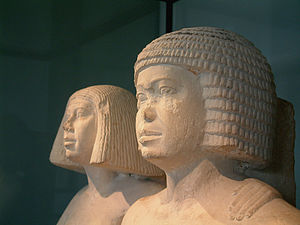 Wealthy Egyptians would wear elaborate wigs and scented head cones of animal fat on top of their wigs.[3] Other ancient cultures, including the Assyrians,[5] Phoenicians, Jews in ancient Israel,[6] Greeks and Romans, also used wigs as an everyday fashion....
16th and 17th Centuries
After the fall of the Western Roman Empire, the use of wigs fell into disuse in the West for a thousand years until they were revived in the 16th century as a means of compensating for hair loss or improving one's personal appearance.[8] They also served a practical purpose: the unhygienic conditions of the time meant that hair attracted head lice, a problem that could be much reduced if natural hair were shaved and replaced with a more easily de-loused artificial hairpiece.[9] Fur hoods were also used in a similar preventive fashion.
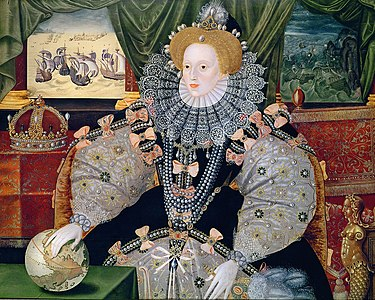
Royal patronage was crucial to the revival of the wig.[10] Queen Elizabeth I of England famously wore a red wig, tightly and elaborately curled in a "Roman" style, while among men King Louis XIII of France (1601–1643) started to pioneer wig-wearing in 1624 when he had prematurely begun to bald.[11] This fashion was largely promoted by his son and successor Louis XIV of France (1638–1715), which contributed to its spread in Europe and European-influenced countries in the 1660s.
Perukes or periwigs for men were introduced into the English-speaking world with other French styles when Charles II was restored to the throne in 1660, following a lengthy exile in France. These wigs were shoulder-length or longer, imitating the long hair that had become fashionable among men since the 1620s. Their use soon became popular in the English court. The London diarist Samuel Pepys recorded the day in 1665 that a barber had shaved his head and that he tried on his new periwig for the first time, but in a year of plague he was uneasy about wearing it:[12]
3rd September 1665: Up, and put on my coloured silk suit, very fine, and my new periwig, bought a good while since, but darst not wear it because the plague was in Westminster when I bought it. And it is a wonder what will be the fashion after the plague is done as to periwigs, for nobody will dare to buy any haire for fear of the infection? That it had been cut off the heads of people dead of the plague....
18th Century
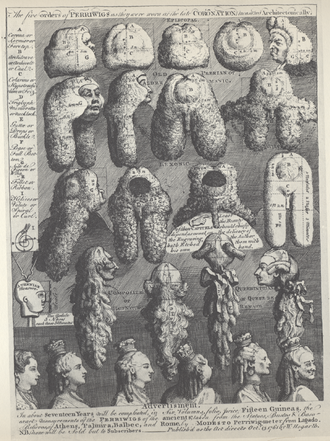
In the 18th century, men's wigs were powdered to give them their distinctive white or off-white color.[16] Women in the 18th century did not wear wigs, but wore a coiffure supplemented by artificial hair or hair from other sources. Powdered wigs (men) and powdered natural hair with supplemental hairpieces (women) became essential for full dress occasions and continued in use until almost the end of the 18th century.
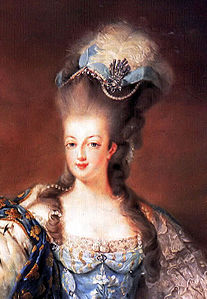
(Marie Antoinette wearing the distinctive pouf style coiffure; her own natural hair is extended on the top with an artificial hairpiece.)
The elaborate form of wigs worn at the coronation of George III in 1761 was lampooned by William Hogarth in his engraving Five Orders of Periwigs. Powdering wigs and extensions was messy and inconvenient, and the development of the naturally white or off-white powderless wig (made of horsehair) for men made the retention of wigs in everyday court dress a practical possibility.
By 1765, wig-wearing went out of fashion except for some occupational groups such as coachmen and lawyers. During this period, people tend to simply wear their natural hair, styled and powdered to resemble a wig. However, the trend revived extravagantly during the Macaroni period of the 1770s.[14] Women mainly powdered their hair grey, or blue-ish grey, and from the 1770s onwards never bright white like men. Wig powder was made from finely ground starch that was scented with orange flower, lavender, or orris root. Wig powder was occasionally colored violet, blue, pink or yellow, but was most often off-white.[17]
By the 1780s, young men were setting a fashion trend by lightly powdering their natural hair, as women had already done from the 1770s onwards. After 1790, both wigs and powder were reserved for older, more conservative men, and were in use by ladies being presented at court. After 1790, English women seldom powdered their hair.
In 1795, the British government levied a tax on hair powder of one guinea per year. This tax effectively caused the demise of both the fashion for wigs and powder. Granville Leveson-Gower, in Paris during the winter of 1796, at the height of the Thermidorian Directory, noted "The word citoyen seemed but very little in use, and hair powder being very common, the appearance of the people was less democratic than in England."[18]
Among women in the French court of Versailles in the mid-to-late 18th century, large, elaborate and often themed wigs (such as the stereotypical "boat poufs") were in vogue. These combed-up hair extensions were often very heavy, weighted down with pomades, powders, and other ornamentation. In the late 18th century these coiffures (along with many other indulgences in court life) became symbolic of the decadence of the French nobility, and for that reason quickly became out of fashion from the beginning of the French Revolution in 1789.
During the 18th century, men's wigs became smaller and more formal with several professions adopting them as part of their official costumes. This tradition survives in a few legal systems. They are routinely worn in various countries of the Commonwealth. Until 1823, bishops of the Church of England and Church of Ireland wore ceremonial wigs. The wigs worn by barristers are in the style favoured in the late eighteenth century. Judges' wigs, in everyday use as court dress, are short like barristers' wigs (although in a slightly different style), but for ceremonial occasions judges and also senior barristers (QCs) wear full-bottomed wigs.[19]
19th and 20th Centuries
Due to the association with ruling classes in European monarchies the wearing of wigs as a symbol of social status was largely abandoned in the newly created republics, the United States and France, by the start of the 19th century, though formal court dress of European monarchies still required a powdered wig or long powdered hair tied in a queue until the accession of Napoleon Bonaparte to the throne as emperor (1804-1814).
In the United States, only four presidents, from John Adams to James Monroe, wore curly powdered wigs tied in a queue according to the old-fashioned style of the 18th century,[20][21] though Thomas Jefferson stopped wearing a wig shortly after becaming president.[22] Unlike them, the first president, George Washington, never wore a wig; instead, he powdered, curled and tied in a queue his own long hair.[23]
Women's wigs developed in a somewhat different way. They were worn from the 18th century onwards, although at first only surreptitiously. Full wigs in the 19th and early 20th century were not fashionable. They were often worn by old ladies who had lost their hair. In the film Mr. Skeffington (1944), Bette Davis's character has to wear a wig after a bout of diphtheria, which is a moment of pathos and a symbol of her frailty.
During the late nineteenth and early twentieth century hairdressers in England and France did a brisk business supplying postiches, or pre-made small wiglets, curls, and false buns to be incorporated into the hairstyle. The use of postiches did not diminish even as women's hair grew shorter in the decade between 1910 and 1920, but they seem to have gone out of fashion during the 1920s.[24] In the 1960s a new type of synthetic wig was developed using a modacrylic fiber which made wigs more affordable. Reid-Meredith was a pioneer in the sales of these types of wigs.[25]
21st Century
The art of wigs became a billion dollar industry in the 21st century. Three main processes happen within the industry: the collection of material, manufacturing, and distribution. India is the main source of hair. It has been reported from time to time that for global human hair trade, women from the ASEAN region are being exploited.[26] Hair from this region has a significant commercial value in the international market.[27]
Particularly in India, the women are forced by their husbands into selling their hair,[28] and slum children were being tricked into "having their heads shaved in exchange for toys".[29] Scrap pickers are another source of hair in India, these people find hair in miscellaneous places such as hair brushes, clothes, or in the trash. While manufacturing and processing mainly takes place in China, where the hair is sorted through and constructed into wigs, the final product exported abroad, with the top countries being the United States and the United Kingdom.[30]
Official Use
In Britain, most Commonwealth nations, and the Republic of Ireland special wigs are also worn by barristers, judges, and certain parliamentary and municipal or civic officials as a symbol of the office. Hong Kong barristers and judges continue to wear wigs as part of court dress as a legacy of the court system from the time of British rule. In July 2007, judges in New South Wales, Australia, voted to discontinue the wearing of wigs in the NSW Court of Appeal.[31] New Zealand lawyers and judges have ceased to wear wigs except for ceremonial occasions, such as when newly-qualified lawyers are called to the bar. In Canada lawyers and judges do not wear wigs.
Entertainment
A number of celebrities, including Donna Summer, Dolly Parton, Sia, Nicki Minaj, Katy Perry, Lady Gaga, Diana Ross & The Supremes, Tina Turner and Raquel Welch, popularized wigs. Cher has worn all kinds of wigs in the last 40 years, from blonde to black, and curly to straight. They may also be worn for fun as part of fancy dress (costume wearing), when they can be of outlandish color or made from tinsel. They are quite common at Halloween, when "rubber wigs" (solid bald cap-like hats, shaped like hair), are sold at some stores....
Extra Connections:
When Benjamin Franklin was on a diplomatic mission to get support for the colonies during the American Revolution, he caused a sensation / scandal by coming to the court of Louis XVI without the required wig and sword.
Research Notes:
This is Versailles: Sickness of Shame: Syphilis
Syphilis was one of those diseases one did not talk about but everyone knew existed. Being sexually transferred it was tabu; quite odd considering that both adultery and liaisons were not only common but accepted. Throughout Europe syphilis also had another name though it is unlikely that it would have won favour with the French: the French pox. In France it was referred to as the "Neapolitan disease".
Syphilis was a particularly nasty type of illness which was impossible to hide from the outside world. Patients suffered first from sore ulcers in the genital area which could later evolve into blindness, paralysis and it was far from uncommon that the nose simply caved into the face. This latter symptom meant the rise of artificial noses which could be enamelled or painted to look as much like the original as possible.
During the 17th century the doctors relied on mercury as the sole "treatment" for this dreadful disease - it need hardly be said that they had little success. Instead their patients suffered mercury poisonings which included uncontrolled salivation. This treatment gave rise to the saying: "A night with Venus, a lifetime with Mercury". To make matters worse syphilis was a slow killer.
Being sexually transferred it was immediately assumed that anyone who fell victim to the disease led a life of debauchery. In some cases that was indeed the case and since the noblemen of France has never scorned the society of Paris' finer brothels it is very likely. But, there were some who led completely decent lives and who had merely been infected through their (cheating) spouse. The court in which Louis XIV grew up in definitely saw syphilis as a sign of god's wrath for a misspent life. The mother of the unfortunate Fouquet made it clear that she considered the two aspects definitely intertwined....
https://www.mentalfloss.com/article/31056/why-did-people-wear-powdered-wigs
For nearly two centuries, powdered wigs—called perukes—were all the rage. The chic hairpiece would have never become popular, however, if it hadn't been for a venereal disease, a pair of self-conscious kings, and poor hair hygiene.
The peruke’s story begins like many others—with syphilis. By 1580, the STD had become the worst epidemic to strike Europe since the Black Death. According to William Clowes, an “infinite multitude” of syphilis patients clogged London’s hospitals, and more filtered in each day. Without antibiotics, victims faced the full brunt of the disease: open sores, nasty rashes, blindness, dementia, and patchy hair loss. Baldness swept the land.
At the time, hair loss was a one-way ticket to public embarrassment. Long hair was a trendy status symbol, and a bald dome could stain any reputation. When Samuel Pepys’s brother acquired syphilis, the diarist wrote, “If [my brother] lives, he will not be able to show his head—which will be a very great shame to me.” Hair was that big of a deal.
Cover-Up
And so, the syphilis outbreak sparked a surge in wigmaking. Victims hid their baldness, as well as the bloody sores that scoured their faces, with wigs made of horse, goat, or human hair. Perukes were also coated with powder—scented with lavender or orange—to hide any funky aromas. Although common, wigs were not exactly stylish. They were just a shameful necessity. That changed in 1655, when the King of France started losing his hair.
Louis XIV was only 17 when his mop started thinning. Worried that baldness would hurt his reputation, Louis hired 48 wigmakers to save his image. Five years later, the King of England—Louis’s cousin, Charles II—did the same thing when his hair started to gray (both men likely had syphilis). Courtiers and other aristocrats immediately copied the two kings. They sported wigs, and the style trickled down to the upper-middle class. Europe’s newest fad was born.
The cost of wigs increased, and perukes became a scheme for flaunting wealth. An everyday wig cost about 25 shillings—a week’s pay for a common Londoner. The bill for large, elaborate perukes ballooned to as high as 800 shillings. The word “bigwig” was coined to describe snobs who could afford big, poufy perukes.
When Louis and Charles died, wigs stayed around. Perukes remained popular because they were so practical. At the time, head lice were everywhere, and nitpicking was painful and time-consuming. Wigs, however, curbed the problem. Lice stopped infesting people’s hair—which had to be shaved for the peruke to fit—and camped out on wigs instead. Delousing a wig was much easier than delousing a head of hair: you’d send the dirty headpiece to a wigmaker, who would boil the wig and remove the nits....
...
With wigs virtually obligatory garb for men with social rank, wigmakers gained considerable prestige. A wigmakers' guild was established in France in 1665, a development soon copied elsewhere in Europe. Their job was a skilled one as 17th century wigs were extraordinarily elaborate, covering the back and shoulders and flowing down the chest; not surprisingly, they were also extremely heavy and often uncomfortable to wear. Such wigs were expensive to produce. The best examples were made from natural human hair. The hair of horses and goats was often used as a cheaper alternative.[13]^(https://en.wikipedia.org/wiki/Wig#cite_note-13).....
The seventeenth century saw the complete resurgence of the wig and it became the height of fashion for both men and women, with many shaving their heads beneath for both comfort and fit. Hair historian Richard Corson sees the ascendance of Louis XIV to the French throne as pivotal. The king supplemented his thinning hair with false pieces until "eventually he agreed to have his head shaved, which was done daily thereafter, and to wear a wig." (Corson, p. 215) By the eighteenth century, those who had the finances had a large wig for formal occasions and a smaller one for use in the home. The larger or more "full bottomed" the wig, the more expensive, thus they were also a mark of class and income and the target of wig snatch-ers.
If one was unable to afford a wig, one made one's natural hair look as wiglike as possible. By the mid-eighteenth century, white was the favored color for wigs, and they were first greased then powdered with flour or a mixture of starch and plaster of paris in the house's wig closet using special bellows. Lucrative trades were constructed around their care and maintenance, such as hairdressing, so-called because hair was dressed rather than cut. Women's wigs were particularly high, powdered, and bejeweled, and the subject of much caricature. To achieve the look, hair was harvested from the heads of the rural working classes. Richard Corson noted that the full wig was disappearing by about 1790, however, "when there was a good deal of natural hair in evidence" (Corson, p. 298)....
Medium: During the late 1600s, Louis XIV was not only the king of France but the king of fashion as well. In fact, it was the Sun King that set France on the road to style stardom. Fashion, you see, became his economic stimulus plan. He endorsed clothing lines, had rules about what outfits to wear for different functions, and rewarded the good with permission to imitate his shoe style.
Everyone wanted to look like the fashion king, even to the point of imitating his hair. Those unlucky courtiers who couldn’t naturally grow long luscious locks like their monarch could make up for their imperfections with a wig. Naturally, everyone can’t be as perfect as me, said the king admiring his naturally long locks, “But it’s understandable they should want to try.Then one fateful day the king, who had previously turned his royal nose up at the whole wig thing, realized his hair was beginning to take its leave — and without the royal permission.
What IF?
In that moment, when the Sun King was faced with making the decision to add fake locks to his royal head, did he realize the impact he would have on society? What if he had chosen to be bodaciously bald? Bald Heads are powerful heads, he could have cried out.As king I am perpetually infused with the knowledge of the universe. Hair merely interferes with the reception.
He could have pulled baldness out of the mire of negativity, signaling to the world bald heads are actually beautiful shiny orbs of the gods. Unfortunately, it wasn’t to be. He wasn’t strong enough to buck tradition and embrace the naked noggin. Instead, he elevated his aura with a wig, eventually hiring 40 wig makers to support his new habit.
Louis XIV’s ancestor, Charles the Bald. Perhaps this is the reason he went with the wig.
Oh that wondrous wig
To cover the royal head was no easy task. It could take hair from up to 10 heads just to make one wig. Fine hair, you see, is like fine wine. You can’t just use any old head, especially for the king. What was needed was quality hair. Now the Dutch had the best hair, but within France, the Normans were the preferred suppliers. Men were off the list of donators, and so were city women. The best hair came from the country women. They went around with their heads covered, keeping their locks lovely and protected.
Of course, a good wig maker had to be dedicated to his profession. The king's wig maker, Georges Binet, certainly was. “I would strip every head in the kingdom bald in order to adorn that of his majesty,” he said. He might have found it necessary too because the king had nearly 1000 wigs. After all, a fashion king can’t just have good hair, he’s got to have great hair and it should be fitting for every occasion.
A wig for official functions?
Got it.
A wig for hunting?
Got it.
How about a wig for just staying home and kicking back on a lazy Sunday afternoon?
Oh yeah baby, got that too.
The fellowship of the wig
And so the revolution began. The wig, or perruque as they called it in France, became indispensable. Everyone wanted to imitate the style of their fashionable king, and the wig began to soar to new heights.
By the second half of Louis’s reign (1660–1715) hair had become quite dramatic. These wigs, known as the full bottom, had long tresses cascading down the back, over the shoulders, and down the chest. The hair was parted down the middle and swooped up into peaks on both sides — a most particularly endearing feature. The fad caught on so well that the number of Parisian wig makers went from 200 in 1637 to 945 by 1771.
Louis’ wigs caught on across the channel in England too. Charles II, who spent time exiled in France after getting in a little tiff with Oliver Cromwell and friends, returned home with his own Louis style faux curls. In fact the wig was taking over Europe as a sign of status and power. Although wigs were being made everywhere in varying degrees of quality, French made wigs were the way to go. If you had the money, you could even get one from the shop of Georges Binet. You could then boast to all your friends that you and the king shared the same wig maker.
Louis XIV never let anyone see his bald head except his barber.
The easy life
Of course, wig makers loved what Louis XIV was doing for them, and did their best to improve the wigs popularity. One selling point was the ease and convince of the wig. For those who had the money, a wig guaranteed everyday would be a perfect hair day, and the owner didn’t have to do a thing.
After all, why bother washing and styling your own hair when you could just as easily take it off and have someone else tidy it up for you? To wear one all you had to do was first shave off all your own hair and replace it with a nice little cap. This was to basically sop up the sweat accumulating under your heavy load of false locks. Wigs obviously weren’t worn at night, so the head was tucked into a cozy night cap, hairless heads can be prone to colds after all.
Nicolaas Witsen, a Dutch statesman, showing of his lovelly wig in 1701
Wig care 101
To keep those curls nice and bouncy they would need to be wrapped around hot clay rollers, definitely a step better completed with the wig off. Then, of course, your wig would have to be powdered. A pomade would first be applied to help the powder stick. Color choices were grayish white, light brown, tan, and after 1703 a guy could go pure white. Other options were black, blue, lavender, pink, red or yellow. Generally, the powder was made of wheat flour or white clay. Jasmine, orris root, or bergamot were often added to give the wig a pleasant smell. So much powder was applied that an extra two pounds were added to the weight of the wig, allowing the wearer to work out and be fashionable at the same time.
Easy come, easy go
Fashion is a fickle lover and what’s in today can be out tomorrow, and so it was with the wig. All the hype over the height seemed to vanish overnight. The use of the wig continued, but by the time the sun was setting on the Sun Kings reign hair was taking on a more natural look. Tamer wigs continued to be worn until the French Revolution when the whole monarch look lost popularity.
Nicol Valentin Medium