Giotto
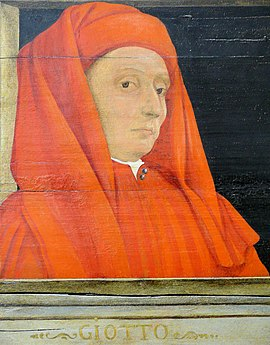
Name: Giotto di Bondone
Nickname/Alias: Giotto
Achievements: 14th-century Italian painter and designer, generally considered the founder of modern painting.
Born: c.1267; Colle di Vespignano, near Florence, Italy
Died: January 8, 1337; Florence, Italy (Aged around 70)
Field & Discipline: Art; Painter
Language: Italian
Father: Bondone (d. c.1312)
Mother: Unknown
Siblings: Possibly Martino
Spouse: Ciuta (Ricevuta) di Lapo del Pela (m. 1290)
Children: Four sons and four daughters, including: Caterina; Chiara; Lucia;
Bice; Francesco (1297-1318); Bondone (also called Donato and Niccolo)
Education: Probably apprenticed to Cimabue
Major Work:
Frescoes in the Arena Chapel, Padua (1304-06)
Life & Times:
Much of Giotto’s biography must be derived from administrative documents and early literary and historical sources (most notably by the 16th-century artist and historian [biography by] Vasari*. Around 1280 his family probably moved to Florence and established him as an apprentice in the workshop of the local master-painter, [taught by] Cimabue*, who was the most outstanding Italian painter of the time.
Giotto may have paid his first visit to Rome in 1290 before settling at Assisi for the next ten years. It was around 1290, that he married Ciuta di Lapo del Pela, with whom he would have eight children.
During his early years at Assisi (1290-95), Giotto produced a number of Old and New Testament scenes in the upper church of San Francisco (including “Isaac Blessing Jacob,” and the vault decorated with the “Doctors of the Church”).
Around 1296, he was commissioned by the Franciscan General Giovanni di Muro to execute a series of frescoes on the legend of Saint Francis in the upper church of San Francisco at Assisi. Each fresco depicts an incident in the life of St. Francis, with human and animal figures portrayed with a revolutionary realism, and with an emphasis on drama and emotion, the scenes expressing the protagonist's gentleness and humanity.
In 1300, Giotto then travelled from Assisi to Rome, where he painted the frescoes in the Loggia of the Church of St. John Lateran representing Pope Boniface VIII. By this time Giotto was in his early thirties, and had established himself as a highly respected master-painter with his own studio, several assistants, and a certain degree of prosperity.
In 1301 he travelled first to Ravenna and then to Rimini, where he painted the frescoes in the Church of San Francesco (now Tempio Malatestiano). Around 1303 he then moved to Padua on the invitation of the Grey Friars, where he was commissioned to produce a series of frescoes in the Church of Saint Anthony and, probably during 1304-06, he produced the fresco cycle in the Arena (or Scrovegni) Chapel (founded 1303).
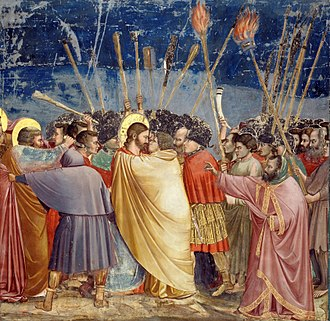
This series of 38 frescoes illustrate scenes from the lives of Jesus Christ, the Virgin Mary and Joachim, allegories of the Vices and Virtues, the Court of Heaven, and the Last Judgement, the huge latter scene, which entirely covers the west wall of the church, being generally considered Giotto's masterwork and the one in which he allowed his assistants to intervene least. These frescoes are admired especially for the simplicity and naturalism of the composition, the sculptural monumentality and grandeur of the figures, the three-dimensional quality of the depicted architecture, and the finely foreshortened objects.
During 1305-10, it is believed that Giotto painted the only panel painting accepted to be his own work, “The Madonna in Glory” (Uffizi), originally painted for Florence's Church of Ognissanti. During this period it is likely also that Giotto painted the frescoes “Raising of Lazarus” and “Scenes from the Life of Mary Magdalene” in the Church of San Francesco in Assisi, and from 1311 to 1315 he is believed to have returned to Florence.
Around 1313 he experimented for the first time in painting “a secco” (i.e. on to dry plaster) on the wall in preference to the traditional “buon fresco” (wet plaster) technique, for his fresco series “Scenes from the Life of St. John the Baptist and St. John the Evangelist” for the Peruzzi Chapel of the Church of Santa Croce, Florence.
He again used this technique for his two later polyptychs at the same church, “Christ Blessing” (Raleigh Museum, North Carolina) and “Madonna and Child,” and, on his return to Assisi (c.1315-20), for his “Scenes from the Infancy of Christ” and four “Franciscan Allegories” for the lower church of San Francisco.
In 1320, Giotto returned again to Florence, where he completed another cycle of frescoes documenting the life of Saint Francis, this time on the walls of the Bardi Chapel at Santa Croce. It is also likely that it was during this period that he received another important commission at Rome, this time from Cardinal Stefaneschi for a double-sided altarpiece for the high altar in Old
St. Peter's (San Pietro) known as the Stefaneschi Altarpiece, showing “Christ Enthroned,” “The Martyrdom of St. Peter,” “The Beheading of St Paul,” with on the back “St Peter Enthroned among Sts James, Paul, Andrew and John the Evangelist” (now in the Vatican), and for a huge mosaic known as the Navicella, or “The Ship of the Church.”
In 1327, Giotto, together with Taddeo and Bernardo Gaddi, was the first painter to be admitted to the Guild of Doctors and Apothecaries, and the following year he and several of his pupils moved to Naples, where he began working in the service of Robert of Anjou at the Neapolitan court. Although almost nothing has survived from this period (1328-33), some remnants of works produced by his studio in Naples bear witness to the development of the same tendencies appearing in his Stefaneschi altarpiece and the frescoes in the Bardi chapel towards a more refined use of colour and a Gothicizing, aristocratic taste.
On his return to Florence, in April l334, Giotto was honoured with the title of Magnus Magister (Great Master) and appointed city architect and superintendent of public works. In this capacity, he directed the early stages of the building of the famous campanile, or bell tower, of the Duomo
(begun July 1334), and he may have designed some of the bas-reliefs carved by Andrea Pisano on the campanile.
Moreover, the bronze doors of the baptistery by Andrea Pisano show clear traces of Giotto's frescoes in Santa Croce, and might possibly have been originally designed by one of his pupils. Indeed, the whole course of painting in Tuscany was dominated by his pupils and followers, including Taddeo Gaddi, Bernardo Daddi, Maso di Banco, Andrea Orcagna, and Pietro and Ambrogio Lorenzetti in Siena.
Between 1334 and his death Giotto also stayed in Milan, where he worked for Prince Azzoni Visconti. The last works undertaken in his workshop, which Giotto started but could not have seen finished, were the frescoes of “Scenes from the Life of St Mary Magdalene,” “Paradise” (with the famous portrait of his friend [a pal of] Dante*, who mentions Giotto in his “Divine Comedy”), and “Hell” in the Podesta Chapel in the Bargello, Florence.
Giotto was buried in the Santa Reparata with great honors.
Giotto appears in the writings of many contemporary authors, including Boccaccio, Dante and Franco Sacchetti. Sacchetti recounted the likely fictional incident in which a civilian commissioned Giotto to paint a shield with his coat of arms; Giotto instead painted the shield "armed to the teeth", complete with a sword, lance, dagger, and suit of armor. He told the man to "Go into the world a little, before you talk of arms as if you were the Duke of Bavaria", and in response was sued. Giotto countersued and won two florins.[47] In The Divine Comedy, Dante acknowledged the greatness of his living contemporary by the words of a painter in Purgatorio (XI, 94–96): "Cimabue believed that he held the field/In painting, and now Giotto has the cry,/ So the fame of the former is obscure."[10] Giotto died in January 1337.
Burial and legacy
According to Vasari,[9] Giotto was buried in the Cathedral of Florence, on the left of the entrance and with the spot marked by a white marble plaque. According to other sources, he was buried in the Church of Santa Reparata. The apparently-contradictory reports are explained by the fact that the remains of Santa Reparata are directly beneath the Cathedral and the church continued in use while the construction of the cathedral proceeded in the early 14th century.
During an excavation in the 1970s, bones were discovered beneath the paving of Santa Reparata at a spot close to the location given by Vasari but unmarked on either level. Forensic examination of the bones by anthropologist Francesco Mallegni and a team of experts in 2000 brought to light some evidence that seemed to confirm that they were those of a painter (particularly the range of chemicals, including arsenic and lead, both commonly found in paint, which the bones had absorbed).[48] The bones were those of a very short man, little over four feet tall, who may have suffered from a form of congenital dwarfism. That supports a tradition at the Church of Santa Croce that a dwarf who appears in one of the frescoes is a self-portrait of Giotto. On the other hand, a man wearing a white hat who appears in the Last Judgement at Padua is also said to be a portrait of Giotto. The appearance of this man conflicts with the image in Santa Croce, in regards to stature.[48]
Forensic reconstruction of the skeleton at Santa Reperata showed a short man with a very large head, a large hooked nose and one eye more prominent than the other. The bones of the neck indicated that the man spent a lot of time with his head tilted backwards. The front teeth were worn in a way consistent with frequently holding a brush between the teeth. The man was about 70 at the time of death.[48] While the Italian researchers were convinced that the body belonged to Giotto and it was reburied with honour near the grave of Filippo Brunelleschi, others have been highly sceptical.[49] Franklin Toker, a professor of art history at the University of Pittsburgh, who was present at the original excavation in 1970, says that they are probably "the bones of some fat butcher".[50]
Assessment: Giotto was a major 14th-century Florentine painter and architect who is generally considered the father of European painting and the first of the great Italian masters.
Oneliner: Giotto, major 14th century Italian painter
Bibliography:
- Encyclopedia Britannica.
- Grove Dictionary of Art.
- Schneider, Laurie, Giotto in Perspective, Oxford, 1974.