Cimabue
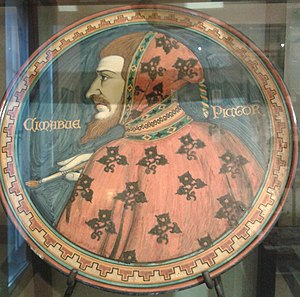
Name: Cimabue
Nickname/Alias: born: Cenni Bencivieni di Pepo
Achievements: 13th-century Italian painter and mosaicist, the last great Italian artist in the Byzantine style, which had dominated early medieval painting in Italy.
Born: c. 1240
Died: before 14 July 1302; Pisa, Italy (Aged around 62)
Field & Discipline: Art; Painter
Language: Italian
Father: Unknown
Mother: Unknown
Siblings: Unknown
Spouse: Unknown
Children: Unknown
Education: Unknown
Major Work:
“Great Crucifixion,” Church of San Francesco, Assisi (1277-80)
Life & Times:
Cimabue was born Cenni di Pepo, probably around 1240 (as indicated by the artist and historian [biographied by] Vasari* in his “Lives of the most Eminent Italian Painters, Sculptors, and Architects ...” 1550), his nickname meaning either "bull-headed" or, possibly, "one who crushes the views of others.”
This characteristic may be the reason that in the “Divine Comedy,” the Italian poet [admired by] Dante*, who hailed him as the greatest of Giotto's predecessors, placed Cimabue among the proud in Purgatory. Nothing is known of Cimabue's parents or early training, as Vasari's claim that he was apprenticed to Greek Byzantine painters living in Italy is unverified. He was clearly influenced by the Italo-Byzantine painter Giunta Pisano and by Coppo di Marcovaldo, to whom he may well have been apprenticed.
The earliest work generally attributed to Cimabue is the large “Crucifix” in San Domenico, Arezzo, which probably dates from the 1260s (definitely before 1272) and shows his early influences. The enamel-like surfaces and linear definition of forms in this work, along with the treatment of the loincloth and draperies, suggest Byzantine influence, also found in the work of Coppo di Marcovaldo, while the foreshortened body of Christ is reminiscent of the art of Giunta Pisano, the most influential Pisan painter during the first half of the 13th century.
By 1272, Cimabue had moved to Rome, where he witnessed the transfer of a community of Franciscan nuns to the Augustinian rule. By the late 1270s he had moved to Assisi, where he executed his famous cycle of frescoes in the upper church of San Francesco, for which there are two possible dates - during the reign of Giovanni Gaetano Orsini as Pope Nicholas III (1277-80), or when three Orsini were senators of Rome during the reign of Pope Nicholas IV (1288-92), the former now generally being considered the most likely. The frescoes on the walls of the choir of San Francesco occupy a central role in the surviving works of Cimabue, and include the New Testament scenes in the apse, representing the “Life of the Virgin,” the “Annunciation of the Death of the Virgin,” and her “Death,” “Assumption” and “Coronation.”
Cimabue's work in the upper church also includes frescoes in the vaults representing the “Four Evangelists” (the only frescoes in good condition, noted for their innovative three-dimensional, architectural qualities), and on the lower walls of the transepts representing the “Mission of the Apostles,” the “Apocalypse” (celebrated for his vivid depiction in an exploded perspective of the violent collapse of Babylon and of the demons parading before its walls) in the lunettes and wall area of the south transept, “St Peter Healing the Lame” and “St Peter Healing the Sick” in the north transept, and “Angels” and the “Great Crucifixion” in the south transept, the latter one of his very finest works.
The dating of 1277-80 seems to be confirmed by Cimabue's inclusion in the fresco of “St Mark the Evangelist” of a view of Rome, including the Palace of the Senators decorated with the arms of the Orsini family, an apparent reference to the fact that Pope Nicholas III (an Orsini) was a senator in Rome from September 1728 to August 1780.
It is uncertain but probable that during the 1280s Cimabue was working in Florence, where he executed the large “Crucifix” for the Church of Santa Croce (c.1285, now in the Museo di Santa Croce, Florence) and his famed “Madonna and Child” for the Church of Santa Trinita (now in the Uffizi, Florence), an altarpiece of Madonna and the Christ child enthroned with angels and four prophets and generally considered Cimabue's finest Madonna, which closely resembles the work of Corso di Buono, head of the Painters' Guild in Florence in 1295.
Although he was a master of the Byzantine stylization of the human form, Cimabue was among the first to combine this with a close observation of nature, and the four prophets at the base of the throne of his Santa Trinita Madonna are modelled using light and dark in a highly sculptural manner that seems far in advance of its date.
During the 1290s, Cimabue returned to Assisi where he executed another of his most important works, this time in the lower church, the “Madonna Enthroned with St Francis” (c.1290-95). It has also been suggested that Cimabue collaborated in the famous cycle of mosaics for the Florence Baptistery in the late 13th century, and was possibly responsible for the mosaic “Joseph Sold into Egypt.”
The frescoes at Assisi and a panel representing “St Francis” (now in the Museum of S. Maria degli Angeli, near Assisi) established Cimabue as the greatest Florentine painter of his day. By 1301, Cimabue had then moved to Pisa, where he worked on the mosaic figure of “St. John the Evangelist” in the apse of Pisa Cathedral (dated 1301-02). He died in Pisa before 14 July 1302, aged around 62.
His style and achievements were undoubtedly the foundation on which rested the extraordinary and innovative works by [influenced] Giotto* and Duccio in the 14th century, both of whom he influenced and possibly trained, and art historians from the 14th century onwards have recognized that his art and career marks the dividing line between the old and the new traditions in western European painting.
Assessment: Cimabue was the most celebrated and outstanding painter in Italy at the end of the 13th century, although his chief fame now rests on his role as the probable teacher of Giotto.
Oneliner: Cimabue, 13th century Italian painter
Bibliography:
- Battista, Eugenio, Cimabue, London, 1967.
- Encyclopedia Britannica.
- Grove Dictionary of Art.
- Salvini, Roberto, "Cimabue,” in Encyclopedia of World Art, vol. 3 (col. 614-619), 1960.