La Condamine
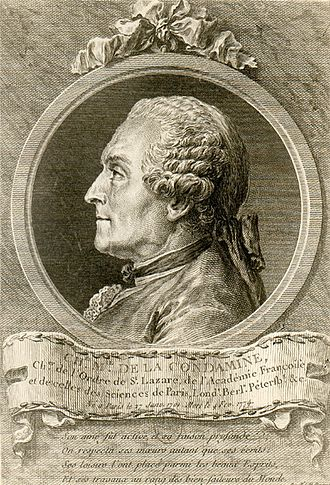 [
Charles-Marie de La Condamine](https://en.wikipedia.org/wiki/Charles_Marie_de_La_Condamine)
Achievements: First scientific exploration of the Amazon.
Born: January 28, 1701; Paris, France
Died: February 4, 1774; Paris, France (Aged 73)
Field & Discipline: Mathematics; Natural History
Language: French
Education: Jesuit College of Louis-le-Grand, Paris
Major Work: “Journal du voyage fait par ordre du roi a l'équateur” (“Journal of a Voyage to the Equator, Made by Order of the King” 1751)
Life & Times:
During the 1720’s La Condamine became acquainted with many scientists in Paris and in 1730 he was made a member of the Academie Royale des Sciences. In May 1731 he sailed on a naval voyage to Algiers, Alexandria, and around the coast of Palestine, and Cyprus, stopping in Constantinople in October 1731 for five months. After about a year, La Condamine returned to Paris and on 12 November 1732 he presented to the Academie his mathematical and physical observations of the voyage.
A few months later the Academie chose La Condamine to lead an expedition to Peru which, along with another expedition to the Arctic (both funded by the French Minster of Marine the [sent on expedition by] Maurepas*), aimed to check [checked theory of] Newton's* theory that the Earth was a flattened sphere. [collaborated with] Maupertuis* led the expedition to Lapland in order to measure a degree of meridian, while La Condamine went to Peru to make the same measurements at the Equator.
La Condamine left Paris in April 1735 for La Rochelle, where he embarked with his two companions and the naturalist [sailed with] Joseph de Jussieu*. They set sail for America in May, stopping at Martinique, Santo Domingo and Carthagena, landed at Portobelo, Panama, crossed the isthmus, and finally disembarked at Manta, Quito in Peru (now in Equador) in March 1736. His two companions finished their journey by different routes, La Condamine going overland to Quito from Manta, while Godin and Bouguer sailed to Quito from Guayaquil, meeting up with La Condamine in June.
In October 1736 the group conducted the measurements of the base for the surveying operations in the Yaruqui plain, laying the groundwork for the measurement of the arc of meridian that passes through a high valley nearly perpendicular to the Equator which extends southwards from Quito to Cuenca. However, difficulties soon arose, resulting from tensions between Godin and Bouguer and the non-arrival of funding from Paris. In order to solve the financial problem, in January 1737 La Condamine made the extremely difficult five-week journey to Lima to get credit from the Lima banks.
He arrived back in Quito in June, to find Godin now working alone (and refusing to communicate any of his results to his colleagues). As a result, La Condamine began to collaborate with Bouguer, and after a further two years' work, in August 1739 the pair completed the geometric measurement of the arc of meridian. Finally, the scientists had to make the astronomical measurement of the same arc by calculating exactly the latitude of its two extremities. In December 1741, while checking observations made with La Condamine, Bouguer discovered a small error, which he corrected but which gave rise to a long argument, with Bouguer refusing to allow La Condamine to recheck all their results.
From this point all three men worked independently, completing their measurements and observations in April 1743, when they returned to France by three different routes. La Condamine chose the longest and most dangerous route, which included a two-month raft journey down the Amazon River in July-August 1743.
Although as a scientist he was concerned primarily with astronomical observations and topographical details, La Condamine made many botanical observations concerning curare and cinchona, and was also the first to report the use made of [discovered] rubber* by several tribes. He reached the Atlantic Ocean at Para in September, and arrived at Cayenne in French Guiana in February 1744. He left Cayenne in August 1744, and arrived back in Paris the following February, after a absence of ten years, bringing with him a collection of more than 200 natural history specimens (including the poison curare) and various works of art, which he gave to [gave samples to] Buffon*.
On his return he wrote up his notes into the first scientific account of the Amazon, which he later published as “Journal du voyage fait par ordre du roi a l'équateur” (“Journal of a Voyage to the Equator, Made by Order of the King”, 1751). The Peru expedition proved Newton right (i.e. the equatorial meridian was longer than the one measured in Lapland).
Meanwhile, in 1748 La Condamine was elected a fellow of the Royal Society of London, and in the 1750s he became involved in the row over inoculation, becoming well-known as a dedicated popularizer of the procedure, probably as a result of contracting smallpox as a child.
During the 1750s he was also made a foreign member of the academies of Berlin, St. Petersburg and Bologna, and was elected to the Academie Francaise in 1760. He died in 1774, at the age of 73, after a hernia operation.
Extra Connections:
His work related to [work related to] Hancock and [work related to] Charles Macintosh, who started the modern rubber industry in 1820.
Assessment: He explored the Amazon, brought back the poison curare, and the first definite information on rubber and platinum.
Oneliner: La Condamine, explorer and finder of rubber
Bibliography:
- Dictionary of Scientific Biography.
- Encyclopedia Britannica.
Father: Unknown (b. 1640)
Mother: Marguerite-Louise de Chourses (m. 1700)
Siblings: Younger sister
Spouse: Charlotte Bouzier d'Estouilly (m. 1756)
Children: Unknown