Booth, Wm
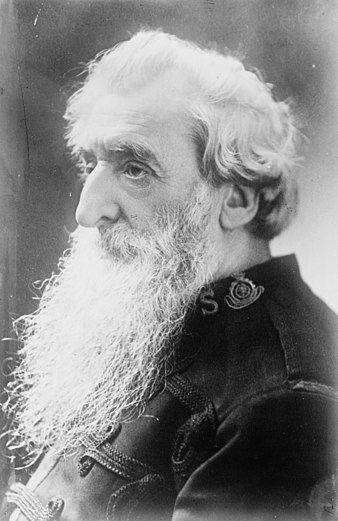
NICKNAME/ALIAS: 'General' Booth.
DATE OF BIRTH: 10th April 1829
PLACE OF BIRTH: Nottingham, Nottinghamshire, England.
DATE OF DEATH: 20th August 1912
PLACE OF DEATH: London, England.
DISCIPLINE: Religion.
FIELD: Revivalist leader.
ASSESSMENT: Booth was entirely ignorant of theology, but possessed eloquence, fervor and a sense of the practical and spiritual needs of the poor that made him a powerful force in social and religious life.
LANGUAGE: English.
EDUCATION: Biddulph's School, Nottingham, 1836-41.
ACHIEVEMENT): Founded Salvation Army.
MAJOR WORK: 'In Darkest England and the Way Out', 1890.
LIFE AND TIMES:
In September 1842, his father died and Booth's mother moved the family to a small shop in a poor quarter of Nottingham, where they sold toys, needles, tape, cotton and other such household items. In the same year, a Parliamentary election was held, and there was great excitement in the town as the Conservative candidate was being opposed by a radical reformer, a Chartist, from Birmingham.
The Chartists were a working-class movement and their leader, O'Connor*, came to campaign in Nottingham, where there were violent clashes in the streets between Chartists and soldiers, with many arrests. O'Connor's oratory and the daily spectacle of children crying for bread in the streets had a profound effect on Booth and, from then on, he became a champion of the oppressed.
In 1846 Booth joined a group of young revivalists who conducted religious services on the streets of Nottingham and became a revivalist preacher. In 1849 he moved to London in order to search for better-paid work and took a job in a pawnshop.
During this first period in London, he was introduced to the Mumford family. The father was a carriage-builder living in Brixton and his daughter Catherine Mumford, was an active member of the local Wesleyan Methodist Church.
During the early 1950s Booth, having now joined the Methodist New Connection at Brixton, increasingly devoted his time to regular preaching, traveling frequently to other parts of the country on "revivalist missions".
On 10th April 1852, he finally gave up his business career in order to devote himself to preaching and in 1855, he and Catherine were married. Booth, now twenty six, had by this time become well-known for his passionate and uncompromising sermons. His fire-and-brimstone speeches were tempered by a profound pity for the outcast and a hatred of dirt, squalor, and suffering.
Moving from place to place, the Booths and their children, of which one was born every year for the first few years of marriage, had no fixed home or regular income. A convinced believer in women's right to preach the gospel, Catherine Booth published a pamphlet on the subject, ‘Female Ministry’ in 1859 and began to preach in her husband's church in Gateshead, in 1860.
By this time, Booth's violent and fiery sermons had begun to lose favor with the New Connection and in 1861 he resigned, rather than submit to the authority of the church, and began his career as an independent revivalist. Catherine, who was now a preacher herself, kept him going and the family moved first to Cornwall in 1862, then to Cardiff, Wales in 1863 and finally to Sheffield the following year, where his preaching proved spectacularly successful.
In late 1864, Catherine persuaded Booth, now the father of six children, with a seventh on the way, to return to London. There, in June 1865, two missionaries to East London heard him addressing the crowds outside the 'Blind-Beggar' public-house and invited him to lead a tent-mission in Whitechapel.
The date of this mission, 2nd July 1865, is taken by the Salvation Army as the date of its real foundation. Booth's movement had always had a slight military flavor and he suggested that it should change its name to 'The Volunteer Army'. His son Bramwell pointed out that this would be confused with the real 'Volunteer (Reserve) Army', an undisciplined rabble in the eyes of most people at the time. In a moment of inspiration Booth crossed out the word 'Volunteer' and wrote the word 'Salvation' in its place and a new concept was born.
Booth extended the organization to the USA in 1880 and Australia in 1881, with his son, Ballington, in charge, but, after a family disagreement, Ballington set up his own army, the Volunteers of America, some years later.
Booth himself visited Canada and the US in 1886-87 and the European mainland in 1888, but remained in England to see the publication, in 1890, of his famous work 'In Darkest England, and the Way Out', in which he proposed many social changes to help the poor.
The book created a sensation. Several leading businessmen liberally subscribed money and a large part of the scheme was carried out. The first thing to be set up was a labor bureau to help people find work. Booth bought a farm where the long-term unemployed could be retrained for work. A bank was set up to make small loans for workers to buy tools.
Despite this success, Booth’s happiness was blighted by his wife's death in 1890.
In 1891, he began a world tour of evangelism, beginning in Europe. The writer Kipling* was a fellow passenger on the 'SS Valetta' from Adelaide, Australia to Colombo, Ceylon, in the autumn of 1891. Booth returned to England in 1893. Several years after his return, and nine years after the publication of 'In Darkest England, and the Way Out', the Salvation Army had served twenty seven million cheap meals, lodged eleven million homeless people, traced eighteen thousand missing persons and found jobs for nine thousand unemployed people.
Booth’s work had been opposed and ridiculed for many years and his most outspoken attacker was the biologist TH Huxley*, but this gave way towards the end of the 19th century to a very widespread sympathy based on the huge success of Booth’s program. Many honors followed.
In 1902, Booth was officially invited to be present at the coronation of King Edward VII. He was also invited to open the US Senate with a prayer in the same year, was made a freeman of London in 1905 and received an honorary doctorate from Oxford University in 1907.
Booth lived to the age of eighty-three and, despite being almost blind and plagued by ill-health, was still a devoted Christian activist, who saw his twin objectives as the saving of lost souls and righting the social injustices of his time. He never lost his zeal for the Gospel, his faith in God, or his heartfelt compassion for the poor.
On 20th August 1912, William Booth died, his death inspiring world-wide grief and his son, William Bramwell Booth, Chief of Staff since 1880, took over as General of the Salvation Army.
EXTRA CONNECTIONS: Shaw's* play 'Major Barbara' (1905) was based on his experience of the Salvation Army.
President William Taft wrote "[Booth's] long life and great talents were dedicated to the noble work of helping the poor and weak and giving them another chance to attain success and happiness.
ONELINER: William Booth, founder of the Salvation Army
PARENTS: Samuel Booth and Mary Moss.
SPOUSE: Catherine Mumford, married 1855.
SIBLINGS: Three surviving: Ann, Emma and Mary.
CHILDREN: William Bramwell, Ballington, Catherine, Emma, Herbert, Marian, Evangeline Cora, Lucy.
BIBLIOGRAPHY:
Begbie, Harold, Life of William Booth: The Founder of the Salvation Army, London: Macmillan & Co., 1920.