Hunter, John
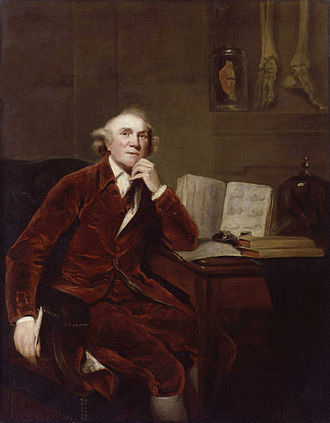
NAME: Hunter, John
ACHIEVEMENT(S): Founder of pathological anatomy in England
NICKNAME/ALIAS: None
DATE AND PLACE OF BIRTH: February 13, 1728, Long Calderwood, Lanarkshire, Scotland
DATE/PLACE OF DEATH/AGE AT DEATH: October 16, 1793, Tooting, England. Aged 65
DISCIPLINE: Surgeon
FIELD: Medicine
EDUCATION: East Kilbridge Grammar School
MAJOR WORK: "Treatise on the Blood, Inflammation and Gun-Shot Wounds", "Treatise on the Natural History of the Human Teeth"
LIFE AND TIMES:
At 17, and apparently illiterate, Hunter was sent to Glasgow to learn carpentry from his brother-in-law. After three years, he was sent to his elder brother <brother was> William Hunter*, a teacher of anatomy and surgery in London.
Hunter immersed himself in the study of medicine, attending surgical classes at various London hospitals, including Chelsea Hospital, where he was taught by <taught by> Cheselden*. In 1748, Hunter began working as an assistant at his brother's anatomy school in Covent Garden.
In 1753, he was appointed a Master of Anatomy of the Surgeon's Corporation and the next year was made house surgeon at St. George's Hospital, where he taught <taught> Jenner*. Unsatisfied at St. George's, he resigned five months, and returned to his brother's anatomy school.
Except for the short time at St. George's, Hunter worked for his brother for 11 years. He made detailed studies of the structure and function of the lymphatic vessels, and the growth and structure of bones, mainly from material collected from post-mortem examinations. He also began a collection of the hearing organs of fish.
In 1762, he began describing, and in many cases preserving, evidence of unusual morbid conditions, including adhesion of the lungs and heart to surrounding tissues, aneurysms, and the corrosion of the stomach walls by gastric juice.
After intensive study, Hunter and his brother came up with new descriptions of the human tear ducts, the tubules of the testis, the descent of the testis and congenital hernia, and the absorbent function of the lymphatic system.
In 1761, during the Seven Years' War, Hunter was hired as a staff surgeon in the British Army and was sent to care for the wounded in the siege of Belle-isle, off the coast of France. His experience gave him material for his major work: "Treatise on the Blood, Inflammation and Gun-Shot Wounds" (published in 1794, after his death.)
In 1764, Hunter set up his own surgical practice in London, augmenting his income by teaching anatomy and surgery and by working as a dental surgeon. In 1768, he accepted a position as surgeon at St. George's Hospital, where he achieved the practical advance for which he is best remembered: tying the artery in a sound part at a distance from the wound. In 1771, Hunter married <wife was> Home*, a talented musician and poet.
Hunter was greatly interested in marine life, particularly whales, and wrote the monograph "On the Structure and Economy of Whales". From 1770 to 1790, he published a number of papers, including the famous: "Treatise on the Natural History of the Human Teeth", in which he originated the terms "cuspids", "bicuspids", "molars" and "incisors," and described his experiments on the transplantation of tissues, especially that of a human tooth fixed into a cock's comb.
His widely-varying research also covered lymph and blood circulation, the sense of smell, tissue-grafting and a number of diseases. In one experiment to prove that syphilis and gonorrhea were types of the same disease, he inoculated himself with the diseases (later developing syphilis), and publishing his findings as "Treatise on the Venereal Disease".
In 1776 Hunter was appointed surgeon-extraordinary to King George III, and 10 years later received the Copley Medal, the highest award of the Royal Society. In 1786, he was appointed Assistant Surgeon-General to the Armed Forces and in 1790 Inspector-General of Regimental Hospitals.
He helped establish a museum of natural history and commissioned artists to decorate the museum and an adjoining lecture theater he had built. The murals depicted North American Indians, Eskimos, dwarfs, and examples of albinism. George Stubbs painted a rhinoceros, two monkeys and a yak.
During the last 15 years of his life, Hunter was constantly troubled with angina, and at a meeting at St. George's Hospital in October, 1793, he suffered a severe attack, collapsed and died.
His museum, which on his death consisted of about 14,000 specimens, was purchased by the British government in 1799 and given to the Royal College of Surgeons, forming the basis of the Hunterian Museum.
ASSESSMENT: Considered one of the greatest British surgeons.
EXTRA CONNECTIONS: When he left his brother's anatomy school at Covent Garden, his job as assistant was taken over by <succeeded by> Hewson*.
He was painted by <painted by> Sir Thomas Lawrence*.
He knew <knew> Cruikshank*
<work studied by> Paley* studied his work.
He was a friend of <a pal of> Smollett*
He worked with <worked with> Charles Bell*
He taught Sir Ashley Paston <taught> Cooper*
His work was known to William <work known to> Heberden*
His work was criticized by <work criticized by> Magendie*
ONELINER: John Hunter, major 18th century surgeon
BIBLIOGRAPHY:
EB, DNB, DSB
Gloyne, S.R., John Hunter, Edinburgh 1950.
John Hunter (surgeon) - Wikipedia
LANGUAGE: English
PARENTS: John Hunter; Agnes Paul
SIBLINGS: Nine, of whom two survived infancy: William; Dorothy
SPOUSE: Anne Home
CHILDREN: Four, of whom two survived infancy: John Banks; Agnes Margaretta