Monroe, James Pres
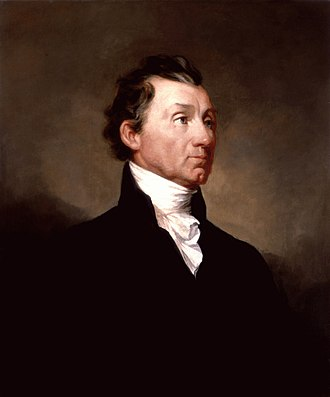
NAME: Monroe, James
ACHIEVEMENTS: Fifth President of US
NICKNAME/ALIAS:
None
DATE AND PLACE OF BIRTH:
28 April 1758, Westmoreland County, VA
DATE AND PLACE OF DEATH AND AGE AT DEATH:
4 July 1831, NY, NY. Aged 73
DISCIPLINE: Politician
FIELD: Politics
EDUCATION:
Local plantation school, Westmoreland County
College of William and Mary, Williamsburg
MAJOR WORK:
"Writings" (pubd.1898-1903)
LIFE AND TIMES:
Monroe joined Washington's army for the winter retreat from New York and fought at the battle of Trenton, where he was wounded. He took part in the battle of the Brandywine in 1777 and after the battle looked after <a pal of> Lafayette* who had been wounded. It was the start of a long friendship.
By the end of the year, Monroe had been promoted to major and he wintered with the army at Valley Forge. In November 1778, carrying a letter of recommendation from Washington, he went to Philadelphia where his uncle was a member of the Continental Congress.
He was then appointed aide to <a pal of> Jefferson* then governor of Virginia and who became a lifelong friend. He studied law under Jefferson before being elected delegate for Virginia in 1782 and being was chosen as a member of the governor's council. In 1783 he was sent as a delegate to the Confederation Congress set up under the Articles of Confederation, the first constitution of independent America.
He continued to represent Virginia as a delegate in 1787 and in 1788 as a member of the convention which ratified the new constitution. He was elected to the US senate in 1790 and was instrumental, with James Madison, in establishing the Republican party, which opposed the federalist views of <opposed> Washington's* government.
He was appointed minister to France in 1794 in the hope that as a known friend of France he might be able to appease the French over the trade treaty which agreed between Britain and the US. In Paris, Monroe placated the French with the idea that Washington's government would not be in power much longer and the treaty might never be ratified. He was recalled by Washington in 1776, leaving the matter unresolved.
In 1799 he was elected governor of Virginia and was re-elected until 1802.
Monroe had never given up his view that US trade on the Mississippi was a natural right and that the Spanish monopoly must be ended. In 1801, Spain ceded Louisiana and the Floridas to France, which was a much more serious matter. Carlos IV of Spain had allowed Americans to trade but Napoleon was known as an aggressive expansionist. When the Spanish administrator withdrew the US right of deposit at New Orleans following America’s agreement with France, there was talk of war.
In 1803 Jefferson appointed Monroe as an envoy to France to aid <collaborated with> Robert R Livingston* who was already there with the authority to purchase New Orleans or another gulf port. In addition, Monroe was charged with getting the Floridas from Spain. When he arrived in Paris he found that Napoleon had already offered to sell the whole of Louisiana to the US. Exceeding their instructions, he and Livingston signed the famous treaty with France, the Louisiana Purchase, by which the US purchased the French territory.
Monroe had also been made minister for London and arrived there from Paris in July 1803. He remained there until 1807, visiting Madrid for discussions on the Floridas and negotiating with the British about their forcible conscription of American seamen and the seizure of American ships.
Monroe returned to the United States in 1807. He was elected Governor of Virginia again in 1811 but resigned when he was appointed Secretary of State by President James Madison the same year. Monroe and his younger followers among the Republicans were known as the War Hawks and in 1812, war was declared between the US and Britain. Monroe wanted a military command, but was denied this by the Secretary of War, who was Robert Livingston's brother-in-law and who felt Monroe had denied Livingston his achievements in Paris. Armstrong resigned after the invasion of Washington by the British in 1814 and Monroe was made Secretary of War, a post he held until 1815.
The following year he became the fifth President of the United States. He was the last member of those who had taken part in the revolution to become President and was regarded as somewhat old-fashioned. His cabinet was exceptionally able and included <Sec. of State was> John Quincy Adams* as Secretary of State.
In foreign affairs his main aims were the acquisition of Florida and agreement with Spain of the Louisiana boundaries. In 1817 he ordered the occupation by American forces of Amelia Island in the St John's River. The following year American forces went into Florida in pursuit of Indians. A harassed Spain came to the negotiating table and in 1819 they ceded Florida and agreed the Louisiana boundaries.
Monroe was a moderate nationalist but he did not agree with interfering with the constitutional rights of states. This standpoint precipitated the Missouri Crisis of 1819-20 when he refused to add conditions to the right of Missouri to be recognised as a state. This infuriated the abolitionists. In the end the Missouri Compromise saved the day: Missouri was admitted without condition but a ban was put on slavery north of 36o 30' which would be binding for any future states.
Monroe was elected for a second term and his administration, being generally a prosperous time for the country, was named the Era of Good Feeling.
In his annual message to the nation in 1823 Monroe issued a statement of policy which became known as the Monroe Doctrine. This was in response to the formation of new states in Latin America and threatened intervention from Spain and France in that sphere. The doctrine stated that the western hemisphere was politically separate from Europe and that neither hemisphere should interfere in each other's government. In addition, there should be no more European colonisation in the New World.
Monroe retired to his home in Loudoun County after his second term of office ended.
ASSESSMENT: Monroe’s firm grasp of the importance of establishing national boundaries helped to secure Louisiana and Florida for the country and culminated in the issuing of the Monroe Doctrine which enshrined the principle of non-intervention by the European powers in the newly independent America.
EXTRA CONNECTIONS: Knew <knew> PS DuPont, <knew> Andrew Jackson*
ONELINER: James Monroe, President of the United States
BIBLIOGRAPHY:
Cresson, WP, James Monroe, University of North Carolina Press, Chapel
Hill, 1946.
LANGUAGE: English
PARENTS:
Father: Spencer Monroe
Mother: Elizabeth Jones
SIBLINGS:
3 brothers: Andrew, Joseph, Spence
1 sister: Elizabeth
SPOUSE:
Elizabeth Kortright
CHILDREN:
2 daughters: Elizabeth, Maria