Lafayette
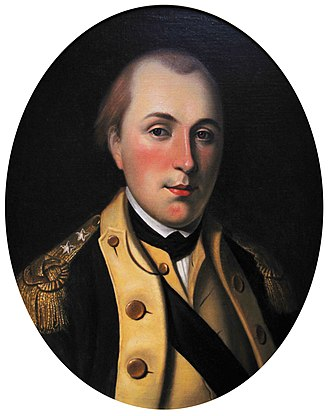
Lafayette, Marie-Joseph-Paul-Yves-Roch-Gilbert du Motier, Marquis de,
ACHIEVEMENT(S): Helped America achieve independence
NICKNAME/ALIAS: also spelled La Fayette
DATE/PLACE OF BIRTH: 6 September 1757, at Chavaniac, France.
DATE/PLACE/AGE AT DEATH: 20 May 1834, in Paris, France. Aged 76
DISCIPLINE: Military. Politics. FIELD: Soldier
LANGUAGE: French and English
PARENTS: Michel Louis Roch Gilbert du Motier, Marquis de La Fayette
(1732-59) and Julie de la Riviere (d. 1770), married 1755
SPOUSE: Adrienne de Noailles, married 1774
CHILDREN: Henriette (b. 1775), Anastasie (b. 1777), Georges Washington (b.1779), Virginie (b. 1782)
EDUCATION: Tutored by the Abbe Fayon, 1763-68; College du Plessis, 1768-71;
Academie de Versailles, 1771-
MAJOR WORK: 'Memoires, correspondence, et manuscripts', 6 vols., 1837-38
LIFE AND TIMES:
Destined for a military career, in 1771 Lafayette entered the Academie de Versailles, the most exclusive military school in France, and the following year a contract was arranged betrothing him to Marie Adrienne Francoise de Noailles, the daughter of the Duc d'Ayen and granddaughter of the Duc de Noailles.
This marriage (which took place in 1774) brought Lafayette into one of the most influential families in France, and a month later, with the accession of Louis XVI* to the throne, Lafayette joined the circle of young courtiers around Louis and Marie-Antoinette and was granted a captaincy in the Black Musketeers.
In early 1777 Lafayette's friendship with Franklin* inspired a strong desire to fight for the colonists, especially when promised a major-generalship in the American Army by Deane*, the American agent in Paris.
However, the plan was strongly opposed by the powerful de Noailles family, who feared that a great deal of Lafayette's fortune could disappear abroad, and Louis XVI was persuaded to forbid his departure. As a result, the 19-year-old Lafayette was arrested at Bordeaux, after the departure of his ship the 'Victoire' for Spain, but escaped and travelled by horse to Los Pasajes in Spain, from where he finally sailed for America on 20 April 1777.
In America he met Washington*, who befriended the young Frenchman. In September 1777 Lafayette first saw action at the Battle of Brandywine in Pennsylvania, during which he received a wound in the leg. Three months later Washington gave him a division of Virginian soldiers.
With the alliance of February 1778 between France and the United States against Great Britain, Lafayette's status was further improved, particularly once war was declared between Britain and France. He asked for and received permission from Washington to return to France to request military aid from Louis XVI, and embarked for France in January 1779.
On his return, Lafayette received a hero's welcome, and once more entered Versailles, where he spent the next few months planning an invasion of England; however, this expedition eventually proved impossible, and instead he was granted financial and military aid for the American colonists.
He left for America with a 6,000-man expeditionary force early the following year, arriving at Marblehead, Massachusetts in April 1780, and in January 1781 was finally given command of a small army in Virginia. After forcing the British commander Cornwallis* to retreat across Virginia, Lafayette successfully trapped the British at Yorktown in late July.
During the siege that followed, Lafayette was joined by a French fleet - with d'Arblay* as adjutant general - and several additional American divisions, and on 19 October 1781 Cornwallis surrendered, effectively marking the end of the British cause in America.
During 1782 he served as Franklin's aide in France and in Spain during the ensuing negotiations for peace, and he visited the United States again in 1784, during which he was made a citizen of several states.
During the mid-1780s Lafayette emerged as a leader of the liberal French aristocrats and an outspoken advocate of religious toleration and the abolition of the colonial slave trade. In May 1789 Lafayette was elected as a representative of the nobility both to the Estates General finally convened by Louis XVI and then to the revolutionary National Assembly. On 11 July he presented to the Assembly his draft of a Declaration of the Rights of Man and of the Citizen which was revised and adopted, on 27 August.
Meanwhile, on 15 July, the day after the storming of the Bastille, Lafayette was elected commander of the newly-formed National Guard of Paris, with responsibility for maintaining order in the midst of revolution. In October 1789 his troops saved Louis XVI and Queen Marie-Antoinette from the fury of a crowd that invaded Versailles, and then carried the royal family to Paris.
The increasing likelihood of war with Austria meant Lafayette was recalled to military duty in December 1791, when he was given command of the French army at Metz, guarding the northern and western frontiers.
In April 1792 a mob in Paris had decided to march on the Tuileries and dethrone Louis XVI. Lafayette attempted to return with his troops to Paris to restore the King and to dissolve the Assembly. He was declared a traitor by the Assembly. On 19 August 1792 Lafayette deserted his troops and fled to Flanders, where he was arrested by the occupying Austrians, and for the next five years he was held as a prisoner-of-war in various Prussian and Austrian prisons.
In 1797 Napoleon* arranged Lafayette's release and in 1799 he returned to France, where he lived in retirement at his wife's estate at Lagrange - where, among others, the American author Fenimore Cooper* visited regularly.
In 1815 he again became a parliamentary representative, and during most of the reign of Louis XVIII (1814-24) served as a liberal member of the Chamber of Deputies. He revisited the United States in 1824-25, accompanied by the reformer and author Frances Wright*, on the invitation of Congress.
He returned to France to represent Meaux in the Chamber from 1825 to 1834, when he was visited by another American, the reformer Robert Dale Owen*. In the July Revolution of 1830 he served once more as commander of the National Guard in opposition to the reactionary Charles X, who was deposed. Lafayette retired six months later.
ASSESSMENT: A French aristocrat, general, politician and reformer, who fought with the American colonists against the British in the American Revolution, and became an early American hero.
EXTRA CONNECTIONS: Met Buchanan*
He knew US Ambassador George Bancroft*
He knew Catherine Greene*
He was a colleague of Thomas Jefferson*
Gave JQ Adams an alligator that lived in the White House.
ONELINER: Marquis de Lafayette, hero of American War of Independence
BIBLIOGRAPHY:
EB, Colliers Encyclopedia
Buckman, Peter, Lafayette, New York & London: Paddington Press Ltd., 1977.
Multimedia:
Sarah Vowell Lafayette in the Somewhat United States
http://www.c-span.org/video/?329001-1/book-discussion-lafayette-somewhat-united-states