Prokofiev
Prokofiev, Sergey Sergeyevich.
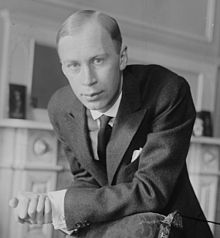
ACHIEVEMENT(S): Major 20th century Russian composer
DATE/PLACE OF BIRTH: 23rd April 1891, at Sontsovka, Ekaterinoslav district, Ukraine.
DATE/PLACE/AGE AT DEATH: 5th March 1953, Moscow, USSR. Aged 61.
DISCIPLINE: Composer and pianist.
FIELD: Music.
LANGUAGE: Russian and English.
EDUCATION: Composition lessons from Reinhold Glier, 1902-03; St. Petersburg
Conservatory, 1904-14.
MAJOR WORK: 'The Love of Three Oranges', 1921.
LIFE AND TIMES:
In September 1904, Prokofiev passed the entrance examination for the St. Petersburg Conservatory, where he spent the next ten years. In 1911, his first Piano Sonata and the Opus 3 piano pieces appeared in print for the first time. He then began what he later considered to be his first mature work, the complex and controversial First Piano Concerto. This was followed by his Second Piano Concerto, (completed early 1913 and which, according to the critics, left its listeners "frozen with fright, hair standing on end").
Immediately after graduation in June 1914, he visited London, where he saw and fell under the spell of Stravinsky's* stage works: 'The Nightingale', 'The Firebird' and 'The Rite of Spring'. He also met Diaghilev* and played him his Second Piano Concerto. Diaghilev immediately commissioned him to write a ballet and became one of his most influential advisors over the next fifteen years.
Prokofiev then returned to Petrograd and avoided conscription into the Russian army by enrolling in the Conservatory organ class. He wrote the ballet, 'Ala and Lolli' for Diaghilev, who rejected it. He then reworked the music, and launched it as the 'Scythian Suite', Opus 20. It was poorly received. Diaghilev then commissioned a second ballet, ‘The Tale of the Buffoon’, which Prokofiev completed in 1915. He then moved into opera, producing 'The Gambler', an adaptation of the story by Dostoyevsky*
After the 1917 revolution a new era in Russian politics brought change in Prokofiev’s music, with 'Violin Concerto No. 1 in D Major', the sonata 'Classical Symphony' and began 'Piano Concerto No. 3 in C Major', Opus 26. Inspired by the Italian dramatist Gozzi*, he also began work on the opera, 'The Love of Three Oranges'. In May 1918, he left for New York where, his popular piano recitals of the "Bolshevik Pianist" led to a recording contract. The Chicago Opera commissioned a comic opera. Prokofiev delivered them the completed 'The Love of Three Oranges' in 1919.
In Spring 1920 Prokofiev went to Paris to see Diaghilev and to meet the conductor, Serge Koussevitzky. He immediately started revising the ballet 'The Tale of the Buffoon' for the next season of the Ballet Russe. In 1921 this was produced in both Paris and London in 1921 (which also saw the successful premiere of the 'Third Piano Concerto'). In 1922-23, he spent time in Ettal, Southern Germany, preparing several compositions, including his opera 'The Flaming Angel'. In 1923 he settled in Paris for a period of intense work. That September he married the Spanish-born singer Lina Llubera. The following year his first son, Svyatoslav was born. His second son, Oleg, was born in 1928.
In Paris, he concentrated on developing an avant-garde style and in the summer of 1924, produced the epic 'Symphony No. 2 in D Minor', commissioned by Koussevitzky. This premiered in June 1925, to varied reaction. Late in 1925, he made a concert tour of the United States and, in 1927, a three-month tour of the Soviet Union, where he was rapturously received as a world-renowned Russian musician-revolutionary. He returned to Paris to stage the successful 'Steel Step', on 7th June 1927. He then began work on revising 'The Gambler', which was then produced in 1929, in Brussels. Two other major works, the Third Symphony and the ballet 'The Prodigal Son', both premiered in May of that year.
In 1932, at the peak of his success, he returned to Moscow, and in 1936, after his family joined him, took up permanent residence in the USSR. In the pre-war years Prokofiev produced a number of masterpieces, including the 'Violin Concerto No. 2 in G Minor' (1935), the ballet 'Romeo and Juliet' (1935-36), and the music for Sergei Eisenstein's film 'Alexander Nevsky' (1938). His work in theatre and the cinema also gave rise to a number of programmatic suites, such as the ‘Lieutenant Kije’ suite (1934), the 'Egyptian Nights' suite (1934), and the symphonic children's tale 'Peter and the Wolf' (1936).
In the late 1930s, he made two concert tours abroad, the first in December 1936, to Western Europe and the USA, the second, at the beginning of 1938, to Czechoslovakia, France, Britain and the USA. During the second tour he visited Hollywood to study film music techniques before working on 'Alexander Nevsky'.
In 1939 he finished the opera 'Semyon Kotko' and the opera bouffe, 'Betrothal in a Monastery', based on the play 'The Duenna', by the 18th-century British dramatist, Sheridan*. Early in the war the German invasion of Russia, with its echoes of the 1812 Napoleonic campaign, inspired an opera based on Tolstoy*'s 'War and Peace'. The first version was completed by the summer of 1942. In May, Prokofiev travelled to Alma-Ata, in Kazakhstan, at Eisenstein's* invitation, to work on the music for the film 'Ivan the Terrible'.
After the war he fell foul of the Soviet authorities. At the beginning of 1948, a central committee decree declared the works of most prominent Soviet composers, Prokofiev among them, as "marked with formalist perversions . . . alien to the Soviet people" and many of Prokofiev's earlier works were banned. After 1948, his health failed rapidly and, although he continued to compose, he spent more time at his villa in Nikolina Gora. In October 1952, he attended the premiere of the Seventh Symphony. This was to be his last concert. Five months later, on 5th March, the day of Stalin's death, he died of a brain hemorrhage.
ASSESSMENT: One of the most frequently-performed composers of the 20th century.
EXTRA CONNECTIONS: None.
ONELINER: Sergei Prokofiev, great Russian composer
BIBLIOGRAPHY:
McAllister, Rita, "Sergey Prokofiev", inThe New Grove Russian Masters 2, London: Macmillan, 1986.
PARENTS: Sergey Prokofiev and Mariya Grigoryevna Zhitkova.
SIBLINGS: None.
SPOUSE: Lina Llubera, married 1923; Mira Mendel'son, married 1948
CHILDREN: Svatoslav and Oleg.