Ghiberti
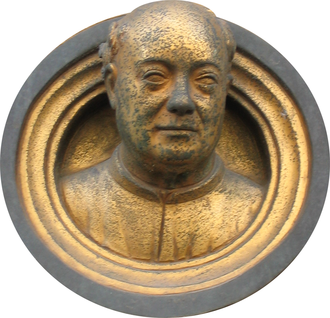
NAME: Ghiberti, Lorenzo
OTHER-NAME: none
BIRTH: 1378 or 1381
DEATH: December 1, 1455
CATEGORY: The Arts
DISCIPLINE: Sculpture
ASSESSMENT: A significant contributor to Renaissance sculpture and the development of perspective. An important figure in 15th century Florentine society.
LANGUAGE: Italian
EDUCATION: Apprenticeship as a Goldsmith, training as a painter, education in Latin and ancient literature
ACHIEVEMENT: The North and East Bronze Doors of San Giovanni de Battista in Florence
MAJOR-WORK: Commentarii
PARENTS: Mona Fiore and either Cione Paltami Ghiberti or Bartolo di Michele (a.k.a. Bartoluccio).
SPOUSE: Marsilia
SIBLINGS: unknown
CHILDREN: Tomaso Ghiberti and Vittorio Ghiberti
LIFE AND TIMES:
The truth about Lorenzo Ghiberti’s birth is unknown, partially because Ghiberti wanted it that way. In relation to his taxes, he first listed the year of his birth as 1381 but in 1442 changed it to 1378. His legitimacy is also debatable because he chose at different times of his life to be believed to be the son of the goldsmith Bartolo di Michele (a.k.a. Bartoluccio) or the son of Cione Paltami Ghiberti (a.k.a. Cione da Pelago). His mother, Mona Fiore, was married to Cione Paltami Ghiberti in 1370 but was in a common law relationship with Bartoluccio from an undetermined date and married him after Cione’s death in 1406. Ghiberti chose either man as his father, depending on the benefits available to him.
What is known for certain about Ghiberti’s childhood is that he grew up in Florence in Bartoluccio’s workshop. Ghiberti’s later life is much clearer, due partly to the fame and acclaim that he earned early. In 1403, Ghiberti won a contract to design in bronze the north doors of the Baptistery of San Giovanni de Battista commissioned by the guild of wool importers (Arte di Calimala). Ghiberti won the contract in a competition which pitted him against sculptor and architect Filippo <competed against> Brunelleschi* and Sienese sculptor Jacopo della Quercia among others. It was Ghiberti’s first and most famous contract. Ghiberti worked with <worked with> Paolo <worked with> Uccello*, <worked with> Donatello*, and possibly Masolino, who all served as apprentices in his bronze foundry prior to 1414.
Ghiberti became an architectural consultant to the Opera del Duomo and starting in 1404 he designed figures and scenes for the stained glass windows of the Basilica di Santa Maria del Fiore. In 1409, Ghiberti joined the guild of goldsmiths and took over the successful bronze foundry from Bartoluccio. Ghiberti later joined the guild of painters in 1423 and the guild of stonemasons in 1428. He received another commission from the Arte di Calimala in 1412 or 1413 for a sculpture of their patron saint, Saint John the Baptist, to be displayed at the church used by all the guilds, OrsanMichele. He married Marsilia, the sixteen year old daughter of a woolcarder named Barolommeo di Luca, around 1416. His first son, Tomaso, was born in 1417 and his second, Vittorio, was born the following year. Sadly these births were followed by the death of Bartoluccio around the year 1422.
In the 1420’s, Ghiberti’s bronze foundry began to branch out. After Ghiberti lost the competition to design the dome of the Basilica di Santa Maria del Fiore to his previous rival Brunelleschi, the bankers’ guild (Cambio) and the wool guild (Lana) followed the example set by the Arte di Calimala and commissioned imposing bronze statues of their patron saints to be displayed at OrsanMichele. It was during Ghiberti’s work on a statue of Saint Matthew for the Cambio that he met <met> Cosimo de Medici the Elder* who was a member of the supervising committee. Around 1425 Ghiberti began the contract for his second set of doors at the baptistery of San Giovanni de Battista, the eastern doors.
Known as the “Gates of Paradise,” the doors were his primary commission throughout the 1430’s. Between 1434 and 1443 Ghiberti designed most of the windows for the apses and the drum of the dome of Santa Maria del Fiore.
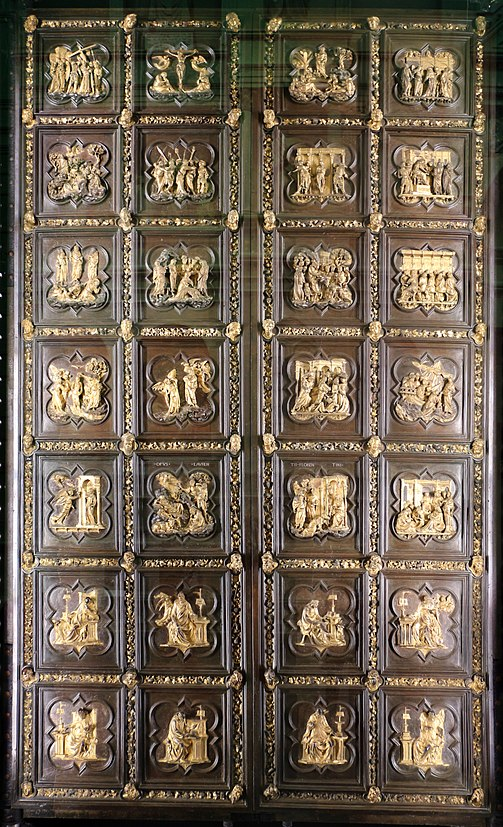
In 1444, Ghiberti’s legitimacy was challenged publicly after he served as one of the Twelve, an elected political office. At issue was not simply his legitimacy, but taxes. Ghiberti was eventually cleared of the charge of illegitimacy, and this got him thrown out of the guild of goldsmiths. He had been allowed to join the guild without a waiting period and without a membership fee because his father was then said to be Bartoluccio, who was already a member. Now publicly identified as the son of Cione, Ghiberti no longer qualified for membership.
Despite his public embarrassment and the loss of his position in the goldsmiths’ guild, Ghiberti continued to have a strong career. He finished the “Gates of Paradise” in 1447 and was commissioned with his son Vittorio to finish the bronze jambs for Andrea Pisano’s set of south doors for the baptistery. Until his death, Ghiberti appeared on documents as the head of the foundry, although increasingly Vittorio was taking the commissions. Ghiberti wrote an autobiography entitled Commentarii , probably during the winter of 1447. Commentarii has been recognized as one of the most significant sources of information on the life of a Renaissance artist.
Ghiberti died on December 1, 1455 and was laid to rest in a tomb in the church of Santa Croce. His significance as a historical figure is not merely established by those he knew and the beautiful objects that he created, but also lies in the artistic changes he helped to facilitate. Influenced by works on optics which used mathematical calculations to establish perspective and other works dealing with realistic portrayal (by authors including <influenced by work of> Vitruvius*, <influenced by work of> Averroës*, <influenced by work of> Witelo*, John Peckham, and <influenced by work of> Roger Bacon*) Ghiberti incorporated the relatively new ideas of perspective into his work. He used layers that graduated the full relief of the main figures of his bronze panels into the thin, almost two dimensional back layer in a technique known as schiacciato.
Ghiberti’s gradual layering created an illusion of space and depth which was new to the art. Ghiberti’s foray into this new method was short lived, however, and only three of the sets of panels from his “Gates of Paradise” show what he achieved. These three sets, the Joseph, Isaac, and Solomon panels (example of drastic change in the art) were composed during a time in which Ghiberti was particularly influenced by the ideas of Leon Battista <influenced by> Alberti*. Ghiberti’s attempts at perspective did not entirely follow Alberti’s guidelines, however, a fact which has been explained as an attempt to simplify Alberti’s ideas so as to put them into practice.
ONELINER: Lorenzo Ghiberti, major Renaissance artist
OTHER CONNECTIONS: He rented a studio to <rented studio to> Perugino*
BIBLIOGRAPHY:
Krautheimer, Richard and Trude Krautheimer-Hess. Lorenzo Ghiberti. Princeton, New Jersey: Princeton University Press, 1956.
Goldschieder, Ludwig. Ghiberti. London: Phaidon Publishers Inc., 1949.
AUDIO/VISUAL:
http://www.bluffton.edu/~sullivanm/italy/florence/duomomuseo/paradisedoors.html
contains images from the original Joseph panel
http://www.bluffton.edu/~sullivanm/italy/florence/ghibertiparadise/ghibertiparadise.html
images of copies of the panels in situ