Alberti
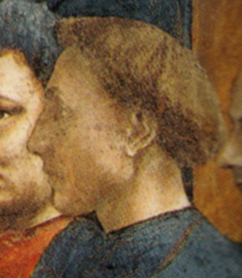
Full Name: Leon Battista Alberti
Achievements: Renaissance perspective design and cryptography
Born: February 14, 1404; Genoa, Italy
Died: April 25, 1472; Rome, Italy (Aged 68)
Field & Discipline: Art; Architecture; Philosophy; Music; Painter; Sculptor
Language: Italian
Father: Lorenzo di Benedetto Alberti
Mother: Unknown
Siblings: Carlo
Spouse: None
Children: None
Education: University of Bologna
Major Work:
“On Architecture”
Life & Times:
After receiving his doctorate in church law at the University of Bologna in 1428, Alberti is believed to have taken a job as secretary to Cardinal Albergati, the Bishop of Bologna. Four years later, through the influence of Bishop Biagio Molin, he moved to Rome to serve as secretary to Pope Eugenius IV, a job he held for 32 years.
During his first stay in Rome, from 1432 to 1434, Alberti pursued his interest in humanistic, scientific and artistic research. In 1443, he published a dialog on family ethics: "On the Family,” the first of his major humanist pieces and a landmark in the history of Italian prose. He also worked out a method for making accurate urban survey maps, which resulted in a brief but seminal work on cartography: “Description of Rome.”
In Rome, Alberti began experimenting with a [experimented with] camera obscura*, a device that allowed images to be projected through a lens onto a surface. By studying light rays and how they form images, he was able to make "artificial images" so natural that his friends thought them "miracles". This interest in pictorial projection, together with his mastery of surveying and mapping, provided the basis for his research into the principles of perspective, a project he devoted himself to when he accompanied Pope Eugenius IV to Florence in 1434.
At the time of Alberti's arrival [a pal of] Brunelleschi* was just completing his majestic dome on the Cathedral. [influenced by] Masaccio* (who had died six years earlier at 26) had stunned the Florentine art world with his exercise in perspective: “The Trinity”. Ghiberti was at work on the East doorway of the Baptistery. And [a pal of] Donatello* and Luca della Robbia were producing reliefs. All these works had a tremendous impact on Alberti.
Forming close friendships with Brunelleschi and Donatello, Alberti began to paint and sculpt, but his major accomplishment was his book: "On Painting," the first systematic exposition of perspective. He outlined the rules for creating a three-dimensional picture on a two-dimensional plane. His work had an immediate and profound effect on Florentine painting and relief work, giving rise to the geometrically-ordered space of the Renaissance style. Later perspective theorists, like painter [influenced] della Francesca* and [influenced] da Vinci*, elaborated on Alberti's ideas, which he re-stated in: “On the Statue,” the sculptural counterpart of "On Painting".
Alberti was also friends with [a pal of] Toscanelli*, the Florentine cartographer who provided Columbus with the map that guided him on his first voyage. Alberti and Toscanelli studied astronomy and geography together. The two sciences were closely linked at the time (and linked to perspective) by the concepts and methods of geometric mapping that had been rediscovered in the writings of ancient astronomer/geographer [influenced by] Ptolemy*.
Around 1438, at the Este court in Ferrara, Alberti began his study of architecture. Asked to judge models submitted for an equestrian statue of [worked for] Leonello d'Este's* father, Alberti not only judged the contest, but wrote: "De equo animante", a treatise on the appearance and habits of horses.. He also designed a "classical" base for the statue: a miniature triumphal arch, which still stands in Ferrara.
While studying classical design, Alberti read the ancient Roman architect [influenced by] Vitruvius'* great text on classical architecture, and decided to write either a commentary on Vitruvius or an entirely new work on classical architecture. With this in mind, he began measuring the ruins of ancient buildings on his return to Rome in 1443,
In 1447, Tommaso Parentucelli da Saranza, an old friend of Alberti's and a patron of the arts, became Pope [adviser to] Nicholas V*, and made Alberti his architectural adviser. Together they came up with grandiose building projects for Renaissance Rome, including the rebuilding of Saint Peter's Basilica and the Vatican. Planning and overseeing a number of projects gave Alberti the architectural and engineering experience to write his comprehensive study of the art of construction. The first building he designed was the Tempio Malatestiano for the rulers of Rimini, Italy. Built in a bold "Roman" style, it established Alberti as a major architect and the successor of Brunelleschi.
In 1452, Alberti presented Pope Nicholas V with his classic treatise on the theory and practice of Renaissance architecture: “On Architecture.” Rich in practical knowledge, this first modern examination of the art of building re-established the rules of classical architecture, emphasizing the proportion and harmony that became the mark of Renaissance art.
During the final 20 years of his life, Alberti created a number outstanding works. In Florence, the facades of Santa Maria Novella and Palazzo Rucellai (built for the merchant Giovanni Rucellai) are famous for their perfect proportions. In Mantua, he designed the church of San Sebastiano for Lodovico Gonzaga, the humanist prince. Also in Mantua, he built the magnificent High Renaissance church of San Andrea.
Alberti's “Florentine Language Rules,” written sometime before 1454, was the first Italian grammar book. Dealing with the relation between Latin and the vernacular, it demonstrated that the Tuscan vernacular was as good a language as Latin.
In the 1460’s Alberti produced a pioneer work in cryptography, which was of great interest to the papacy. “On Encryption” was a brilliant study, containing the first known frequency table and the first poly-alphabetic system of coding by means of what is agreed to be Alberti's invention: the cipher wheel. It also paved the way for important work on ciphers by [prefigured] Vigenere* in the 16th century.
In the 1460s, Alberti became a central figure in[his patron was] Lorenzo (the Magnificent) de' Medici*'s entourage in Florence, together with philosopher Marsilio Ficino. For de' Medici, he wrote a short Latin treatise on the rules of rhetoric, and for the youngsters of the household a small work on moral philosophy. However, his great literary work of this period was: “On the Man of Excellence and Ruler of His Family,” the last in the series of vernacular dialogs that he completed four years before his death.
Assessment: Built a theoretical foundation for Renaissance art with three treatises: on painting, sculpture, and architecture, the first works of their kind since Classical antiquity.
Oneliner: Leon Battista Alberti, great Renaissance architect and cryptographer
Bibliography:
- Dictionary of Scientific Biography.
- Encyclopedia Britannica.
- Gadol, Joan, "Leon Battista Alberti: Universal Man of the Early Renaissance" , Chicago & London: University of Chicago Press, 1969.
- Grove Dictionary of Art.