Alberti 2
Leon Battista Alberti (Italian: [leˈom batˈtista alˈbɛrti]; 14 February 1404 – 25 April 1472) was an Italian Renaissance humanist author, artist, architect, poet, priest, linguist, philosopher, and cryptographer; he epitomised the nature of those identified now as polymaths. He is considered the founder of Western cryptography, a claim he shares with Johannes Trithemius.[1][2]
Although he often is characterized exclusively as an architect, as James Beck has observed,[3] "to single out one of Leon Battista's 'fields' over others as somehow functionally independent and self-sufficient is of no help at all to any effort to characterize Alberti's extensive explorations in the fine arts". Although Alberti is known mostly for being an artist, he was also a mathematician of many sorts and made great advances to this field during the fifteenth century.[4] The two most important buildings he designed are the churches of San Sebastiano (1460) and Sant'Andrea (1472), both in Mantua.[5]
Alberti's life was described in Giorgio Vasari's Lives of the Most Excellent Painters, Sculptors, and Architects.
Biography[]
Early life[]
[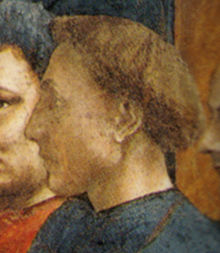 ]
A portrait of Alberti by Filippino Lippi is thought to exist in the Brancacci Chapel, as part of Lippi's completion of the Masaccio painting, the Raising of the Son of Theophilus and St. Peter Enthroned
Leon Battista Alberti was born in 1404 in Genoa. His mother was Bianca Fieschi. His father, Benedetto Alberti, was a wealthy Florentine who had been exiled from his own city, but allowed to return in 1428. Alberti was sent to boarding school in Padua, then studied law at Bologna.[6][7] He lived for a time in Florence, then in 1431 travelled to Rome, where he took holy orders and entered the service of the papal court.[8] During this time he studied the ancient ruins, which excited his interest in architecture and strongly influenced the form of the buildings that he designed.[8]
Leon Battista Alberti was gifted in many ways. He was tall, strong, and a fine athlete who could ride the wildest horse and jump over a person's head.[9] He distinguished himself as a writer while still a child at school, and by the age of twenty had written a play that was successfully passed off as a genuine piece of Classical literature.[7] In 1435 he began his first major written work, Della pittura, which was inspired by the burgeoning pictorial art in Florence in the early fifteenth century. In this work he analysed the nature of painting and explored the elements of perspective, composition, and colour.[8]
In 1438 he began to focus more on architecture and was encouraged by the Marchese Leonello d'Este of Ferrara, for whom he built a small triumphal arch to support an equestrian statue of Leonello's father.[7] In 1447 Alberti became architectural advisor to Pope Nicholas V and was involved in several projects at the Vatican.[7]
First major commission[]
His first major architectural commission was in 1446 for the facade of the Rucellai Palace in Florence. This was followed in 1450 by a commission from Sigismondo Malatesta to transform the Gothic church of San Francesco in Rimini into a memorial chapel, the Tempio Malatestiano.[8] In Florence, he designed the upper parts of the facade for the Dominican church of Santa Maria Novella, famously bridging the nave and lower aisles with two ornately inlaid scrolls, solving a visual problem and setting a precedent to be followed by architects of churches for four hundred years.[10] In 1452, he completed De re aedificatoria, a treatise on architecture, using as its basis the work of Vitruvius and influenced by the archaeological remains of Rome. The work was not published until 1485. It was followed in 1464 by his less influential work, De statua, in which he examines sculpture.[8] Alberti's only known sculpture is a self-portrait medallion, sometimes attributed to Pisanello.

Alberti was employed to design two churches in Mantua, San Sebastiano, which was never completed and for which Alberti's intention can only be speculated upon, and the Basilica of Sant'Andrea. The design for the latter church was completed in 1471, a year before Alberti's death, but was brought to completion and is his most significant work.[10]
Alberti as artist[]
As an artist, Alberti distinguished himself from the ordinary craftsman educated in workshops. He was a humanist who followed Aristotle and Plotinus, and part of the rapidly expanding entourage of intellectuals and artisans supported by the courts of the princes and lords of the time. As a member of noble family and as part of the Roman curia, Alberti had special status. He was a welcomed guest at the Este court in Ferrara, and in Urbino he spent part of the hot-weather season with the soldier-prince Federico III da Montefeltro. The Duke of Urbino was a shrewd military commander, who generously spent money on the patronage of art. Alberti planned to dedicate his treatise on architecture to his friend.[9]
Among Alberti's smaller studies, pioneering in their field, were a treatise in cryptography, De componendis cifris, and the first Italian grammar. With the Florentine cosmographer Paolo Toscanelli he collaborated in astronomy, a close science to geography at that time, and he produced a small Latin work on geography, Descriptio urbis Romae (The Panorama of the City of Rome). Just a few years before his death, Alberti completed De iciarchia (On Ruling the Household), a dialogue about Florence during the Medici rule.
Having taken holy orders, Alberti never married. He loved animals and had a pet dog, a mongrel, for whom he wrote a panegyric (Canis).[9] Vasari describes Alberti as "an admirable citizen, a man of culture... a friend of talented men, open and courteous with everyone. He always lived honourably and like the gentleman he was."[11] Alberti died in Rome on 25 April 1472 at the age of 66.
Publications[]
Further information: Mathematics and architecture
Alberti regarded mathematics as a starting point for the discussion of art and the sciences. "To make clear my exposition in writing this brief commentary on painting," Alberti began his treatise, Della Pittura (On Painting) that he dedicated to Brunelleschi, "I will take first from the mathematicians those things with which my subject is concerned."[12]
...
Architectural works[]

The dramatic facade of Sant' Andrea, Mantua (1471) built to Alberti's design after his death
[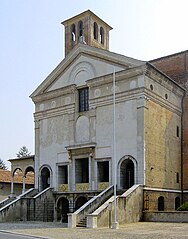 ]
The unfinished and altered facade of San Sebastiano has promoted much speculation as to Alberti's intentions.
Alberti did not concern himself with the practicalities of building, and very few of his major works were brought to completion. As a designer and a student of Vitruvius and of ancient Roman remains, he grasped the nature of column and lintel architecture, from the visual rather than structural viewpoint, and correctly employed the Classical orders, unlike his contemporary, Brunelleschi, who used the Classical column and pilaster in a free interpretation. Among Alberti's concerns was the social effect of architecture, and to this end he was very well aware of the cityscape.[10] This is demonstrated by his inclusion, at the Rucellai Palace, of a continuous bench for seating at the level of the basement. Alberti anticipated the principle of street hierarchy, with wide main streets connected to secondary streets, and buildings of equal height.[17]
In Rome he was employed by Pope Nicholas V for the restoration of the Roman aqueduct of Acqua Vergine, which debouched into a simple basin designed by Alberti, which was swept away later by the Baroque Trevi Fountain.
In some studies,[18] the authors propose that the Villa Medici in Fiesole might owe its design to Alberti, not to Michelozzo, and that it then became the prototype of the Renaissance villa. This hilltop dwelling, commissioned by Giovanni de' Medici, Cosimo il Vecchio's second son, with its view over the city, may be the very first example of a Renaissance villa: that is to say it follows the Albertian criteria for rendering a country dwelling a "villa suburbana". Under this perspective the Villa Medici in Fiesole could therefore be considered the "muse" for numerous other buildings, not only in the Florence area, which from the end of the fifteenth century onward find inspiration and creative innovation from it.
...
Painting[]
Giorgio Vasari, who argued that historical progress in art reached its peak in Michelangelo, emphasized Alberti's scholarly achievements, not his artistic talents: "He spent his time finding out about the world and studying the proportions of antiquities; but above all, following his natural genius, he concentrated on writing rather than on applied work."[11] Leonardo, who ironically called himself "an uneducated person" (omo senza lettere), followed Alberti in the view that painting is science. However, as a scientist, Leonardo was more empirical than Alberti, who was a theorist and did not have similar interest in practice. Alberti believed in ideal beauty, but Leonardo filled his notebooks with observations on human proportions, page after page, ending with his famous drawing of the Vitruvian man, a human figure related to a square and a circle.
In On Painting, Alberti uses the expression "We Painters", but as a painter, or sculptor, he was a dilettante. "In painting Alberti achieved nothing of any great importance or beauty", wrote Vasari.[11] "The very few paintings of his that are extant are far from perfect, but this is not surprising since he devoted himself more to his studies than to draughtsmanship." Jacob Burckhardt portrayed Alberti in The Civilization of the Renaissance in Italy as a truly universal genius. "And Leonardo Da Vinci was to Alberti as the finisher to the beginner, as the master to the dilettante. Would only that Vasari's work were here supplemented by a description like that of Alberti! The colossal outlines of Leonardo's nature can never be more than dimly and distantly conceived."[9]
Alberti is said to appear in Mantegna's great frescoes in the Camera degli Sposi, as the older man dressed in dark red clothes, who whispers in the ear of Ludovico Gonzaga, the ruler of Mantua.[20] In Alberti's self-portrait, a large plaquette, he is clothed as a Roman. To the left of his profile is a winged eye. On the reverse side is the question, Quid tum? (what then), taken from Virgil's Eclogues: "So what, if Amyntas is dark? (quid tum si fuscus Amyntas?) Violets are black, and hyacinths are black."[21]
Contributions[]
[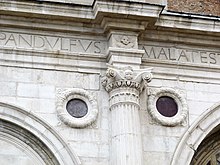 ]
Detail of the facade of Tempio Malatestiano
Alberti made a variety of contributions to several fields:
- Alberti was the creator of a theory called "historia". In his treatise De pictura (1435) he explains the theory of the accumulation of people, animals, and buildings, which create harmony amongst each other, and "hold the eye of the learned and unlearned spectator for a long while with a certain sense of pleasure and emotion". De pictura ("On Painting") contained the first scientific study of perspective. An Italian translation of De pictura (Della pittura) was published in 1436, one year after the original Latin version and addressed Filippo Brunelleschi in the preface. The Latin version had been dedicated to Alberti's humanist patron, Gianfrancesco Gonzaga of Mantua. He also wrote works on sculpture, De statua.
- Alberti used his artistic treatises to propound a new humanistic theory of art. He drew on his contacts with early Quattrocento artists such as Brunelleschi, Donatello, and Ghiberti to provide a practical handbook for the renaissance artist.
- Alberti wrote an influential work on architecture, De re aedificatoria, which by the sixteenth century had been translated into Italian (by Cosimo Bartoli), French, Spanish, and English. An English translation was by Giacomo Leoni in the early eighteenth century. Newer translations are now available.
- Whilst Alberti's treatises on painting and architecture have been hailed as the founding texts of a new form of art, breaking from the Gothic past, it is impossible to know the extent of their practical impact within his lifetime. His praise of the Calumny of Apelles led to several attempts to emulate it, including paintings by Botticelli and Signorelli. His stylistic ideals have been put into practice in the works of Mantegna, Piero della Francesca, and Fra Angelico. But how far Alberti was responsible for these innovations and how far he was simply articulating the trends of the artistic movement, with which his practical experience had made him familiar, is impossible to ascertain.
- He was so skilled in Latin verse that a comedy he wrote in his twentieth year, entitled Philodoxius, would later deceive the younger Aldus Manutius, who edited and published it as the genuine work of 'Lepidus Comicus'.

The upper storey of Santa Maria Novella
[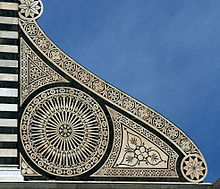 ]
One of the giant scrolls at Santa Maria Novella
- He has been credited with being the author, or alternatively, the designer of the woodcut illustrations, of the Hypnerotomachia Poliphili, a strange fantasy novel.[22]
- Apart from his treatises on the arts, Alberti also wrote: Philodoxus ("Lover of Glory", 1424), De commodis litterarum atque incommodis ("On the Advantages and Disadvantages of Literary Studies", 1429), Intercoenales ("Table Talk", c. 1429), Della famiglia ("On the Family", begun 1432), Vita S. Potiti ("Life of St. Potitus", 1433), De iure (On Law, 1437), Theogenius ("The Origin of the Gods", c. 1440), Profugorium ab aerumna ("Refuge from Mental Anguish",), Momus (1450), and De Iciarchia ("On the Prince", 1468). These and other works were translated and printed in Venice by the humanist Cosimo Bartoli in 1586.
- Alberti was an accomplished cryptographer by the standard of his day and invented the first polyalphabetic cipher, which is now known as the Alberti cipher, and machine-assisted encryption using his Cipher Disk. The polyalphabetic cipher was, at least in principle (for it was not properly used for several hundred years) the most significant advance in cryptography since before Julius Caesar's time. Cryptography historian David Kahn entitles him the "Father of Western Cryptography", pointing to three significant advances in the field that can be attributed to Alberti: "the earliest Western exposition of cryptanalysis, the invention of polyalphabetic substitution, and the invention of enciphered code".David Kahn (1967). *The codebreakers: the story of secret writing*. New York: MacMillan.
- According to Alberti, in a short autobiography written c. 1438 in Latin and in the third person, (many but not all scholars consider this work to be an autobiography) he was capable of "standing with his feet together, and springing over a man's head." The autobiography survives thanks to an eighteenth-century transcription by Antonio Muratori. Alberti also claimed that he "excelled in all bodily exercises; could, with feet tied, leap over a standing man; could in the great cathedral, throw a coin far up to ring against the vault; amused himself by taming wild horses and climbing mountains". Needless to say, many in the Renaissance promoted themselves in various ways and Alberti's eagerness to promote his skills should be understood, to some extent, within that framework. (This advice should be followed in reading the above information, some of which originates in this so-called autobiography.)
- Alberti claimed in his "autobiography" to be an accomplished musician and organist, but there is no hard evidence to support this claim. In fact, musical posers were not uncommon in his day (see the lyrics to the song Musica Son, by Francesco Landini, for complaints to this effect.) He held the appointment of canon in the metropolitan church of Florence, and thus – perhaps – had the leisure to devote himself to this art, but this is only speculation. Vasari also agreed with this.[11]
- He was interested in the drawing of maps and worked with the astronomer, astrologer, and cartographer Paolo Toscanelli.
- In terms of Aesthetics Alberti is one of the first defining the work of art as imitation of nature, exactly as a selection of its most beautiful parts: "So let's take from nature what we are going to paint, and from nature we choose the most beautiful and worthy things".[23]
Works in print[]
[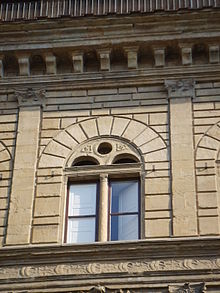 ]
A window of the Rucellai Palace
- De Pictura, 1435. On Painting, in English, De Pictura, in Latin, On Painting. Penguin Classics. 1972. ISBN 978-0-14-043331-9.; Della Pittura, in Italian (1804 [1434]).
- Momus, Latin text and English translation, 2003 ISBN 0-674-00754-9
- De re aedificatoria (1452, Ten Books on Architecture). Alberti, Leon Battista. De re aedificatoria. On the art of building in ten books. (translated by Joseph Rykwert, Robert Tavernor and Neil Leach). Cambridge, Mass.: MIT Press, 1988. ISBN 0-262-51060-X. ISBN 978-0-262-51060-8. Latin, French and Italian editions and in English translation[permanent ^dead link].
- De Cifris A Treatise on Ciphers (1467), trans. A. Zaccagnini. Foreword by David Kahn, Galimberti, Torino 1997.
- Della tranquillitá dell'animo. 1441.
- "Leon Battista Alberti. On Painting. A New Translation and Critical Edition", Edited and Translated by Rocco Sinisgalli, Cambridge University Press, New York, May 2011, ISBN 978-1-107-00062-9, (books.google.de)
- I libri della famiglia, Italian edition[24]
- "Dinner pieces". A Translation of the Intercenales by David Marsh. Center for Medieval and Early Renaissance Studies, State University of New York, Binghamton 1987.
- "Descriptio urbis Romae. Leon Battista Alberti's Delineation of the city of Rome". Peter Hicks, Arizona Board of Regents for Arizona State university 2007.
Legacy[]
Borsi states that Alberti's writings on architecture continue to influence modern and contemporary architecture stating: "The organicism and nature-worship of Wright, the neat classicism of van der Mies, the regulatory outlines and anthropomorphic, harmonic, modular systems of Le Corbusier, and Kahn's revival of the 'antique' are all elements that tempt one to trace Alberti's influence on modern architecture."[25]
In popular culture[]
- Leon Battista Alberti is a major character in Roberto Rossellini's three-part television film The Age of the Medici (1973), with the third and final part, Leon Battista Alberti: Humanism, centering on him, his works (such as Santa Maria Novella), and his thought. He is played by Italian actor Virginio Gazzolo.[26]
- Mentioned in the 1994 film Renaissance Man or Army Intelligence starring Danny DeVito.
- Mentioned in the 2004 book The Rule of Four by Ian Caldwell and Dustin Thomason
Knowledge Web Content (see main node)
Full Name:Leon Battista Alberti
Achievements: Renaissance perspective design and cryptography
Born: February 14, 1404; Genoa, Italy
Died: April 25, 1472; Rome, Italy (Aged 68)
Field & Discipline: Art; Architecture; Philosophy; Music; Painter; Sculptor
Education: University of Bologna
Major Work: “On Architecture”
Life & Times:
After receiving his doctorate in church law at the University of Bologna in 1428, Alberti is believed to have taken a job as secretary to Cardinal Albergati, the Bishop of Bologna. Four years later, through the influence of Bishop Biagio Molin, he moved to Rome to serve as secretary to Pope Eugenius IV, a job he held for 32 years. During his first stay in Rome, from 1432 to 1434, Alberti pursued his interest in humanistic, scientific and artistic research. In 1443, he published a dialog on family ethics: "On the Family,” the first of his major humanist pieces and a landmark in the history of Italian prose. He also worked out a method for making accurate urban survey maps, which resulted in a brief but seminal work on cartography: “Description of Rome.”
In Rome, Alberti began experimenting with a [experimented with] camera obscura*, a device that allowed images to be projected through a lens onto a surface. By studying light rays and how they form images, he was able to make "artificial images" so natural that his friends thought them "miracles". This interest in pictorial projection, together with his mastery of surveying and mapping, provided the basis for his research into the principles of perspective, a project he devoted himself to when he accompanied Pope Eugenius IV to Florence in 1434.
At the time of Alberti's arrival [a pal of] Brunelleschi* was just completing his majestic dome on the Cathedral. [influenced by] Masaccio* (who had died six years earlier at 26) had stunned the Florentine art world with his exercise in perspective: “The Trinity”. Ghiberti was at work on the East doorway of the Baptistery. And [a pal of] Donatello* and Luca della Robbia were producing reliefs. All these works had a tremendous impact on Alberti.
Forming close friendships with Brunelleschi and Donatello, Alberti began to paint and sculpt, but his major accomplishment was his book: "On Painting," the first systematic exposition of perspective. He outlined the rules for creating a three-dimensional picture on a two-dimensional plane. His work had an immediate and profound effect on Florentine painting and relief work, giving rise to the geometrically-ordered space of the Renaissance style. Later perspective theorists, like painter [influenced] della Francesca* and [influenced] da Vinci*, elaborated on Alberti's ideas, which he re-stated in: “On the Statue,” the sculptural counterpart of "On Painting".
Alberti was also friends with [a pal of] Toscanelli*, the Florentine cartographer who provided Columbus with the map that guided him on his first voyage. Alberti and Toscanelli studied astronomy and geography together. The two sciences were closely linked at the time (and linked to perspective) by the concepts and methods of geometric mapping that had been rediscovered in the writings of ancient astronomer/geographer [influenced by] Ptolemy*.
Around 1438, at the Este court in Ferrara, Alberti began his study of architecture. Asked to judge models submitted for an equestrian statue of [worked for] Leonello d'Este's* father, Alberti not only judged the contest, but wrote: "De equo animante", a treatise on the appearance and habits of horses.. He also designed a "classical" base for the statue: a miniature triumphal arch, which still stands in Ferrara. While studying classical design, Alberti read the ancient Roman architect [influenced by] Vitruvius'* great text on classical architecture, and decided to write either a commentary on Vitruvius or an entirely new work on classical architecture. With this in mind, he began measuring the ruins of ancient buildings on his return to Rome in 1443,
In 1447, Tommaso Parentucelli da Saranza, an old friend of Alberti's and a patron of the arts, became Pope [adviser to] Nicholas V*, and made Alberti his architectural adviser. Together they came up with grandiose building projects for Renaissance Rome, including the rebuilding of Saint Peter's Basilica and the Vatican. Planning and overseeing a number of projects gave Alberti the architectural and engineering experience to write his comprehensive study of the art of construction. The first building he designed was the Tempio Malatestiano for the rulers of Rimini, Italy. Built in a bold "Roman" style, it established Alberti as a major architect and the successor of Brunelleschi.
In 1452, Alberti presented Pope Nicholas V with his classic treatise on the theory and practice of Renaissance architecture: “On Architecture.” Rich in practical knowledge, this first modern examination of the art of building re-established the rules of classical architecture, emphasizing the proportion and harmony that became the mark of Renaissance art.
During the final 20 years of his life, Alberti created a number outstanding works. In Florence, the facades of Santa Maria Novella and Palazzo Rucellai (built for the merchant Giovanni Rucellai) are famous for their perfect proportions. In Mantua, he designed the church of San Sebastiano for Lodovico Gonzaga, the humanist prince. Also in Mantua, he built the magnificent High Renaissance church of San Andrea.
Alberti's “Florentine Language Rules,” written sometime before 1454, was the first Italian grammar book. Dealing with the relation between Latin and the vernacular, it demonstrated that the Tuscan vernacular was as good a language as Latin.
In the 1460’s Alberti produced a pioneer work in cryptography, which was of great interest to the papacy. “On Encryption” was a brilliant study, containing the first known frequency table and the first poly-alphabetic system of coding by means of what is agreed to be Alberti's invention: the cipher wheel. It also paved the way for important work on ciphers by prefigured[] Vigenere* in the 16th century.
In the 1460s, Alberti became a central figure in[his patron was] Lorenzo (the Magnificent) de' Medici*'s entourage in Florence, together with philosopher Marsilio Ficino. For de' Medici, he wrote a short Latin treatise on the rules of rhetoric, and for the youngsters of the household a small work on moral philosophy. However, his great literary work of this period was: “On the Man of Excellence and Ruler of His Family,” the last in the series of vernacular dialogs that he completed four years before his death.
Assessment: Built a theoretical foundation for Renaissance art with three treatises: on painting, sculpture, and architecture, the first works of their kind since Classical antiquity.
Oneliner: Leon Battista Alberti, great Renaissance architect and cryptographer
Language: Italian
Father: Lorenzo di Benedetto Alberti
Mother: Unknown
Siblings: Carlo
Spouse: None
Children: None
Bibliography:
- Dictionary of Scientific Biography.
- Encyclopedia Britannica.
- Gadol, Joan, Leon Battista Alberti: Universal Man of the Early Renaissance , Chicago & London: University of Chicago Press, 1969.
- Grove Dictionary of Art.