Ulam
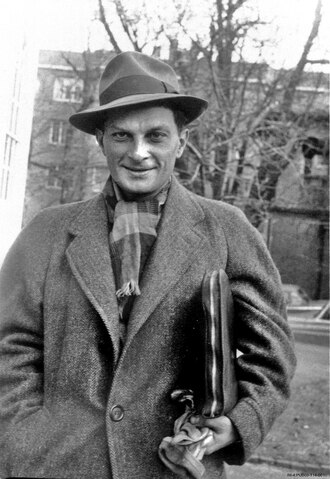
NAME: Ulam, Stanislaw Marcin
ACHIEVEMENT(S): Played a major role in the American development of the hydrogen bomb.
NICKNAME/ALIAS: None
DATE AND PLACE OF BIRTH: April 13, 1909, Lember, Poland
DATE/PLACE OF DEATH/AGE AT DEATH: May 13, 1984, Santa Fe, NM. Aged 75
DISCIPLINE: Mathematician
FIELD:Mathematics
LANGUAGE: Polish, English
PARENTS: Josef Ulam; Anna Auerbach
SIBLINGS: Unknown
SPOUSE: Francoise Aron
CHILDREN: 1 daughter
EDUCATION: Lvov Polytechnic Institute
MAJOR WORK: Teller-Ulam configuration (hydrogen bomb trigger)
LIFE AND TIMES:
During the 1934-35 academic year, Ulam visited European mathematical centers in Vienna, Zurich, Paris and Cambridge, England, and met <worked with> Neumann*, who invited Ulam to spend a year with him at the Institute for Advanced Study at Princeton University in the United States.
1936, Ulam moved to Harvard University, where he was a junior fellow until 1939, and then a lecturer (1939-40), then an instructor (1940-41). He moved to the University of Wisconsin, where he was made an assistant professor (1942-43).
The first 10 years of Ulam’s research (1933-43) were essentially devoted to pure mathematics, such as algebra, measure theory, set theory, and topology.
In 1943, Ulam became an American citizen, and was invited by von Neumann to join the atomic bomb project at the newly created Los Alamos Laboratory in New Mexico, where Ulam would remain until 1965. His research during this period covered weapons design, applied mathematics (much of it related to computers), and space technology.
Initially, Ulam was assigned to a group, headed by Hungarian/American physicist <worked with> Teller* and including <worked with> Gamow*, that was to make preliminary assessments for the development of the hydrogen bomb. However, the hydrogen bomb project did not look promising, so Ulam joined von Neumann in his work on implosion calculations, and, in 1946, came up with the idea of a "statistical approach": a technique for finding approximate solutions to problems by means of artificial sampling.
Ulam and Robert D. Richtmeyer suggested this approach to von Neumann in a joint report in 1947. The approach ultimately was called the Monte Carlo Method. Although originally applied to neutron scattering, it later played a crucial role in the calculation of thermonuclear reactions for the hydrogen bomb, and it became recognized as a fundamental methodology in numerical analysis.
Through the use of electronic computers, this method became widespread, finding applications in weapons design, mathematical economics, probability and operations research, and was arguably the most influential of Ulam’s contributions to "applied" research.
Also in the 1940s, Ulam successfully developed a theory of multiplicative systems, or branching processes, designed to model neutron multiplication in fission processes. This theory proved to have applications in the multiplication of bacteria, radioactive decay, cosmic ray showers, diffusion theory, and trajectories of dynamic systems.
In 1950, Ulam joined other scientists in predicting that the preliminary design of the hydrogen bomb would produce a "fizzle". A subsequent round of calculations, made during 1951 with Italian scientist <worked with> Fermi*, suggested that a revised design for the bomb also would not work.
However, Ulam developed a bold new idea that completely overcame the previous problems.
Working with Teller, Ulam came up with the idea that shock waves from a fission bomb could produce the compression needed to explode a hydrogen bomb and that careful design could focus mechanical shock waves in such a way to promote rapid burning of the fusion fuel. For his part, Teller proposed that radiation implosion, rather than mechanical shock, be used to compress the thermonuclear fuel.
This two-stage radiation implosion design became known as the Teller-Ulam configuration, and was used in the detonation of the first hydrogen device, named "Mike", tested in the Marshall Islands in November, 1954. This success demonstrated the validity of the Teller-Ulam mechanism, and the prototype of a bomb, named "Cherokee", was tested in May, 1956.
Among Ulam’s last Los Alamos assignments were designing (with Everett and Conrad Longmire) space vehicles with nuclear propulsion (later known as Project Orion) and devising a way to extract energy from gravitational systems (i.e. planets) for navigating space vehicles (1958).
Ulam formally retired from Los Alamos in 1967, after which he returned to academic life, accepting the posts of professor and chairman of the mathematics department at the University of Colorado (1965-77) and professor of biomathematics at the University of Colorado Medical School (1958-77).
He also continued to collaborate with his Los Alamos colleagues and broadened his activities into biomathematics and writing. His books from the period include "Problems of Modern Mathematics" (1964), "Mathematics and Logic: Retrospect and Prospects", written with Mark Kac (1968), "Sets, Numbers and Universes" (1974) and his mathematical autobiography, "Adventures of a Mathematician" (1976).
ASSESSMENT: Contributed significantly to the mathematical thinking of his time and to the development of the hydrogen bomb.
EXTRA CONNECTIONS: None
ONELINER: Stanislaw Ulam, major contributor to the hydrogen bomb
BIBLIOGRAPHY:
EB
ANB