Fermi, E
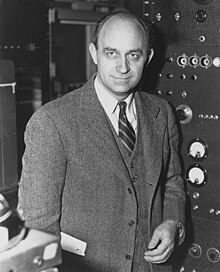
ACHIEVEMENT(S): Directed the first controlled nuclear chain reaction
NICKNAME/ALIAS: The Pope of Physics
DATE/PLACE OF BIRTH: September 29, 1901, Rome, Italy
DATE/PLACE OF DEATH/AGE AT DEATH: November 28, 1954, Chicago, Illinois, United States. Aged 53
DISCIPLINE: Nuclear Physicist
FIELD: Physics
EDUCATION: Ginnasio Liceo Umberto I, Rome, Italy; Reale Scuola Normale Superior, Pisa, Italy
MAJOR WORK: Theory of beta decay
LIFE AND TIMES:
In 1922 Fermi was awarded his doctorate in physics for a thesis on research with X-rays.
For seven months in 1923, Germi studied at the University of Gottingen under German physicist Born*, whose contributions to quantum mechanics would later be used by Fermi in his research.
In 1925, during a three-year teaching fellowship at the University of Florence, Fermi wrote the paper that would establish his name. The paper elaborated on Austrian physicist Pauli*'s recently-discovered exclusion principle, that restricted the possible location of electrons by suggesting that no two subatomic particles could be described in the same way.
Fermi theorized that the same rules developed by Pauli for electrons could be applied to the atoms in a gas, and the mathematical system he invented, later developed independently by British physicist Dirac* (1927), became known as Fermi-Dirac statistics, a quantum-mechanical statistical method for predicting the characteristics of electrons, protons, and neutrons are important in atomic and nuclear physics and in solid-state theory.
Meanwhile, Fermi had brought to Rome a new group of talented young physicists, including several foreign physicists, among them American Teller*. Fermi began to look for a new focus of research and in 1930 settled, like many others, on experimental research on the atomic nucleus (i.e. nuclear, rather than atomic, physics). One of the first problems to which he turned was beta decay in radioactive materials -- the process by which a neutron in an atomic nucleus breaks apart into a proton and electron; the electron is then emitted from the nucleus as a beta particle. The mechanics of beta decay appeared to violate known physical principles and were the subject of intense study in the early 1930s.
Fermi's theory of beta decay was based on Pauli's idea of a neutrino and German physicist Heisenberg*'s theory of isotopic spin. Pauli had suggested that the apparent violation of conservation laws observed during beta decay could be explained by assuming the existence of a second tiny, essentially mass-less particle, also released during the event. Fermi was later to name that particle the "neutrino" ("little neutron"), a hypothesis until it was finally experimentally detected in 1956.
In 1933 he proposed a theory of beta decay, which stated that it took place in the unstable nuclei of radioactive elements, and occurred because a neutron moved from a state of higher energy to one of lower energy as it underwent conversion to (i) a proton, then to (ii) an electron (beta particle), and then to (iii) an antineutrino. To explain the process by which this occurred, Fermi theorized the existence of a new kind of force, now known as the "weak force" . His theory was published in 1933-34 and had far-reaching consequences for the future development of nuclear and particle physics.
In 1934 Frederic and Irene Joliot-Curie were the first to produce artificial radioactivity by bombarding stable isotopes (boron and aluminum) with alpha particles (emitted as positively charged helium nuclei from polonium), which converted the original isotopes into unstable, radioactive forms.
Impressed, Fermi reasoned that this type of experiment might be even more effective if neutrons, rather than alpha particles, were used as the "bullets" because neutrons have no electrical charge and so are not repelled by either the negatively charged electrons or the positively charged nuclei in an atom.
Beginning in 1934, Fermi and his colleagues systematically submitted one element after another to bombardment by neutrons, discovering that slow neutrons (those that had been slowed down by passing through substances containing hydrogen) were more effective in bringing about nuclear changes than were fast neutrons. Revising his experimental procedure so that a block of paraffin wax or a jacket of water was wrapped around the neutron source, Fermi was able to show that 37 of the 63 elements he studied could be converted to radioactive forms by neutron bombardment.
The element that particularly intrigued him was uranium. He knew that one reaction he could expect from the neutron bombardment of uranium (atomic number 92) was the production of a new element with an atomic number one greater than that of uranium, which did not exist naturally. It would, thus be the first synthetic element. But his results from the slow-neutron bombardment of uranium puzzled Fermi.
While his colleagues believed that he had made a new, "transuranic" element of atomic number 93, called neptunium (i.e. during bombardment, the nucleus of uranium had captured a neutron, thus increasing its atomic weight), Fermi did not make this claim, unsure of what had occurred.
In fact, he was on the edge of a world-shaking discovery: bombardment of uranium with neutrons had resulted not in a simple nuclear transformation, but in nuclear fission, a process during which the uranium atom is split, unleashing tremendous amounts of energy.
For this experimental work -- "the discovery of new radioactive substances, and the selective powers of slow neutrons" -- Fermi received a letter of congratulation from the great pioneer of subatomic physics, Englishman Rutherford*, and was awarded the Nobel Prize for physics in 1938.
In January, 1939, Fermi arrived in the United States and took a post as professor of physics at Columbia University. At the same time, the discovery of nuclear fission, by Otto Hahn, Lise Meitner and Fritz Strassmann, was announced in Berlin. After bombarding uranium with slow neutrons, these physicists made a careful chemical analysis of the products formed, and reported that the uranium atom had been split into several parts.
The significance of the discovery was immediately apparent to Fermi. He and visiting Danish physicist Bohr* presided over a reproduction of the Hahn-Meitner-Strassmann experiment at Columbia University in New York in January, 1939. Bohr suggested the possibility of a nuclear chain reaction, for which, it was agreed, the uranium-235 isotope (differing in atomic weight from other forms of uranium) would be the most effective atom.
It was clear the authorities had to be made aware of the political and military implications of the Hahn-Meitner-Strassman experiment and in August, 1939, German/American physicist Einstein* delivered a letter written by Leo Szilard to President Franklin D. Roosevelt*.
The now-famous letter alerted the President to the catastrophe that might happen if Hitler applied the principle of the nuclear chain reaction to the production of an atomic bomb.
Roosevelt acted on the warning, and Fermi became involved in the Manhattan Project, a code name for the work that would produce an atomic bomb.
In 1942, Fermi moved to the Metallurgical Laboratory at the University of Chicago, where research was under Arthur H. Compton. Here, Fermi continued work on the fission of uranium (initiated by neutrons) by building the first nuclear reactor, then called an "atomic pile" because it had a moderator consisting of a pile of purified graphite blocks (to slow the neutrons) with holes drilled in them to take rods of enriched uranium.) Other neutron-absorbing rods of cadmium, called control rods, could be lowered into or withdrawn from the pile to limit the number of slow neutrons available to initiate the fission of uranium.
The primitive nuclear reactor (of which Fermi was the chief designer) was built on the squash court of Chicago University, and in December, 1942, the control rods were withdrawn for the first time and the reactor began to work, using a self-sustaining nuclear chain reaction.
By the end of 1944, through a team led by Compton and Fermi, the United States had built an atomic bomb, which used the same reaction but without control, resulting in a nuclear explosion.
In September, 1944, Fermi moved to Los Alamos, New Mexico, where the final assembly of the first nuclear weapons was to occur (and where he shared accommodation with the eventual spy Fuchs*). He was placed in charge of his own special division, responsible to Oppenheimer* for solving special problems as they arose during bomb construction.
After the first successful tests on July 16, 1945, and after the two bombs were dropped on Japan a month later, Fermi wrapped up his work with the Manhattan Project and returned to the University of Chicago, where he remained for the rest of his life.
ASSESSMENT: The only physicist of the 20th century who made fundamental contributions to both theoretical and experimental physics.
EXTRA CONNECTIONS: He worked with Ulam*
He was a co-member with Marconi* of the Italian Academy started by Mussolini*
ONELINER: Enrico Fermi, who directed the first controlled nuclear chair-reaction
BIBLIOGRAPHY:
EB, DSB
Newton, David E., "Enrico Fermi", inNotable Twentieth Century Scientists, ed. Emily J. McMurray, New York & London: Gale Research, 1995
ANB
LANGUAGE: Italian, English
PARENTS: Albert Fermi; Ida de Gattis
SIBLINGS: Maria; Giulio
SPOUSE: Laura Capon
CHILDREN: Nella; Giulio
Multimedia: